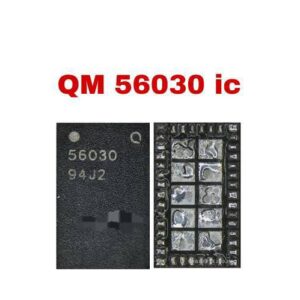
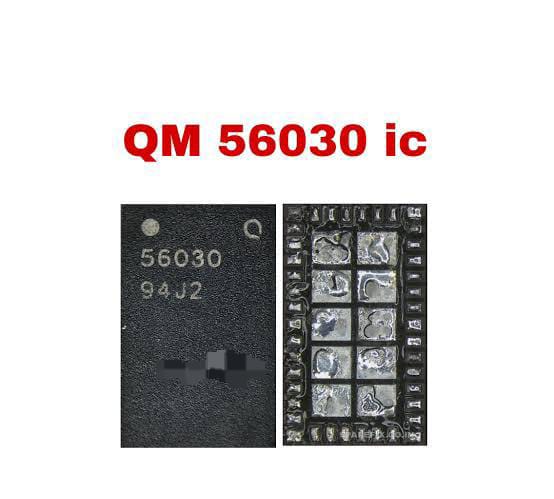
QM 56030 Mobile Phone IC
Premium Performance for Modern Mobile Devices
The QM 56030 Mobile Phone IC is designed to meet the demands of today’s fast-evolving technology landscape. Built for efficiency, reliability, and seamless integration, this integrated circuit ensures optimal performance for your mobile devices. QM 56030 Mobile Phone IC
Advanced Technology for Superior Results
Engineered with precision, the QM 56030 balances power and performance, making it the ideal choice for enhancing the core functionality of smartphones. Its compact design does not compromise on durability and efficiency, offering consistent performance in demanding applications. QM 56030 Mobile Phone IC
Versatility You Can Trust
The QM 56030 IC adapts to a variety of mobile systems and is compatible with numerous configurations. Perfect for repair professionals and manufacturers, it promises quality and consistency at all stages of mobile device development and repair. QM 56030 Mobile Phone IC
The QM56030 is a critical component in the modern mobile telecommunications ecosystem, primarily functioning as a Multi-Mode Multi-Band Power Amplifier (MMMB PA) or an RF Front-End (RFFE) module. Manufactured by Qorvo, it is a high-integration chip designed to manage cellular signals in entry-level and mid-range 4G LTE smartphones. QM 56030 Mobile Phone IC
While often colloquially referred to as a “Power IC” in repair circles (due to its proximity to the power management system), its technical identity is rooted in Radio Frequency (RF) amplification. QM 56030 Mobile Phone IC
Technical Specifications: QM56030
The following table summarizes the core technical parameters of the QM56030. Note that specific performance metrics like gain and efficiency can vary slightly depending on the handset’s circuit implementation. QM 56030 Mobile Phone IC
| Attribute | Specification Details |
| Manufacturer | Qorvo |
| Part Number | QM56030 / QM56030TR13 |
| Function | Multi-Mode Power Amplifier / RF Front-End Module |
| Technology | GaAs (Gallium Arsenide) HBT / SOI (Silicon-on-Insulator) |
| Supported Networks | 2G (GSM/EDGE), 3G (WCDMA), 4G (LTE-FDD/TDD) |
| Frequency Bands | Low Band & Mid-Band (B1, B3, B5, B7, B8, B20, B40, etc.) |
| Package Type | QFN (Quad Flat No-leads) |
| Pin Count | 10 Pins (Integrated Power/Signal pins) |
| Physical Dimensions | Approximately 2.0 mm x 2.0 mm x 0.8 mm |
| Operating Voltage | Typically 3.4V to 4.5V (Vcc) |
| Control Interface | MIPI RFFE / GPIO (Standardized RF Control) |
| Maximum Output Power | Approx. +27 dBm to +30 dBm (depending on band) |
| Thermal Protection | Integrated Thermal Shutdown / Sense |
| Typical Use Case | Cellular signal amplification and antenna switching |
Detailed Component Breakdown
1. Functional Architecture
The QM56030 is more than just a simple amplifier. It is a “module” because it integrates several distinct stages into a single 2mm square piece of silicon and gallium arsenide: QM 56030 Mobile Phone IC
-
Power Amplifier (PA): The primary engine that boosts weak radio signals from the modem/transceiver to a level strong enough to reach distant cell towers. QM 56030 Mobile Phone IC
-
Antenna Switch: A high-speed switch that directs signals between the transmitter and the receiver, ensuring the phone can send and receive data without interference. QM 56030 Mobile Phone IC
-
Filters: Integrated duplexers or filters that prevent the high-power transmit signal from “blinding” the sensitive receiver circuitry. QM 56030 Mobile Phone IC
2. Common Applications & Device Integration
The QM56030 is ubiquitous in the “budget-friendly” smartphone segment, particularly those utilizing MediaTek (e.g., Helio G-series) or lower-end Qualcomm Snapdragon chipsets.
-
Target Devices: Xiaomi Redmi 10C, Redmi Note 10 series, Samsung Galaxy A-series (e.g., A22), and various Huawei/ZTE regional models.
-
Role in Connectivity: It is the “muscle” behind the LTE signal. When this chip fails, the phone will typically show “No Service” or “Emergency Calls Only,” even if the SIM card is recognized and the software is functional.
3. Thermal & Mechanical Characteristics
Because this IC handles high-power RF signals, it generates significant heat during data-intensive tasks (like 4G video streaming or acting as a mobile hotspot).
-
Thermal Cycling: The repeated heating and cooling of the IC can lead to “dry joints” or micro-cracks in the solder balls. This is the #1 cause of failure for the QM56030 in devices like the Redmi 10C.
-
Sensitivity: As a BGA/QFN component, it is highly sensitive to moisture and physical drops. Even a slight motherboard flex can snap the connection between the IC’s pads and the PCB.
4. Repair and Installation Insights
For technicians, the QM56030 is a “Plug and Play” component but requires professional soldering skills.
-
Replacement Difficulty: Moderate. Due to its tiny footprint, it requires a hot air rework station set to approximately 330°C–350°C (depending on the solder used) and high-quality flux.
-
Identification: Look for the laser-etched “56030” on the surface of the chip. It is usually located near the antenna spring contacts or the RF Transceiver IC (like the MT6177 or similar).
Comparison: QM56030 vs. Similar ICs
| Feature | QM56030 | MT6357 (PMIC) | WTR3925 (Transceiver) |
| Main Job | Boost RF Signal | Manage Power/Battery | Modulate/Demodulate RF |
| Failure Symptom | No Signal / Weak Signal | Phone Won’t Turn On | No Signal / WiFi Issues |
| Material | GaAs (Gallium Arsenide) | Silicon | Silicon |
| Typical Location | Near Antenna | Near Processor | Between Modem & PA |
Quick Note for Technicians: When replacing a QM56030, always check the VCC line first. If the IC isn’t receiving the 3.7V–4.2V from the battery/PMIC, a new chip won’t fix the “No Service” issue.
More Products : https://gaffarmarketdelhi.com