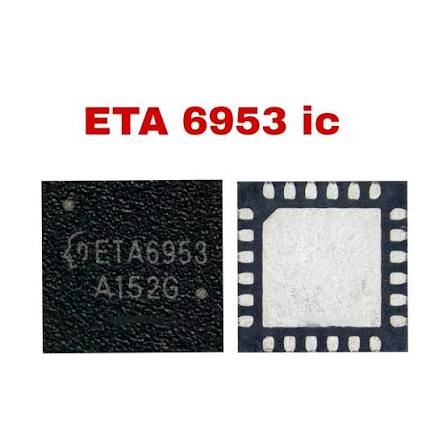
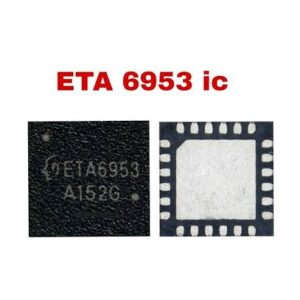
ETA6953 Original Mobile Phone IC
Reliable Power Management for Your Devices
The ETA6953 Original Mobile Phone IC is designed to ensure seamless power management for modern mobile devices. With its high efficiency and stable performance, this IC guarantees optimal device functionality, making it a must-have for all mobile phone repair and manufacturing professionals. ETA6953 Original Mobile Phone IC
Compact Design for Versatile Applications
Engineered with a compact footprint, the ETA6953 is perfect for various mobile phone models and can integrate effortlessly into even the most space-constrained designs. It’s the ideal solution for creating reliable, high-performance mobile electronics that keep up with today’s demands. ETA6953 Original Mobile Phone IC
Durability You Can Count On
Built with long-lasting materials and precision engineering, the ETA6953 stands out as a durable and reliable component. Whether you’re replacing an existing IC or developing a new device, you can count on this product to provide robust and consistent results. ETA6953 Original Mobile Phone IC
The ETA6953 is a highly integrated switch-mode battery charge management and system power path management device designed for single-cell Li-ion and Li-polymer batteries. It is a common “Original IC” found in popular smartphones like the Redmi 9A, Redmi 9C, and Redmi Note 9. ETA6953 Original Mobile Phone IC
Known for its efficiency and high-voltage support, it acts as the primary gatekeeper for power entering the mobile device, ensuring the battery charges safely and the system receives stable power simultaneously. ETA6953 Original Mobile Phone IC
Technical Specifications Table
| Feature | Specification Details |
| IC Function | $I^2C$ Controlled 3A Single-Cell Battery Charger |
| Input Voltage Range | 3.9V to 13.5V (Supports High Voltage Adapters) |
| Maximum Charge Current | 3.0 A (Programmable via $I^2C$) |
| Switching Frequency | 1.5 MHz Synchronous Switching Buck |
| Boost Mode Efficiency | 91% @ 1A Output (OTG Support) |
| Power Path Management | Dynamic regulation (Min system voltage 3.5V) |
| Quiescent Current | 5 µA (Battery Leakage in Ship Mode) |
| Safety Protections | OVP, OCP, Thermal Shutdown, Battery Temp Sensing |
| Communication Interface | $I^2C$ Serial Interface (Standard/Fast Mode) |
| Package Type | QFN-24 (4mm x 4mm) or QFN-16 depending on variant |
| Common Device Use | Xiaomi Redmi 9A, 9C, Note 9, Vivo, and Oppo models |
Core Functional Areas
1. High-Efficiency Buck Charger
The ETA6953 utilizes a synchronous PWM controller with a 1.5 MHz switching frequency. This high frequency allows for the use of smaller inductors and capacitors, saving precious board space in compact mobile designs. It integrates four power MOSFETs:
-
Input Reverse-Blocking FET (Q1)
-
High-Side Switching FET (Q2)
-
Low-Side Switching FET (Q3)
-
Battery FET (Q4)
2. Power Path Management
Unlike simpler chargers, the ETA6953 features Dynamic Power Path Management. It prioritizes the system’s power needs. If the input adapter is limited, the IC will reduce the charging current to ensure the mobile phone remains powered on. It also supports “Supplement Mode,” where the battery assists the adapter if the system load exceeds the adapter’s capacity.
3. USB OTG (On-The-Go) Support
The IC can operate in reverse as a boost converter. It can take the 3.6V–4.2V from the battery and boost it to a stable 5.15V at 1.2A to power external USB accessories (like mouse, keyboard, or flash drives) connected to the phone’s charging port.
4. $I^2C$ Programmability
Technicians and engineers can communicate with the IC via the $I^2C$ bus to monitor and adjust:
-
Input Current Limit: To prevent overloading chargers.
-
Charge Voltage: Fine-tuning for different battery chemistries (up to 4.624V).
-
Status Monitoring: Checking for faults like “VBUS Overvoltage” or “Thermal Shutdown.”
Comparison with Compatible ICs
In the repair industry, the ETA6953 is often compared to or replaced by similar chips, though pin-to-pin compatibility should always be verified before soldering.
| Metric | ETA6953 | BQ25601 (Alternative) |
| Max Charge Current | 3.0A | 3.0A |
| Input OVP | Up to 13.5V | Up to 14V |
| Communication | $I^2C$ | $I^2C$ |
| Typical Brand | Xiaomi / Redmi | Samsung / Huawei |
Common Failure Symptoms
When this IC fails in a mobile phone, users typically encounter:
-
Phone only charges when powered off: The software-controlled charging negotiation (via $I^2C$) is failing.
-
Slow Charging: The IC is stuck in a low-current state (e.g., 500mA) even with a fast charger.
-
No Charging: The input FET (Q1) is likely blown, preventing voltage from reaching the system.
-
Overheating during charge: Internal shorting within the buck converter stage.
More Products : https://gaffarmarketdelhi.com