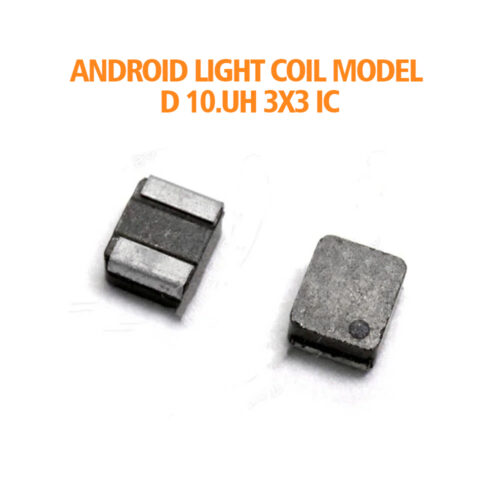
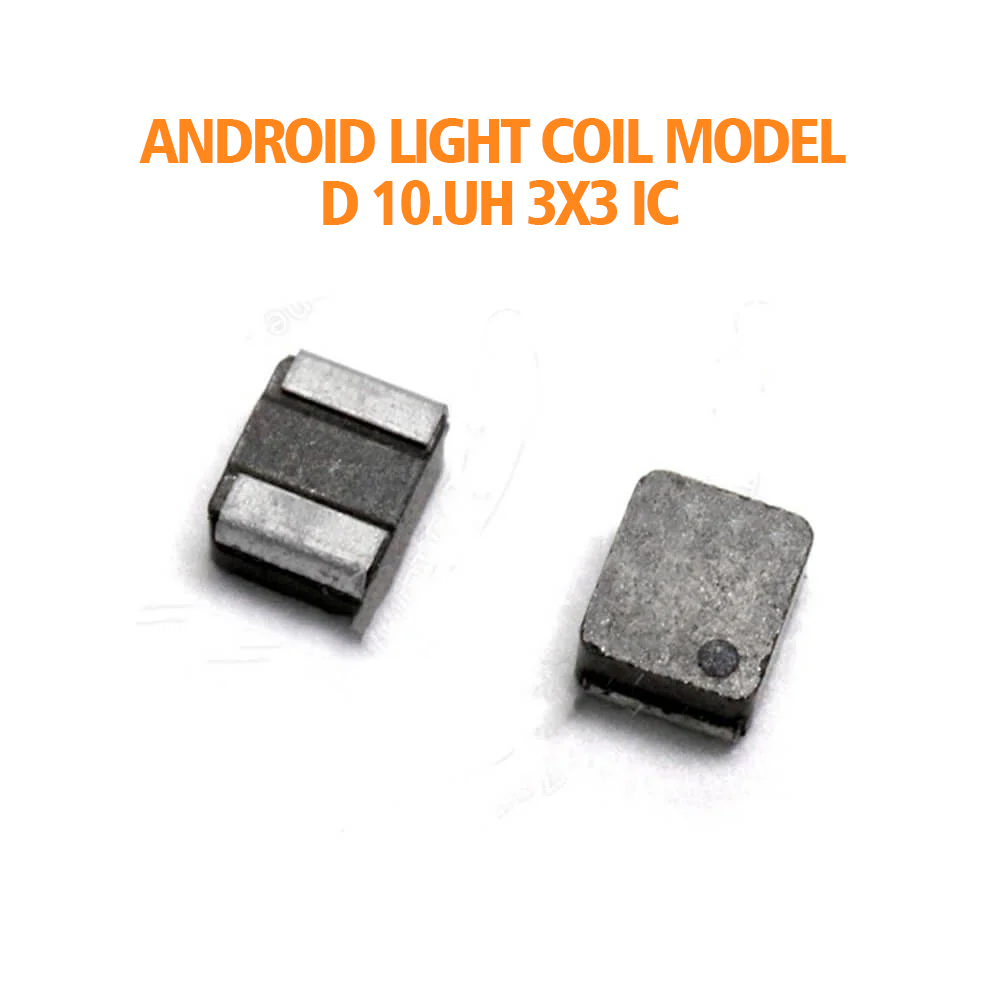
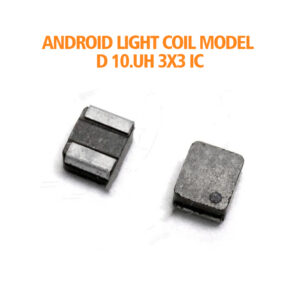
Light Coil Big 3×3 Mobile Phone IC
High-Quality Component for Mobile Devices
Offering exceptional performance and reliability, the Light Coil Big 3×3 Mobile Phone IC is specifically designed to enhance the functionality of modern mobile devices. Built with cutting-edge technology, this IC optimizes power delivery while ensuring seamless performance, making it an ideal choice for manufacturers and repair professionals seeking robust solutions. Light Coil Big 3×3 Mobile Phone IC
Compact Design and Durability
The Light Coil Big 3×3 IC features a refined 3×3 structure, delivering superior compactness without compromising on quality. Its minimalistic size contributes to space efficiency within handheld devices, facilitating seamless integration. Additionally, the IC is reinforced for durability, rendering it capable of enduring the demands of high-performance mobile environments. Light Coil Big 3×3 Mobile Phone IC
Optimized Efficiency for Modern Mobile Needs
Whether powering essential components or enabling advanced functionalities, the Light Coil Mobile Phone IC is designed to meet evolving technological needs. Its optimized energy consumption supports extended battery life without sacrificing speed and responsiveness, providing users with a reliable and efficient solution for their devices.
The Light Coil Big 3×3 Mobile Phone IC allows manufacturers to push the boundaries of device innovation while ensuring reliability and performance end-users can depend on.
In the world of mobile phone hardware repair, the Light Coil Big 3×3 is a critical component within the display backlight section of a smartphone’s motherboard. Despite being referred to as an “IC” (Integrated Circuit) in many repair catalogs, it is primarily a high-capacity power inductor (coil) that works in tandem with the Backlight Driver IC.
1. Overview and Core Function
The “3×3” designation refers to its physical dimensions ($3.0\text{ mm} \times 3.0\text{ mm}$), and “Big” distinguishes it from smaller variants (like 2×2.5 mm) used in more compact or older devices. Light Coil Big 3×3 Mobile Phone IC
Its primary role is voltage boosting. A smartphone battery typically provides $3.7\text{V}$ to $4.2\text{V}$, but the LED string behind a modern LCD screen requires significantly higher voltage—often between $15\text{V}$ and $25\text{V}$—to illuminate. The Light Coil stores energy in its magnetic field when current flows through it and releases it at a higher potential when the circuit is switched by the backlight driver. Light Coil Big 3×3 Mobile Phone IC
2. Technical Specifications
While specific brands (like Samsung, Xiaomi, or Vivo) may use slightly different custom parts, a “Universal” 3×3 Light Coil typically follows these parameters: Light Coil Big 3×3 Mobile Phone IC
| Feature | Specification |
| Dimensions | $3.0 \times 3.0 \times 1.0\text{ mm}$ (approximate height) |
| Inductance Value | Typically $10\mu\text{H}$ (Microhenries) |
| Current Rating | $1.0\text{A}$ to $2.0\text{A}$ (Saturation Current) |
| Tolerance | $\pm 20\%$ |
| DCR (DC Resistance) | Low (typically $< 0.5\Omega$) to prevent overheating |
| Compatibility | Universal (Android devices, MTK, and Qualcomm platforms) |
3. Key Components of the Light Section
The Light Coil does not work alone. It is part of a “Boost Converter” circuit that includes:
-
Backlight Driver IC: The “brain” that switches the current on and off at high frequencies (PWM).
-
Light Coil (3×3): The energy storage component that creates the high-voltage kick.
-
Schottky Diode: Rectifies the current to ensure it only flows toward the display LEDs.
-
Filter Capacitors: Smooth out the high-voltage output to prevent screen flickering.
4. Common Faults and Symptoms
When a 3×3 Light Coil fails—usually due to water damage or electrical surge—the phone will exhibit specific symptoms:
-
“No Light” Issue: The phone vibrates and turns on (you might see a faint image with a flashlight), but the screen is dark.
-
Dim Display: The coil may be partially shorted, leading to insufficient voltage and a very dim screen.
-
Overheating: A damaged coil often generates excessive heat near the CPU or display connector.
-
Burning Smell: Since it handles high current, a physical failure often results in visible charring or a burnt smell on the PCB.
5. Repair and Replacement Tips
Replacing a Light Coil requires precision microsoldering. Because it is a “Big” 3×3 component, it has a larger thermal mass than surrounding resistors, meaning it requires steady heat ($350^\circ\text{C}$ to $380^\circ\text{C}$) to remove.
More Products : https://gaffarmarketdelhi.com