PM 8909 Mobile Phone IC
Enhance Your Device’s Capabilities
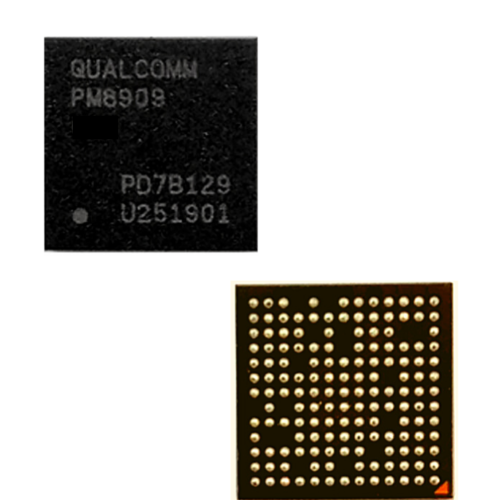
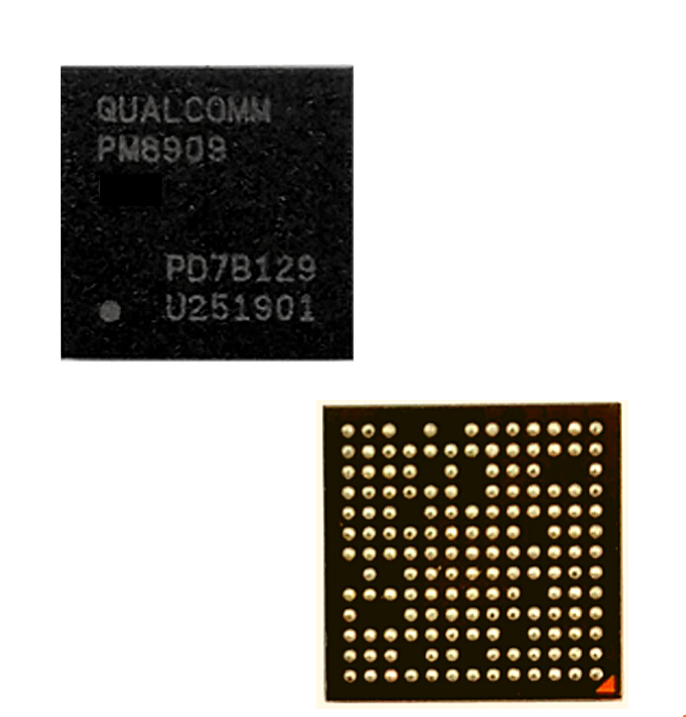
The PM 8909 Mobile Phone IC is a compact and highly efficient integrated circuit designed to enhance device functionality and reliability. Engineered for seamless performance, it ensures your mobile device runs smoothly, delivering exceptional power management for various applications. PM 8909 Mobile Phone IC
Reliable Power Management
This IC excels at regulating power distribution, ensuring efficient energy use without compromising performance. Made with advanced technology, the PM 8909 provides stability and consistency even in resource-intensive conditions, making it ideal for high-performance devices. PM 8909 Mobile Phone IC
Optimized Design for Integration
Built with a small form factor and sophisticated features, the PM 8909 integrates effortlessly into modern mobile designs. Its robust build and versatile functionality make it a trusted choice for manufacturers looking to create cutting-edge devices with lasting reliability.
The PM8909 is a specialized Power Management Integrated Circuit (PMIC) designed by Qualcomm. It serves as the primary energy distribution hub for entry-level 4G smartphones, specifically those running on the Snapdragon 210 and 212 platforms. Unlike higher-end PMICs that focus on extreme performance, the PM8909 is engineered for cost-efficiency and battery longevity in budget-friendly devices. PM 8909 Mobile Phone IC
Below are the detailed specifications and technical insights for the PM8909.
PM8909 Technical Specifications Table
| Feature Category | Specification Details |
| Model Number | PM8909 (Qualcomm Atheros Series) |
| Associated Chipsets | Snapdragon 210 (MSM8909), Snapdragon 212 (APQ8009) |
| Package Type | BGA (Ball Grid Array) / NSP (Nanoscale Package) |
| Pin Count | 152-Ball configuration (Commonly 0.4mm pitch) |
| Process Node | Optimized for 28nm LP (Low Power) architectures |
| Output Channels | 12 to 16 Programmable Power Rails |
| Buck Converters | 4 to 6 Synchronous Switching Regulators (SMPS) |
| LDO Regulators | 10+ Low Dropout Linear Regulators |
| Charging Protocol | Integrated support for Qualcomm Quick Charge 2.0 |
| Audio Codec | Integrated basic Audio Interface/Codec functions |
| Interface Control | SPMI (System Power Management Interface) |
| Protection | Thermal Shutdown, Over-Voltage (OVP), Over-Current (OCP) |
| Typical Devices | Nokia 2, Redmi 4A (Variant), Samsung J2, Lenovo A2020 |
In-Depth Functional Analysis
1. Power Distribution & Efficiency
The PM8909 manages the entire power lifecycle of a mobile device. It takes the battery voltage ($3.7\text{V}$ to $4.2\text{V}$) and steps it down using SMPS (Switched-Mode Power Supplies) for high-drain components like the CPU and GPU. For sensitive analog components like the Wi-Fi radio and camera sensors, it uses LDOs to provide ripple-free, clean voltage. This “dual-stage” regulation ensures that the phone remains power-efficient while maintaining signal integrity.
2. Integrated Charging & Battery Management
One of the standout features of the PM8909 is its integrated battery charging block. In many entry-level designs, a separate charging IC isn’t required because the PM8909 handles:
-
Trickle Charging: For deeply discharged batteries.
-
Constant Current (CC) / Constant Voltage (CV): Standard charging phases. PM 8909 Mobile Phone IC
-
Temperature Monitoring: Using an external NTC thermistor to stop charging if the battery overheats. PM 8909 Mobile Phone IC
3. Support for Multimedia & Connectivity
The IC is designed to support the Snapdragon 210 series, which means it specifically provides power rails for:
-
Display: WXGA (720p) resolution support.
-
Camera: 8MP single camera or dual camera setups. PM 8909 Mobile Phone IC
-
Modem: Integrated X5 LTE modem power requirements. PM 8909 Mobile Phone IC
-
Audio: It often includes an integrated codec to drive the earpiece and microphone, reducing the need for additional chips on the motherboard.
Maintenance & Troubleshooting Guide
For technicians, the PM8909 is a common point of failure in “Dead” budget phones. Key troubleshooting steps include:
-
VPH_PWR Rail: Check the main system power rail. If the PM8909 is shorted, this rail will show continuity to ground.
-
Crystal Oscillator (19.2 MHz): The PM8909 requires a clock signal to “wake up” the CPU. If the crystal or its associated capacitors fail, the phone will not trigger the boot sequence even if the IC is healthy.
-
Reflow vs. Replace: Because it is a BGA chip, moisture can often cause “dry joints” under the balls. A careful reflow at $350^\circ\text{C}$ can sometimes fix “No Power” issues, but for permanent fixes, replacing the chip with an original “New” variant is recommended.
Conclusion
The PM8909 is a “workhorse” IC. While it doesn’t support 100W charging or 4K displays like the PM8550 series, its high level of integration—combining power management, charging, and audio into one chip—makes it the backbone of the global mass-market smartphone industry.
More Products : https://gaffarmarketdelhi.com