PM 7150A Mobile Phone IC
Powerful Performance in a Compact Package
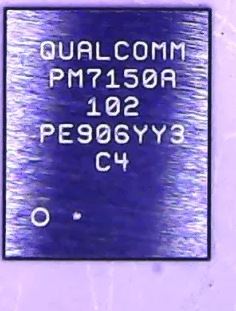
The PM 7150A Mobile Phone IC is designed to deliver seamless performance for your mobile device. Built to manage power efficiently, this integrated circuit ensures smoother operation, reduced energy consumption, and enhanced hardware reliability. PM 7150A Mobile Phone IC
Reliable and Versatile Compatibility
Engineered for broad compatibility, the PM 7150A is suited to a range of smartphone models and helps optimize device functionality. Whether you are replacing or upgrading, this IC is the ideal choice for ensuring uninterrupted operation and peak efficiency. PM 7150A Mobile Phone IC
Why Choose the PM 7150A?
Crafted using cutting-edge technologies, the PM 7150A guarantees exceptional quality and durability. Its compact design is perfect for modern mobile architectures, providing a reliable solution to meet the demands of today’s tech-savvy users. PM 7150A Mobile Phone IC
The PM7150A (specifically the PM7150A-102) is a critical Power Management Integrated Circuit (PMIC) developed by Qualcomm. It is part of the broader PM7150 family, often found in mid-to-high-range smartphones powered by Snapdragon chipsets, such as the Snapdragon 730 and 730G. PM 7150A Mobile Phone IC
This IC acts as the “brain” for electrical distribution, managing everything from battery charging to the precise voltages required by the CPU, GPU, and internal sensors. PM 7150A Mobile Phone IC
Technical Specifications: PM7150A Mobile IC
The following table summarizes the core technical attributes and operational parameters of the PM7150A.
| Feature | Specification Details |
| Model Number | PM7150A / PM7150A-102 |
| Manufacturer | Qualcomm |
| Type | PMIC (Power Management Integrated Circuit) |
| Package Type | BGA (Ball Grid Array) |
| Pin Count / Layout | Standard High-Density BGA for PM7150 series |
| Input Voltage Range | $2.5\text{V} – 5.5\text{V}$ (Nominal $3.7\text{V} – 4.4\text{V}$) |
| Output Voltage (LDOs) | $0.6\text{V}$ to $3.3\text{V}$ (Configurable) |
| Application | Smartphones, Tablets, and IoT devices |
| Charging Support | Qualcomm Quick Charge™ integration |
| Core Functions | Buck/Boost regulation, LDO regulation, Battery Management |
| Dimensions | Approx. $6\text{mm} \times 6\text{mm}$ |
| Weight | ~0.01g |
Key Features and Functional Roles
The PM7150A isn’t just a simple voltage regulator; it is a multi-functional system designed to optimize power efficiency and device safety.
1. Power Distribution & Regulation
The IC converts the battery’s raw voltage into the specific, stable levels required by various hardware modules. It utilizes:
-
Buck Converters: Step-down voltage for power-hungry components like the processor cores.
-
LDO (Low Drop-Out) Regulators: Provide clean, low-noise power for sensitive analog components like the camera sensors and audio DACs.
2. Charging Management
The PM7150A often handles the negotiation between the phone and the charger. It supports high-efficiency charging cycles, monitoring temperature and current to prevent battery degradation or overheating.
3. System Housekeeping
It manages the device’s “Power-On” sequence. When you press the power button, the PM7150A is responsible for waking up the motherboard in the correct order, ensuring the CPU receives power only after the supporting rails are stable.
Compatibility and Common Usage
The PM7150A is widely utilized in the repair industry because it is the primary power IC for several iconic devices. It is frequently paired with its siblings, the PM7150 (Main Power) and PM7150L (Secondary/Light Power).
Common Compatible Models:
-
Samsung: Galaxy A70, A71, A80, M51.
-
Xiaomi / Redmi: Redmi K20, Mi 9T, Note 10 Pro.
-
Vivo: X50 Pro.
-
Oppo/Realme: Various Snapdragon 700-series models.
Repair & Troubleshooting Guide
If a smartphone fails to turn on, hangs at a low current (e.g., $0.05\text{A}$ to $0.15\text{A}$) on a DC power supply, or has “fake charging” issues (shows charging but percentage doesn’t rise), the PM7150A is often the culprit.
Symptoms of Failure:
-
Dead Phone: No response to power button or charger.
-
Short Circuit: The motherboard shows a high current draw before the power button is even pressed.
-
Overheating: The area around the PMIC becomes excessively hot during use.
-
PMIC Output Failure: Specific rails (like $V_{REG\_L5}$ or $V_{CORE}$) are missing when tested with a multimeter.
Installation Requirements:
Replacing this IC is a “Level 3” repair task. Since it is a BGA chip, it requires:
-
Micro-soldering Skills: Ability to handle high-density BGA packages.
-
Equipment: A hot air rework station (set to approx. $350^\circ\text{C} – 380^\circ\text{C}$ depending on lead-free solder use), high-quality flux, and a microscope.
-
Orientation: The “A1” corner (usually marked by a small dot on the chip and a bracket on the PCB) must be aligned perfectly.
Warning: Improper heating can cause “popcorning” of the IC or damage the CPU/RAM situated on the other side of the motherboard. Use heat-shielding tape (Kapton or Aluminum) to protect surrounding components.
Comparison: PM7150 vs. PM7150A
While they belong to the same family, they are not always interchangeable.
-
PM7150: Usually the “Master” PMIC handling the main system rails. PM 7150A Mobile Phone IC
-
PM7150A: Often acts as a “Companion” or “Slave” PMIC handling specific peripheral voltages or enhanced charging features. PM 7150A Mobile Phone IC
-
PM7150L: Typically handles display power, WLED (backlight) drivers, and vibration motors. PM 7150A Mobile Phone IC
Always verify the exact part number (e.g., 102 vs 002) before attempting a replacement to ensure firmware and pinout compatibility.
More Products : https://gaffarmarketdelhi.com