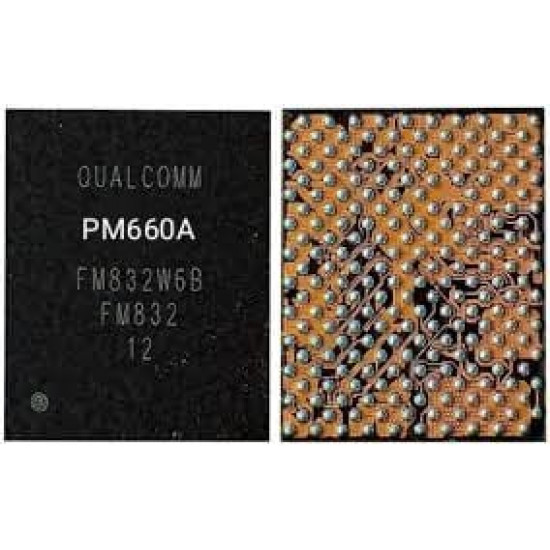
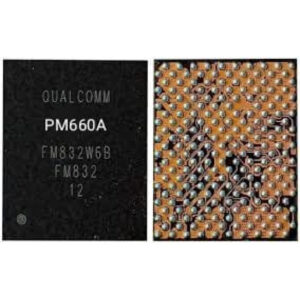
PM 660 A Original Mobile Phone IC
Enhance Your Phone’s Performance
The PM 660 A Original Mobile Phone IC is a premium integrated circuit designed to restore and optimize your mobile device’s functionality. Whether you’re repairing or upgrading, this IC ensures seamless operation and enhanced performance. PM 660 A Original Mobile Phone IC
Precision-Engineered for Durability
Manufactured with high-quality materials, the PM 660 A IC is built to last. Engineered for both compatibility and reliability, this component is the perfect solution to get your device running again, worry-free. PM 660 A Original Mobile Phone IC
Why Choose the PM 660 A Mobile Phone IC?
Designed for ease of installation and exceptional results, the PM 660 A ensures optimal performance for your smartphone. Whether you’re a professional technician or a DIY enthusiast, this product delivers a trustworthy and efficient solution. PM 660 A Original Mobile Phone IC
The PM660A is a highly integrated Power Management Integrated Circuit (PMIC) developed by Qualcomm. It is a cornerstone component in mid-range and premium smartphones, particularly those utilizing the Snapdragon 660 and 845 platforms. Unlike a standard charging chip, the PM660A is a multi-rail regulator responsible for the precise distribution of power to the CPU, GPU, and various camera and display sensors. PM 660 A Original Mobile Phone IC
In modern smartphone architecture, the PM660A often works in tandem with the primary PM660 or PM660L to manage the complex power sequencing required for high-performance mobile computing. PM 660 A Original Mobile Phone IC
Technical Specifications Table
The following table outlines the core electrical and physical parameters of the original Qualcomm PM660A IC.
| Parameter | Specification Details |
| Manufacturer | Qualcomm |
| Part Variant | PM660A (Common versions: 002, 002-01) |
| Function | Power Management Unit (PMU) / Multi-channel Regulator |
| Input Voltage Range | $3.5\text{V}$ to $28\text{V}$ (Supports Fast Charging Inputs) |
| Output Voltage Channels | Up to 12-15 Buck/LDO Regulators |
| Maximum Current Rating | Up to $3\text{A}$ per main rail |
| Interface Protocol | SPMI (System Power Management Interface) / $I^2C$ |
| Package Type | BGA (Ball Grid Array) |
| Ball Count | ~216 Pins (Variant dependent) |
| Operating Temperature | $-10^\circ\text{C}$ to $+100^\circ\text{C}$ |
| Key Features | Thermal Throttling, Over-Voltage Protection (OVP), Power Sequencing |
Key Functional Components
The PM660A isn’t just a single “switch”; it is a miniature power plant inside the phone. Its architecture includes:
-
Buck Converters: These are high-efficiency step-down regulators used for high-drain components like the processor cores. They convert battery voltage (approx. $3.8\text{V}$) into the precise, lower voltages (often sub-$1.0\text{V}$) needed by the silicon.
-
LDO Regulators: Low Dropout regulators provide “clean,” noise-free power to sensitive analog components, such as the camera’s image signal processor (ISP) and the audio DAC.
-
Charging Logic: It manages the handshake between the USB port and the battery, ensuring that high-voltage fast charging does not damage the internal cells.
-
Haptic & Backlight Drivers: In some configurations, the “A” variant specifically handles auxiliary power for the vibration motor (haptics) and display backlight dimming.
Compatibility and Device Usage
The PM660A is most famously found in the “Global” and “Pro” versions of popular mid-range devices. Because it uses a BGA (Ball Grid Array) mounting style, it requires professional micro-soldering tools (hot air station and reballing stencils) for replacement.
-
Xiaomi: Redmi Note 5, Redmi Note 5 Pro, Mi Max 3, Mi A2, Redmi Note 7.
-
Oppo: R11, R11 Plus.
-
Vivo: X20, X21.
Important Note for Technicians: While the PM660 and PM660A belong to the same family, they are not always interchangeable. The “A” variant often has a different pin mapping for peripheral power rails. Always match the specific suffix (e.g.,
002-01) found on the original chip before attempting a repair.
Common Fault Symptoms
When this IC fails, the mobile device usually exhibits “dead” behavior or specific power-related glitches:
-
No Power-On: The device fails to trigger the boot sequence despite a charged battery.
-
Charging Errors: The phone detects the charger but the percentage does not increase, or it shows a “Temperature too low/high” error.
-
Short Circuits: The motherboard shows a low-resistance path to ground, often causing the IC to get physically hot when connected to a DC power supply.
-
Stuck in Boot Loop: The device starts but crashes as soon as a high-power component (like the camera or Wi-Fi) is activated.
More Products : https://gaffarmarketdelhi.com