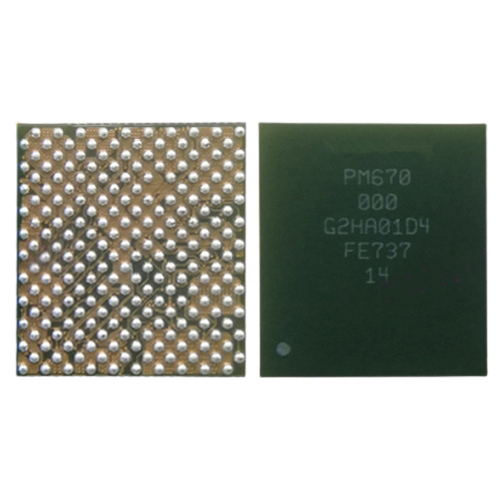
PM 670 Mobile Phone IC
Powerful and Efficient Design
The PM 670 Mobile Phone IC is engineered to deliver high performance and seamless functionality for your mobile device needs. Its efficient design ensures low power consumption, making it ideal for modern smartphones that prioritize battery life and performance. PM 670 Mobile Phone IC
Enhanced Connectivity Features
This integrated circuit offers advanced connectivity options, ensuring smooth communication across various network configurations. Its versatility and precision help enhance the overall user experience by boosting signal performance and reliability. PM 670 Mobile Phone IC
Reliable Performance You Can Trust
Manufactured with cutting-edge technology, the PM 670 Mobile Phone IC is designed to meet rigorous quality standards. With consistent and dependable performance, this IC is a trusted choice for mobile device manufacturers and enthusiasts alike. PM 670 Mobile Phone IC
The PM670 is a highly integrated Power Management Integrated Circuit (PMIC) designed by Qualcomm. It serves as the primary power hub for mid-range and high-end smartphones, most notably those powered by the Snapdragon 670 and Snapdragon 710 chipsets. PM 670 Mobile Phone IC
Below is a detailed technical breakdown of its specifications, architecture, and functional roles. PM 670 Mobile Phone IC
Technical Specifications: PM670 PMIC
The PM670 is responsible for converting the raw voltage from the Lithium-Ion battery into the precise, regulated voltages required by various sub-systems like the CPU, GPU, RAM, and Modem.
Core Hardware Specifications
| Feature | Specification Details |
| Manufacturer | Qualcomm |
| Model Number | PM670 (Variants: 001, 002) |
| Package Type | Fine-pitch BGA (Ball Grid Array) |
| Pin Count | 144+ Pins (Varies by revision) |
| Input Voltage Range | $3.4\text{V} – 4.4\text{V}$ (Typical Li-Ion Operating Range) |
| Switching Regulators | Multi-phase Buck Converters for CPU/GPU |
| LDO Regulators | 20+ Low Dropout Regulators for sensitive analog circuits |
| Communication Bus | SPMI (System Power Management Interface) |
| Thermal Protection | Integrated thermal shutdown and over-temperature sensors |
Functional Block Breakdown
The PM670 is not just a voltage regulator; it is a complex system that manages the entire lifecycle of the device’s power.
1. Buck Converters (Step-Down)
The PM670 utilizes high-frequency switching regulators to provide high current to the processor cores. These are often “multi-phase” to reduce heat and improve transient response when the CPU suddenly jumps from idle to full load.
-
VCORE: Powers the Kryo 360 CPU cores.
-
VGPU: Powers the Adreno 615/616 GPU.
-
VMODEM: Essential for LTE/5G baseband processing.
2. LDO Regulators (Analog/Quiet Power)
For components sensitive to electrical noise—such as the camera sensor, Wi-Fi/Bluetooth radio, and audio DAC—the PM670 provides Low Dropout (LDO) outputs. These are less efficient than Buck converters but offer “cleaner” power.
3. Battery & Charging Management
While the PM670 handles distribution, it often works in tandem with the SMB (Switch Mode Battery) charger IC (like the SMB1351) or a secondary PMIC (like the PM670L) to manage:
-
Fuel Gauging: Calculating the exact percentage of the battery remaining.
-
Charging Protection: Monitoring for over-voltage or short-circuit conditions during fast charging.
PM670 vs. PM670L: The Difference
In modern smartphone architecture, power management is often split between two chips to distribute heat and simplify board routing.
| Feature | PM670 (Main PMIC) | PM670L (Secondary/Companion) |
| Primary Role | CPU, GPU, Modem, System Logic | Display (LCD/OLED bias), Flash LED, Speaker Amp |
| Position | Near the SoC (System on Chip) | Near the Display/Battery Connector |
| Subsystems | RAM, I/O, Core Voltage | WLED Driver, Haptics, Secondary LDOs |
Common Applications & Troubleshooting
The PM670 is found in several iconic devices from the 2018–2021 era, including:
-
Xiaomi: Mi 8 SE, Redmi Note 7 Pro
-
Oppo/Vivo: R17, X23
-
Samsung: Galaxy A series (selected models)
Failure Symptoms
Because the PM670 is the “heart” of the motherboard, its failure usually results in catastrophic device behavior:
-
Dead Phone: The device shows no response to the power button and 0.00A current draw on a USB ammeter.
-
Short Circuit: The device gets extremely hot near the PMIC as soon as the battery is connected.
-
Boot Loop: The IC fails to provide the “Power Good” signal to the CPU, causing the phone to restart indefinitely.
-
No Graphics/Display: If the internal LDOs for the display interface fail, the phone may vibrate (showing it’s on) but remain black.
Repair & Technical Handling
The PM670 is a BGA (Ball Grid Array) chip, meaning its connections are tiny solder balls underneath the package.
-
Reballing: If the phone was dropped, the solder joints might crack. Technicians use a stencil and 183°C or 138°C solder paste to “reball” the IC.
-
Replacement: When the IC is internally shorted, it must be replaced. Due to the proximity of the CPU/RAM, technicians often use Kapton tape or heat shields to prevent accidental desoldering of nearby components during the $350^\circ\text{C}$ hot air rework process.
More Products : https://gaffarmarketdelhi.com