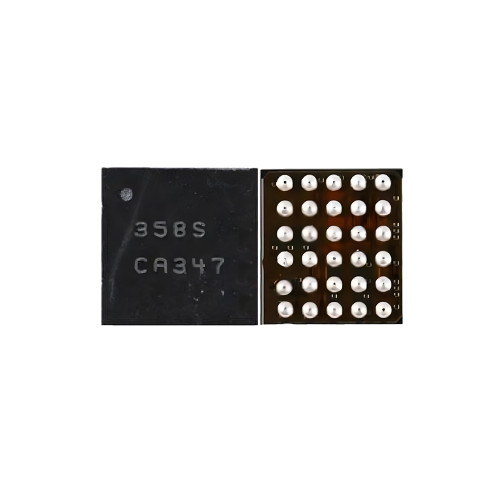
Mobile Phone IC For 358S Original
The 358S series (specifically variants like 358S-1939, 358S-2166, and 358S-2122) is a widely used family of Power Management Integrated Circuits (PMICs). These chips are primarily classified as USB Charging Control ICs or Interface PMICs.
They are critical components in the power architecture of smartphones and tablets, particularly within the Samsung Galaxy Tab, Redmi, and Asus Zenfone lines. These chips manage the transition of power from the charging port to the battery and the system.
Core Specifications: 358S Series
| Feature | Specification Detail |
| Model Family | 358S Series (1939, 2122, 2166, 2225) |
| IC Category | Secondary PMIC / Charging Controller |
| Package Type | 30-Pin BGA (Ball Grid Array) |
| Pin Layout | 5×6 Matrix Grid |
| Input Voltage ($V_{BUS}$) | 3.8V to 5.2V (Standard USB supply) |
| Max Charging Current | Up to 5.0A (Internal switching limit) |
| Functions | Battery Charging, USB Path Control, OTG Boost |
| Communication | $I^{2}C$ Interface (Inter-Integrated Circuit) |
| Key Protections | Thermal Shutdown, OVP (Over-Voltage), OCP (Over-Current) |
Functional Architecture
The 358S IC acts as a specialized “gatekeeper” for the device’s power intake. Its roles are divided into three major blocks:
1. Switching Regulator (Charger)
The 358S is a buck-boost switching regulator. It takes the variable voltage from a USB charger and converts it into a stable $4.2\text{V}$ to $4.4\text{V}$ output to charge the Lithium-Ion battery. This switching method is highly efficient, generating significantly less heat than older linear chargers.
2. USB Interface (MUIC)
The Micro-USB Interface Controller (MUIC) block detects what is plugged into the charging port. It monitors the D+ and D- data lines to identify whether it is a standard wall charger, a computer USB port, or a USB-OTG accessory.
3. OTG Power Supply
When the phone acts as a host (OTG mode), the 358S reverses its role. It takes power from the battery and boosts it to 5V to power external devices like USB flash drives or keyboards connected to the phone.
Common Failure Symptoms
In the repair industry, the 358S is a “high-traffic” component that often fails due to external electrical stress.
-
Fake Charging: The phone shows the lightning bolt charging icon, but the battery percentage stays stagnant or drops.
-
Total Power Loss: A short circuit within the 358S can pull the main system voltage (VPH_PWR) to ground, preventing the phone from turning on entirely.
-
No USB Connectivity: The phone charges but is not recognized by any computer for data transfer or firmware flashing.
-
Rapid Battery Drain: A leaky or partially damaged 358S can consume current even when the phone is off, causing the battery to drain overnight.
Repair & Installation Guide
The 358S is a 30-pin BGA component. Replacing it requires advanced micro-soldering skills.
-
Pin 1 Orientation: There is a small dot on the corner of the chip. Installing the IC in the wrong direction will immediately short the battery line and likely destroy the motherboard.
-
Heat Profile: Use a hot air station set to $340\degree\text{C}$ to $355\degree\text{C}$. Because it is a 30-pin grid, ensure the heat is distributed evenly to avoid “popcorning” the silicon.
-
Surrounding Components: Pay close attention to the Sense Resistor and the Power Inductor (large grey coil) next to the IC. If these are cracked or cold-soldered, the 358S will not be able to output current to the battery.