Mobile Phone IC For PM660L Original
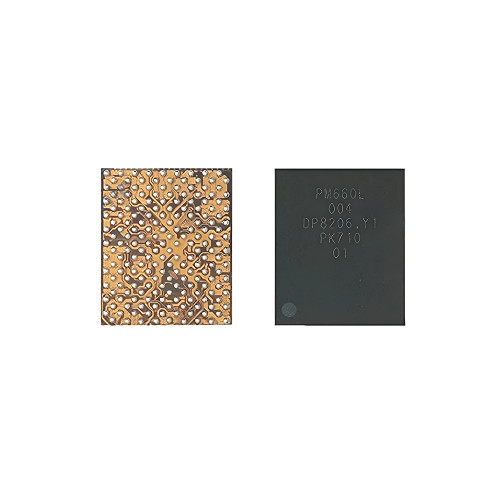
The Qualcomm PM660L is a secondary Power Management Integrated Circuit (PMIC) designed to work in tandem with the primary PM660 chip. While the primary PMIC handles core system voltages and the boot sequence, the “L” (Companion/Light) variant is specialized for high-current peripheral management, specifically targeting the display, backlight, and camera flash subsystems.
It is a common component in mid-range smartphones powered by the Snapdragon 660, 636, and 632 platforms, such as the Xiaomi Redmi Note 5 Pro, Nokia 7 Plus, and various Motorola G-series models.
PM660L Original Technical Specifications
The table below details the original electrical characteristics and physical parameters of the PM660L (variant PM660L-004).
| Feature / Parameter | Original Specification |
| Manufacturer | Qualcomm Technologies, Inc. |
| Package Type | 185-pin WLPSP (Wafer Level Chip Scale Package) |
| Input Voltage (VIN) | 3.0V to 4.8V (Standard Operating Range) |
| Buck Converters | 2 to 4 High-Efficiency Step-Down Supplies |
| LDO Regulators | 12 to 15 Low-Dropout Linear Regulators |
| Display Support | Integrated WLED Driver (Backlight Control) |
| Flash Support | Integrated Dual-Channel LED Flash Driver |
| Communication Bus | SPMI (System Power Management Interface) |
| Efficiency | >92% on core power rails |
| Operating Temp | -40°C to +125°C (Junction Temperature) |
| Protection Features | OVP, UVP, Thermal Shutdown, and Over-Current Protection |
Key Functional Blocks & Responsibilities
The PM660L is essential for the visual and multimedia experience of a smartphone. Its internal architecture is divided into several specialized “islands”:
1. WLED (White LED) Backlight Driver
This is often the most critical part of the PM660L. It integrates a boost converter that can step up battery voltage (approx. 3.8V) to the much higher levels required by an LCD backlight (up to 25V – 35V). It supports multi-string LED configurations with precise dimming control.
2. LCD Bias Power ($VSP$ / $VSN$)
For modern LCD displays to function, they require specific positive and negative voltages (typically $+5V$ and $-5V$). The PM660L contains the charge pump circuitry needed to generate these “bias” voltages, which are crucial for pixels to toggle correctly.
3. Dual Flash LED Driver
The IC manages the camera flash and torch modes. It is capable of delivering high burst currents (up to 1.5A or 2.0A) to the flash LEDs while ensuring thermal safety so the LEDs do not burn out during sustained “torch” use.
4. Additional Buck & LDO Rails
While the primary PM660 manages the CPU, the PM660L provides “clean” power for:
-
Camera Modules: Dedicated low-noise LDOs for the Image Signal Processor (ISP) and sensor arrays.
-
Haptic Feedback: Drivers for vibration motors (ERM or LRA).
Professional Repair & Diagnostics
In the repair industry, the PM660L is a frequent suspect when a phone has “half-functional” symptoms.
Common Failure Symptoms:
-
No Backlight: The phone boots and shows an image (visible with a flashlight), but the screen is dark.
-
No Graphics: The phone turns on but the screen remains completely black/blank (Bias voltage failure).
-
Flashlight Failure: The camera works, but the flash will not fire, or the “Torch” toggle is greyed out.
-
Overheating near PMIC: A shorted capacitor on the $VPH\_PWR$ line near the PM660L can prevent the entire phone from turning on.
Technician’s Note: When replacing this IC, it is vital to check the large Boost Inductor nearby. If the inductor is scorched or “leaky,” replacing the PM660L alone will not fix the backlight issue, and may even cause the new IC to blow immediately.