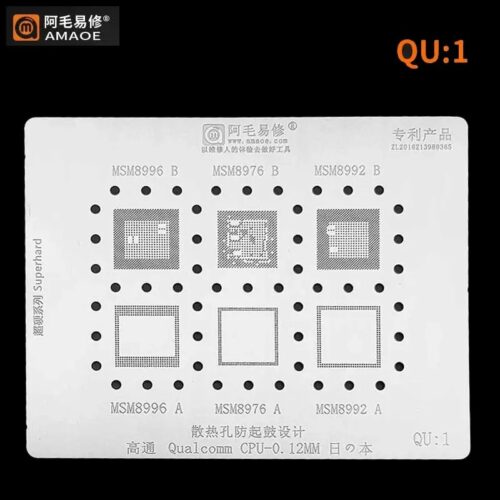
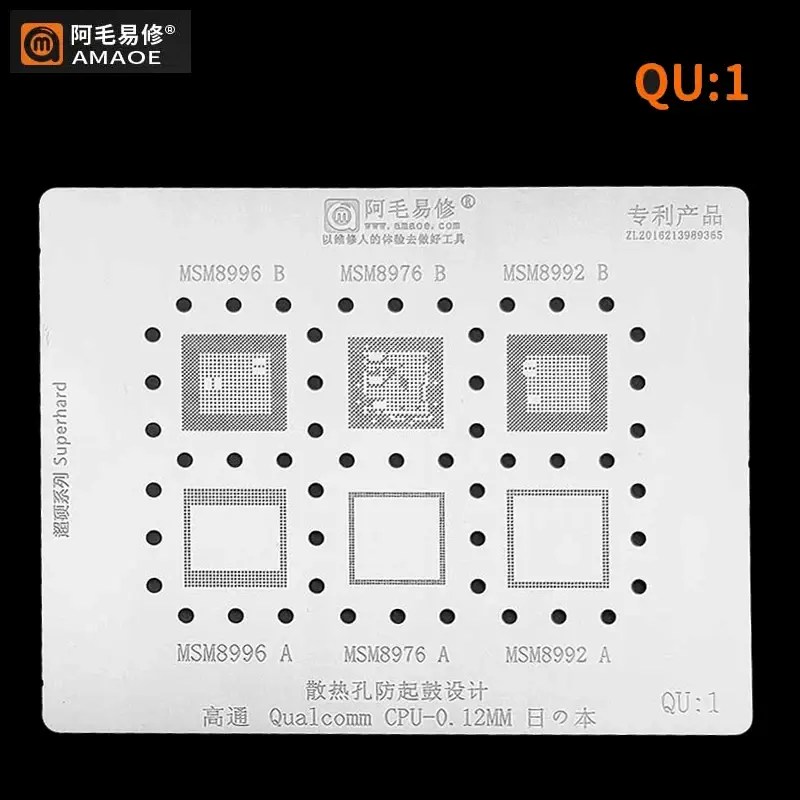
Amaoe QU1 BGA Reballing Stencil-Original
Exceptional Quality and Precision
The Amaoe QU1 BGA Reballing Stencil-Original is designed to deliver unbeatable accuracy for chipset repair professionals and enthusiasts. Crafted from durable, high-grade materials, it ensures seamless reballing performance every time. Amaoe QU1 BGA Reballing Stencil-Original
Versatility for Chipset Maintenance
This stencil is perfectly suited for reballing a variety of BGA chipsets, offering unmatched versatility to meet your repair demands. Each stencil is precisely engineered for compatibility and ease of use during intricate repair tasks. Amaoe QU1 BGA Reballing Stencil-Original
User-Friendly and Reliable Design
Amaoe QU1 separates itself with a design optimized for hassle-free handling. Its compact and lightweight structure enables quick setup and teardown, making it a reliable companion for professionals working in fast-paced repair environments. Amaoe QU1 BGA Reballing Stencil-Original
The Amaoe QU1 BGA Reballing Stencil is a professional-grade precision tool engineered for the intricate process of “tin planting” or reballing integrated circuits (ICs) on mobile device motherboards. Specifically designed for Qualcomm MSM-series processors and power management chips, the QU1 is a cornerstone for technicians performing high-level chip repairs on Android smartphones, particularly Xiaomi and Samsung devices. Amaoe QU1 BGA Reballing Stencil-Original
The stencil’s primary function is to act as a high-accuracy template, ensuring that solder paste is deposited in perfectly uniform amounts across the BGA (Ball Grid Array) contact pads. This prevents bridge-shorting and ensures a stable electrical connection once the chip is reflowed. Amaoe QU1 BGA Reballing Stencil-Original
Full Specifications: Amaoe QU1
| Feature | Specification Details |
| Brand | Amaoe (Authentic Original) |
| Model Number | QU1 (Part of the Qualcomm Series) |
| Material | High-Grade Japanese Imported Alloy Steel |
| Thickness | $0.12\text{ mm}$ (Ultra-thin precision) |
| Hole Type | Square-Round (Square base with rounded corners) |
| Manufacturing Process | High-precision CNC Laser Cutting & Etching |
| Heat Resistance | Up to $450^{\circ}\text{C}$ (Anti-warping/Anti-bulge) |
| Main Compatible CPUs | Qualcomm MSM8994, MSM8974, MSM8960 |
| Support Tiers | Upper & Lower BGA Layers (CPU + RAM Sandwich) |
| Surface Finish | Matte non-glare (Protects eyes during microscope use) |
| Magnetic Support | Compatible with magnetic reballing stations |
| Dimensions | Approx. $10\text{ cm} \times 8\text{ cm}$ |
| Weight | ~0.01 kg |
Key Technical Attributes
1. Heat Resistance and Stability
Unlike cheaper generic meshes that often “bulge” or warp when hit with a heat gun, the Amaoe QU1 uses a specific alloy steel that maintains its flat profile. This is critical because any gap between the stencil and the chip during the heating process will cause solder balls to merge, ruining the repair.
2. Square-Round Hole Design
The apertures in the QU1 are designed with a square-round geometry. This hybrid shape allows for a higher volume of solder paste to be held compared to a standard circular hole, while the rounded corners facilitate the “release” of the stencil from the chip once the solder has solidified, preventing the newly formed balls from sticking to the mesh.
3. Optimized $0.12\text{ mm}$ Thickness
The thickness is mathematically balanced at $0.12\text{ mm}$. This is the industry standard for modern smartphone ICs because it provides exactly the right amount of height for the solder ball to ensure a strong mechanical bond without creating a “tower” that is prone to collapsing or shorting under the weight of the CPU.
Detailed Chip Compatibility
While the QU1 is frequently associated with the MSM8994 (Snapdragon 810), it is a multi-purpose template for several specific Qualcomm architectures:
-
Qualcomm MSM8994: Found in flagship devices like the Xiaomi Mi Note Pro and Nexus 6P.
-
Qualcomm MSM8974: Used in the Xiaomi Mi 3, Samsung Galaxy S5, and LG G3.
-
Qualcomm MSM8960: Common in older high-performance devices and LTE-enabled mid-range phones.
-
RAM/Memory Layers: Supports the reballing of the LPDDR memory chips that are often stacked directly on top of these CPUs (Package-on-Package or PoP).
Usage Recommendation
For the best results with the Amaoe QU1, technicians generally recommend using a Medium Temperature Solder Paste ($183^{\circ}\text{C}$ leaded or $190^{\circ}\text{C}$ lead-free). High-viscosity “dry” paste is preferred to ensure the balls do not shift during the initial melting phase.
More Products : https://gaffarmarketdelhi.com