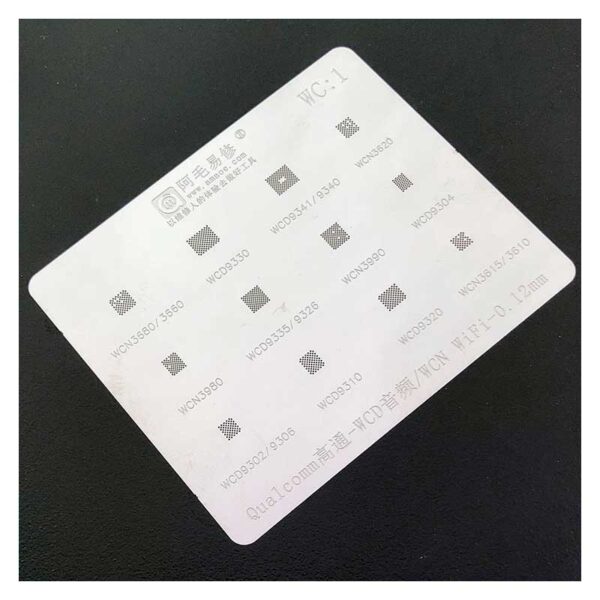
AMAOE Stencil Original Qualcomm WCD/WCN WC1 0.12mm
High-Quality Precision for Complex Repairs
The AMAOE Stencil Original Qualcomm WCD/WCN WC1 0.12mm ensures unmatched precision and durability. Designed specifically for Qualcomm chipsets, this stencil offers seamless alignment and accurate soldering for professional-level repairs. A must-have tool for technicians handling complex BGA rework and soldering tasks. AMAOE Stencil Original Qualcomm WCD/WCN WC1 0.12mm
Durable and Reliable Construction
Crafted with high-grade metal, this 0.12mm stencil guarantees long-term use while ensuring consistent results on various types of Qualcomm chipsets. Its intricate design minimizes errors during the repair process, saving you time and increasing productivity.
The Perfect Tool for Professionals
Whether you’re a seasoned repair expert or a novice learning the trade, the AMAOE Stencil delivers the level of accuracy and performance you need. Elevate your repair projects with this reliable solder stencil, perfect for intricate and precise Qualcomm chipset repairs. AMAOE Stencil Original Qualcomm WCD/WCN WC1 0.12mm
The AMAOE Stencil Original Qualcomm WCD/WCN WC1 is a precision-engineered tool designed for the specialized world of BGA (Ball Grid Array) reballing. Specifically tailored for Qualcomm’s high-performance audio and connectivity chips, this stencil is a staple in the kits of professional mobile technicians. AMAOE Stencil Original Qualcomm WCD/WCN WC1 0.12mm
Below is a comprehensive breakdown of its specifications, use cases, and technical advantages. AMAOE Stencil Original Qualcomm WCD/WCN WC1 0.12mm
🛠️ Technical Specifications: AMAOE WCD/WCN WC1
The following table outlines the core physical and technical parameters of the stencil.
| Feature | Specification Details |
| Brand | AMAOE (Original Quality) |
| Series | Qualcomm Audio/Connectivity (WCD/WCN) |
| Model Number | WC1 |
| Thickness | 0.12mm |
| Material | High-Grade Japanese Imported Steel |
| Hole Shape | Square Holes with Rounded Corners (Anti-Drumming) |
| Manufacturing Process | High-Precision Laser Cutting |
| Supported Chips | WCD9330, WCD9335, WCN3610, WCN3660, WCN3680, etc. |
| Heat Resistance | High (Deformation Resistant up to standard soldering temps) |
| Application | BGA Reballing, IC Chip Repair, Mobile Logic Board Repair |
🔍 Understanding the WC1 Model
The “WC” in the model name typically stands for the chip prefixes it supports—primarily the WCD (Audio Codec) and WCN (Wireless Connectivity/Wi-Fi/Bluetooth) series.
Supported Integrated Circuits (ICs)
This stencil is specifically “mapped” to fit several critical Qualcomm components found in flagship devices (Samsung, Google Pixel, Xiaomi, etc.): AMAOE Stencil Original Qualcomm WCD/WCN WC1 0.12mm
-
WCD Series: These are audio processing chips. If a phone has “no sound” or “mic not working” issues despite part replacements, the WCD chip usually needs reballing. AMAOE Stencil Original Qualcomm WCD/WCN WC1 0.12mm
-
WCN Series: These manage Wi-Fi and Bluetooth. Common failures include greyed-out Wi-Fi toggles or poor signal strength. AMAOE Stencil Original Qualcomm WCD/WCN WC1 0.12mm
💎 Key Features & Design Philosophy
1. The 0.12mm Thickness “Sweet Spot”
AMAOE utilizes a 0.12mm thickness for the WC1. This is widely considered the industry standard for modern smartphones.
-
Why 0.12mm? If a stencil is too thin (0.10mm), the solder balls may be too small to create a reliable connection. If too thick (0.15mm+), you risk solder bridging (shorts) between the tiny pins of Qualcomm chips.
2. Square Holes with Rounded Corners
Unlike cheaper stencils that use simple circular drills, AMAOE uses laser-cut square holes with slight interior rounding. AMAOE Stencil Original Qualcomm WCD/WCN WC1 0.12mm
-
Release Ease: This design prevents the solder paste from getting stuck in the corners of the stencil when you lift it off the chip. AMAOE Stencil Original Qualcomm WCD/WCN WC1 0.12mm
-
Consistency: It ensures every “ball” of solder is the exact same volume, preventing uneven chips that won’t sit flat on the logic board. AMAOE Stencil Original Qualcomm WCD/WCN WC1 0.12mm
3. High-Temperature Stability
The imported steel is treated to withstand the thermal expansion that occurs when a heat gun (usually set between 300°C to 350°C) is applied. Cheap stencils “drum” or warp upward when heated, causing solder paste to leak underneath and ruin the job.
📋 Step-by-Step Reballing Guide with AMAOE
Using a high-quality stencil like the WC1 requires a specific workflow to ensure the longevity of the Qualcomm chip:
-
Preparation: Clean the IC chip thoroughly using a soldering iron and wick to remove old solder. Use Isopropyl Alcohol (IPA) to ensure the surface is mirror-clean.
-
Alignment: Place the chip under the WC1 stencil. Because the WC1 is transparently etched, you can easily align the chip pads with the stencil holes.
-
Paste Application: Apply a high-quality solder paste (e.g., 183°C or 138°C leaded paste). Spread it evenly across the holes using a scraper.
-
Heating: Hold the stencil down with tweezers. Use a hot air station with a circular motion. The paste will liquefy and form perfect spheres.
-
Release: Let it cool for 5 seconds. Gently tap the chip out. The 0.12mm precision ensures the chip drops out without resistance.
⚖️ Pros and Cons
| Pros | Cons |
| Extreme precision for tiny Qualcomm pads | Higher cost than generic “universal” stencils |
| Resistant to heat warping (anti-bulge) | Requires specific alignment for each chip model |
| Long lifespan (can be used hundreds of times) | Sharp edges require careful handling |
💡 Maintenance Tips
To keep your AMAOE WC1 in top shape:
-
Never scrape with steel: Use a plastic or soft copper scraper to apply paste to avoid scratching the stencil surface.
-
Ultrasonic Cleaning: If solder paste dries in the holes, use an ultrasonic cleaner or soak it in flux remover.
-
Storage: Store flat. Even a slight bend in a 0.12mm stencil can make it unusable for precision work.
The WC1 is more than just a piece of metal; it is a bridge between a dead device and a functional one. For a technician, it represents the difference between a “one-shot” successful repair and hours of frustrating troubleshooting.
More Products ; https://gaffarmarketdelhi.com