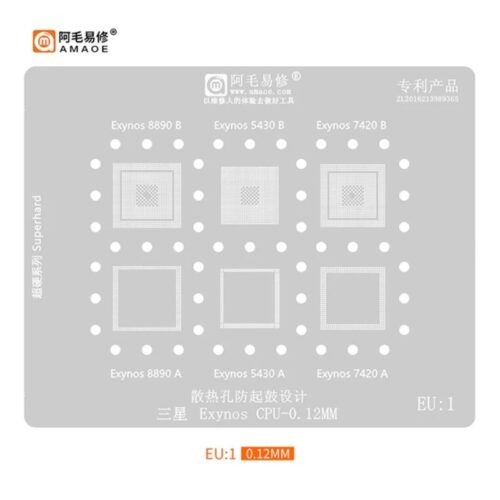

Amaoe EU1 BGA Reballing Stencil Original
High-Quality Reballing Stencil
The Amaoe EU1 BGA Reballing Stencil Original is designed for precise and efficient repairs in microelectronic reballing processes. Crafted with accuracy in mind, this stencil ensures that BGA components are reworked with perfection. Amaoe EU1 BGA Reballing Stencil Original
Durable and Reliable Construction
Made with premium-grade materials, the Amaoe EU1 BGA Reballing Stencil provides superior durability and a long lifespan, standing up to repetitive use without any loss of performance. Its design offers an ideal balance of flexibility and sturdiness for professional use. Amaoe EU1 BGA Reballing Stencil Original
Perfect for Technical Experts
Whether you are a seasoned technician or a DIY enthusiast, the Amaoe EU1 BGA Reballing Stencil offers unmatched compatibility with a wide range of BGA components. Upgrade your toolkit with this must-have stencil for precise and seamless reballing operations. Amaoe EU1 BGA Reballing Stencil Original
The Amaoe EU1 BGA Reballing Stencil is a staple in the toolkit of professional micro-soldering technicians, specifically those dealing with high-end Android and European-market chipset repairs. Known for its high-precision laser-cut holes and “anti-bulge” design, the EU1 set is engineered to handle the thermal stress of reballing without warping. Amaoe EU1 BGA Reballing Stencil Original
Below is the comprehensive technical breakdown and specifications for the EU1 series. Amaoe EU1 BGA Reballing Stencil Original
Technical Specifications: Amaoe EU1 Stencil
| Feature | Specification |
| Model Name | Amaoe EU1 (Universal/European Market Series) |
| Material | High-Grade Imported Japanese Steel |
| Thickness | 0.12mm (Standardized for uniform solder paste application) |
| Manufacturing Process | High-Precision Square-Hole Laser Cutting |
| Heat Resistance | Up to 450°C (Optimized for lead-free solder profiles) |
| Compatibility | Universal Android, Exynos, Kirin, and Qualcomm Chips |
| Hole Shape | Square holes with tapered edges for easy release |
| Stencil Coating | Anti-static, Non-stick surface treatment |
Detailed Component Support
The EU1 is frequently updated, but the “Original Full Specification” typically covers a specific range of Power Management ICs (PMICs), CPUs, and specialized chips found in Samsung, Huawei, and high-end Xiaomi devices.
1. Power Management ICs (PMICs)
The stencil includes dedicated grids for common PMICs such as: Amaoe EU1 BGA Reballing Stencil Original
-
HI6421 / HI6422: Commonly found in Huawei/Honor devices. Amaoe EU1 BGA Reballing Stencil Original
-
S515 / S525: Samsung power management controllers. Amaoe EU1 BGA Reballing Stencil Original
-
MAX Series: Various Maxim Integrated chips used in power distribution. Amaoe EU1 BGA Reballing Stencil Original
2. Audio and RF Chips
High-fidelity audio ICs and Radio Frequency (RF) transceivers require precise reballing to prevent signal loss:
-
WCD9335 / WCD9341: Qualcomm audio codecs.
-
S2MPB02: Samsung-specific power and audio interface chips.
3. CPU and RAM (Interconnects)
While the EU1 is often used for smaller ICs, it includes the pitch patterns for:
-
0.3mm to 0.5mm Pitch: Ensuring compatibility with modern high-density BGA (Ball Grid Array) layouts.
Key Design Features
Square Hole Technology
Unlike older circular-hole stencils, the Amaoe EU1 uses square holes. This is a critical design choice:
-
Paste Retention: Square holes hold solder paste more effectively during the “scraping” phase.
-
Formation: When heated, the solder naturally pulls into a sphere due to surface tension. The square hole provides a “corner” that allows air to escape, preventing the solder balls from popping out or bridging.
Anti-Bulge Cooling Grooves
One of the primary frustrations in reballing is the stencil “doming” or bulging when hit with a heat gun. The EU1 features thermal expansion grooves strategically placed between the IC patterns. These grooves allow the metal to expand laterally rather than upwards, keeping the stencil flat against the chip.
0.12mm Precision Thickness
The thickness is calibrated specifically for modern mobile PCB clearances. At 0.12mm, it deposits exactly enough paste to form a ball that is high enough to bridge to the board but small enough to avoid shorts under the weight of the IC.
Usage Guidelines for Best Results
To maximize the lifespan of your Amaoe EU1 stencil and ensure a 100% success rate:
-
Alignment: Use a microscope to ensure the BGA pads are perfectly centered in the square holes. Even a 0.05mm offset can lead to bridging.
-
Paste Application: Use “Dry” solder paste (approx. 183°C for Leaded or 217°C for Lead-free). If the paste is too wet, it will seep under the stencil.
-
Heat Profile: Use a nozzle with a wide diameter and keep the heat gun at a 45-degree angle. This prevents the hot air from pushing the solder balls out of their sockets before they melt.
-
Cleaning: Clean immediately after use with 99.9% Isopropyl Alcohol (IPA) and a soft-bristled brush. Never use a metal scraper to clean the holes, as this will burr the edges.
Summary of Advantages
-
Durability: The Japanese steel retains its shape after hundreds of heat cycles.
-
Efficiency: The “Easy-Release” coating means you don’t have to fight to get the chip out of the stencil after the balls have cooled.
-
Accuracy: Laser-cut precision ensures that every solder ball is the exact same volume, preventing “tilted” chips during board installation.
More Products : https://gaffarmarketdelhi.com