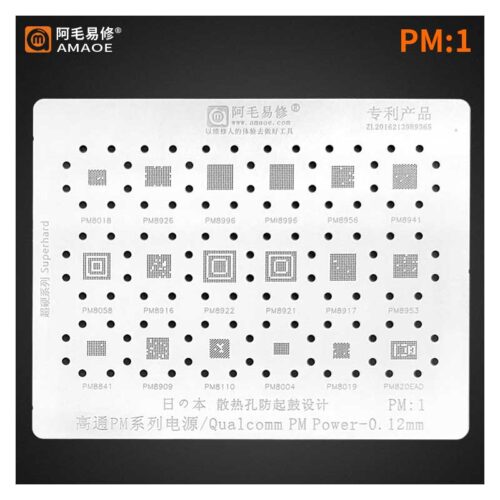
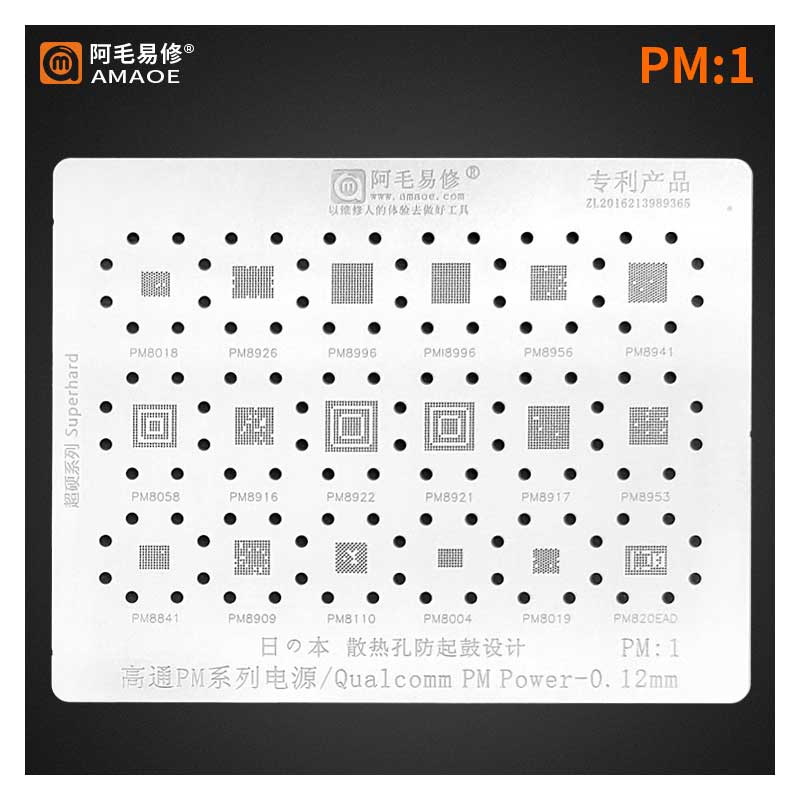
Amaoe PM1 BGA Reballing Stencil Original
Effortless Reballing with Precision
The Amaoe PM1 BGA Reballing Stencil Original is designed for professionals seeking consistent and high-quality reballing results. This tool is perfect for intricate soldering tasks, ensuring accuracy while saving time on challenging repairs or assembly projects. Amaoe PM1 BGA Reballing Stencil Original
Durable and User-Friendly Design
Crafted with premium-grade materials, the Amaoe PM1 stencil is durable and provides reliable performance throughout its lifespan. Its ergonomic design allows for easy alignment, making it accessible even for those newer to reballing processes. Amaoe PM1 BGA Reballing Stencil Original
Versatility for Multiple Applications
From reballing motherboard components to repairing intricate circuits, this stencil is compatible with a range of devices. Its precise cut-outs ensure seamless application, making it an essential toolkit for technicians and enthusiasts alike. Amaoe PM1 BGA Reballing Stencil Original
The Amaoe PM1 BGA Reballing Stencil is a cornerstone tool for professional electronics technicians, particularly those specializing in mobile phone repair and micro-soldering. Amaoe has built a reputation for high-precision stencils that feature heat-resistant properties and square-hole designs that prevent solder ball bridging. Amaoe PM1 BGA Reballing Stencil Original
Below is a comprehensive breakdown of the PM1 specifications, technical features, and its role in modern BGA (Ball Grid Array) rework. Amaoe PM1 BGA Reballing Stencil Original
Technical Specifications Table
The following table outlines the physical and functional attributes of the Amaoe PM1.
| Feature | Specification |
| Model Name | Amaoe PM1 (Power Management Series) |
| Material | High-Grade Imported Japanese Stainless Steel |
| Stencil Thickness | 0.12mm (Industry standard for precision) |
| Hole Type | Laser-cut Square Holes with rounded corners |
| Heat Resistance | Up to 350°C – 400°C (Anti-bulge technology) |
| Primary Application | Power Management ICs (PMIC), Audio ICs, Charging ICs |
| Supported Brands | Qualcomm, MediaTek, Samsung, HiSilicon, Apple |
| Alignment Style | High-transparency etching for pin visibility |
| Surface Finish | Matte/Satin to reduce glare under microscopes |
Targeted IC Compatibility
The “PM” in PM1 stands for Power Management, though this specific stencil is a “universal” power IC kit. It is designed to cover a wide array of chips found in flagship and mid-range Android and iOS devices.
1. Power Management ICs (PMIC)
The PM1 is famous for its support of Qualcomm’s “PM” series chips. These are the hearts of the device’s power distribution. Amaoe PM1 BGA Reballing Stencil Original
-
Qualcomm Series: PM8916, PM8909, PM8953, PM8226. Amaoe PM1 BGA Reballing Stencil Original
-
MediaTek Series: MT6323, MT6328, MT6350. Amaoe PM1 BGA Reballing Stencil Original
2. Audio & Charging ICs
Beyond power, the stencil includes layouts for:
-
SMB series charging chips (Qualcomm Quick Charge controllers). Amaoe PM1 BGA Reballing Stencil Original
-
Small-scale Audio Codecs.
-
Amaoe PM1 BGA Reballing Stencil Original Interface ICs and logic controllers.
Key Design Features
1. Square Hole Technology
Unlike older circular hole stencils, Amaoe uses square holes with a slight taper. This is critical because:
-
Solder Release: It is easier for the solder paste to release from a square hole once it melts into a sphere.
-
Uniformity: It ensures that every solder ball is exactly the same height, preventing “high spots” that cause motherboard warping or poor contact.
2. 0.12mm Thickness
At 0.12mm, the stencil strikes a balance between durability and precision. If a stencil is too thin (0.10mm), it warps under the heat of a hot air station. If it is too thick (0.15mm), the resulting solder balls are too large and may short-circuit (bridge) during the soldering process.
3. Anti-Drum/Anti-Bulge Design
The steel alloy used by Amaoe is specifically treated to have a low thermal expansion coefficient. When you apply 320°C with a hot air gun, the stencil remains flat against the chip rather than “doming” or “drumming” upward.
Step-by-Step Reballing Process with PM1
To get the most out of the Amaoe PM1, a standardized workflow is essential:
-
Preparation: Clean the IC thoroughly using a soldering iron and wick until the pads are flat. Clean with Isopropyl Alcohol (IPA).
-
Alignment: Place the IC under the stencil. The PM1 features etched markings that allow you to see the pads through the steel for perfect alignment.
-
Application: Apply a high-quality solder paste (usually 183°C leaded or 217°C lead-free). Use a spatula to press the paste firmly into the square holes.
-
Cleaning: Wipe away excess paste from the top of the stencil.
-
Heating: Using a hot air station (set to approx. 300°C – 320°C with low airflow), heat the stencil evenly. Watch for the paste to turn into shiny spheres.
-
Release: Let it cool for 5 seconds, then gently tap the IC out.
Comparison: PM1 vs. Other Amaoe Series
| Stencil Series | Primary Focus | Best For |
| PM1 | General Power ICs | Repairing power-on issues, charging faults. |
| CPU Series | Large Processors | A-series (Apple), Snapdragon, Kirin CPUs. |
| EMMC/UFS | Memory Chips | Data recovery and storage upgrades. |
| MU Series | MTK/Universal | Broad-spectrum Android repairs. |
Maintenance and Care
To ensure the PM1 lasts for hundreds of reballs:
-
Never scrape with steel: Use plastic or soft copper spatulas to avoid scratching the hole edges.
-
Ultrasonic Cleaning: Occasionally place the stencil in an ultrasonic cleaner with IPA to remove dried flux trapped in the corners of the square holes.
-
Storage: Keep the stencil flat. Even a small kink in the 0.12mm steel can ruin its ability to sit flush on a chip.
More Products : https://gaffarmarketdelhi.com