
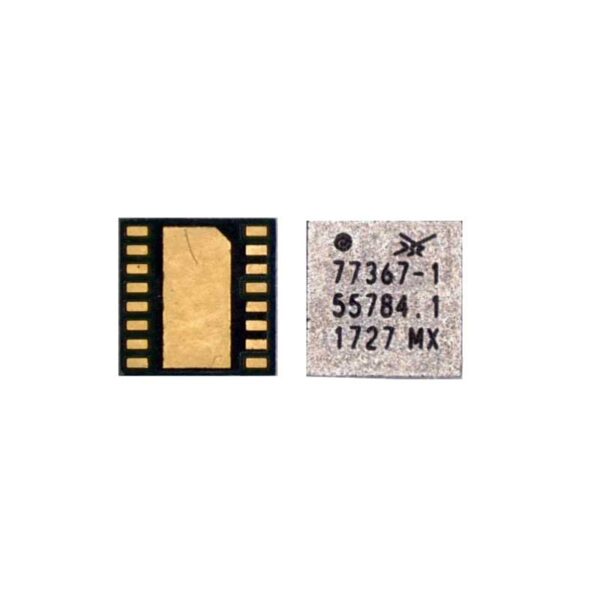
77367-1 Mobile Phone IC
Unveiling the 77367-1 Mobile Phone IC
The 77367-1 Mobile Phone IC represents a breakthrough in mobile device technology, offering exceptional performance, reliability, and seamless integration for modern smartphones. Designed to meet the rigorous demands of contemporary mobile devices, this integrated circuit comes equipped with cutting-edge features to ensure optimal functionality and user satisfaction.
Exceptional Features and Capabilities
At the heart of the 77367-1 Mobile Phone IC is its advanced processing power and energy efficiency. Thanks to innovative engineering, this IC enhances device performance while optimizing power consumption—a critical factor for both smartphone usage and longevity. It is compatible with a wide range of devices and supports faster data transmission, lower latency, and robust signal management, ensuring your smartphone operates smoothly even under heavy workloads.
Its compact design allows effortless integration into modern slimline devices, making it an ideal fit for manufacturers prioritizing lightweight and streamlined builds. The 77367-1 is equipped to handle high-speed interconnectivity, enhancing the user’s mobile experience across communication, gaming, streaming, and multitasking.
Applications and Benefits
The 77367-1 Mobile Phone IC serves as a critical component in mobile device manufacturing, supporting everything from communication to app execution. Whether you are a consumer looking for upgraded performance or an OEM searching for efficient components, this IC is tailored to meet diverse needs. This versatile integrated circuit is perfect for those seeking high reliability and consistent results in their devices.
Investing in the 77367-1 ensures powerful, future-ready technology capable of enabling next-generation mobile experiences. Its ability to streamline smartphone operations and improve device responsiveness directly contributes to elevated performance and user satisfaction.
The 77367-1 Mobile Phone IC is truly a standout solution for modern mobile technologies, driving innovation while focusing on efficiency, reliability, and connectivity.
The 77367-1 is a specialized high-performance Power Amplifier Module (PAM) commonly integrated into the Radio Frequency (RF) front-end of high-end smartphones.1 It is a critical component that bridges the gap between the phone’s internal logic and the outside world by boosting low-power communication signals to levels strong enough to reach cellular base stations.
Technical Architecture and Integration
The 77367-1 is built as a Multi-Chip Module (MCM), specifically optimized for space-constrained environments. In modern mobile design, particularly within the iPhone 7, 8, and X series, space on the motherboard is at a premium. This IC integrates several stages of amplification and switching into a single, compact surface-mount package.
-
Amplification Stages: The module typically contains multiple amplification paths using Gallium Arsenide (GaAs) Heterojunction Bipolar Transistor (HBT) technology. This material is preferred over standard silicon for RF because it can handle high frequencies with significantly better power efficiency and lower heat generation.
-
Front-End Management: It acts as a “Front-End” module, meaning it is one of the final components the signal passes through before hitting the antenna.2 It handles the transmission and reception across various bands, often supporting GSM, WCDMA, and LTE protocols.3
Key Specifications and Features
The 77367-1 is designed for reliability and high data throughput. Its core specifications include:
-
Frequency Coverage: It is a multi-band component, meaning it is engineered to function across different global frequencies (Low Band and High Band).4
-
MIPI RFFE Control: The IC is controlled via the MIPI RFFE (Radio Frequency Front End) digital interface. This allows the phone’s CPU to instantly adjust the amplifier’s gain and power mode based on how far the user is from the nearest cell tower, which is vital for saving battery life.
-
Power Output: In peak conditions, it is rated for high efficiency to ensure that the maximum amount of energy is converted into signal strength rather than wasted as heat.
-
Matching Networks: All input and output ports are internally matched to 50 $\Omega$. This simplifies the PCB design, as hardware engineers don’t need to add as many external capacitors or inductors to “tune” the signal path.
Common Failure Symptoms
Because the 77367-1 handles high electrical current and creates thermal stress, it is a common point of failure. Mobile technicians often replace this IC when a device exhibits the following issues:
-
“No Service” or Constant “Searching”: The phone can detect a network but cannot transmit a signal strong enough to register with the carrier.
-
Short Circuits: Since the 77367-1 is connected directly to the VBATT or VCC_MAIN power lines, a failed chip can short the entire board, preventing the phone from turning on.
-
Signal Fluctuation: The phone may show 4 bars of signal one moment and “No Service” the next, indicating that the amplifier is failing to maintain stable output.
Repair and Maintenance
Replacing the 77367-1 is a precision task involving microsoldering. Technicians must use a hot air station set to approximately 350°C–380°C to desolder the chip without damaging the sensitive layers of the PCB. Proper alignment is crucial, as even a slight shift during the soldering process can bridge the tiny pins underneath, causing a permanent short.
More Products : https://gaffarmarketdelhi.com