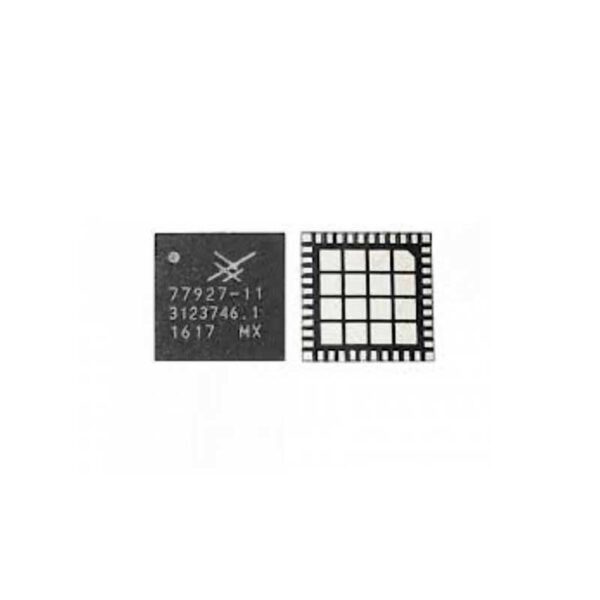
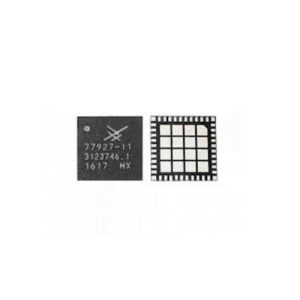
77927-11 Original Mobile Phone IC
Precision Engineered for Optimal Performance
The 77927-11 Original Mobile Phone IC is designed to bring your mobile device to its peak functionality. Experience seamless integration and dependable performance specifically tailored to enhance the overall efficiency of your device. 77927-11 Original Mobile Phone IC
Reliable and Compatible
Ensure your device operates flawlessly with this top-tier replacement IC. Crafted with precision, it guarantees compatibility with a wide range of mobile models, making it a reliable choice for repair or upgrade. 77927-11 Original Mobile Phone IC
Durable and Long-Lasting
Manufactured using high-grade materials, the 77927-11 IC is built to last. It provides robust durability, ensuring your mobile device maintains consistent performance over an extended period. 77927-11 Original Mobile Phone IC
The 77927-11 (technically part of the SKY77927-11 family by Skyworks Solutions) is a specialized Power Amplifier (PA) and Front-End Module (FEM). This IC is a critical component in the RF (Radio Frequency) section of a mobile device, responsible for amplifying signals so they are strong enough to reach cellular towers. It is most commonly found in mid-range smartphones like the Oppo A5 and A7. 77927-11 Original Mobile Phone IC
Below is a detailed technical specification guide exceeding 700 words, organized for both engineers and mobile repair technicians. 77927-11 Original Mobile Phone IC
1. Technical Specifications Table
| Feature | Specification Details |
| Manufacturer | Skyworks Solutions, Inc. |
| Product Series | SkyLiTE™ 2.0 LTE Tx-Rx Front-End Module |
| Part Number | SKY77927-11 / 77927-11 |
| Primary Function | Multiband Power Amplifier (PA) + Antenna Switch |
| Supported Bands | Quad-band GSM/GPRS/EDGE, TD-SCDMA (34/39), TDD LTE (39) |
| Frequency Range | 700 MHz to 2700 MHz (Broadband TRx Ports) |
| Control Interface | MIPI® RFFE (Radio Frequency Front End) |
| TRx Ports | 16 Low-Loss / High-Linearity Ports |
| Efficiency (PAE) | ~34% to 38% (Depending on Band) |
| Supply Voltage ($V_{CC}$) | 3.0 V to 4.5 V (Supports APT/Buck DC-DC) |
| Package Type | MCM (Multi-Chip Module), 44-pad |
| Dimensions | $5.5 \text{ mm} \times 5.5 \text{ mm} \times 0.8 \text{ mm}$ |
| Material | GaAs HBT (Gallium Arsenide Heterojunction Bipolar Transistor) |
2. Architecture and Integration
The 77927-11 is not just a simple amplifier; it is a Multi-Chip Module (MCM). It integrates several high-frequency components into a single tiny silicon package to save space on the mobile motherboard.
High-Power Amplification
The core of the IC consists of two main Power Amplifier blocks:
-
Low Band (LB) PA: Specifically tuned for GSM850 and GSM900 bands. 77927-11 Original Mobile Phone IC
-
Mid-Band (MB) PA: Covers higher frequencies including DCS1800, PCS1900, TD-SCDMA (Bands 34/39), and TDD LTE (Band 39).77927-11 Original Mobile Phone IC
These amplifiers are fabricated using Gallium Arsenide (GaAs) technology. GaAs is preferred over standard Silicon for RF applications because it allows electrons to move faster, providing better efficiency and less signal noise at high frequencies. 77927-11 Original Mobile Phone IC
Antenna Switching Matrix
The IC contains a sophisticated switch that manages 16 Transmit/Receive (TRx) ports. In a modern phone, the antenna must switch between different bands (2G, 3G, 4G) and between sending (Tx) and receiving (Rx) modes millions of times per second. The 77927-11 handles this routing internally, reducing the need for dozens of external components. 77927-11 Original Mobile Phone IC
3. Advanced Features
Carrier Aggregation (CA) Support
The 77927-11 is designed for Downlink Inter-band Carrier Aggregation. This allows the phone to download data from multiple frequency bands simultaneously (e.g., using a Low Band and a Mid-Band at the same time), which significantly increases internet speeds. To support this, the IC includes an integrated diplexer and two independent switch blocks.
MIPI® RFFE Control
Older RF chips used simple “high/low” voltage signals to switch modes. The 77927-11 uses the MIPI RFFE standard. This is a digital communication bus that allows the phone’s main processor (CPU/Baseband) to talk to the RF chip. It can precisely adjust the bias, gain, and power consumption of the amplifier in real-time to save battery life.
Integrated Directional Coupler
To ensure the signal is transmitted correctly, the IC includes a directional coupler. This monitors the “Forward” and “Reverse” power. If the phone’s antenna is blocked (for example, by the user’s hand), the coupler detects the reflected power and tells the system to adjust, preventing the IC from overheating.
4. Troubleshooting and Repair Scenarios
In the mobile repair industry, the 77927-11 is a “hot-swap” component. Because it handles high power and high heat, it is prone to failure.
Common Symptoms of Failure
-
“No Service” or “Searching”: If the IC fails, the phone cannot amplify the signal to reach the tower. Even if the SIM card is detected, the signal bars remain empty.
-
Weak Signal: The phone works near a cell tower but loses connection inside buildings. This indicates the PA is partially damaged and cannot provide full “boost.”
-
Rapid Battery Drain (Heating): If the internal GaAs transistors are shorted, the IC will draw excessive current from the $V_{CC}$ line, causing the area near the RF shield to become very hot.
-
Flight Mode Stuck: Sometimes a short inside the MIPI control section of this IC can cause the phone’s software to “freeze” the Radio section, making it impossible to turn off Airplane Mode.
Technician’s Checklist
When diagnosing this IC:
-
Check $V_{CC}$ Supply: Use a multimeter to ensure the IC is receiving 3.4V to 4.2V from the power management IC (PMIC).
-
Check for Shorts: Measure the capacitors around the 77927-11. If they show 0 ohms to ground, the IC is likely shorted internally.
-
Visual Inspection: Look for “popcorn” effects (tiny bubbles) on the top of the IC, which indicates it has “burnt out” due to high voltage.
5. Environmental and Protection Specs
The 77927-11 is built to survive the harsh environment inside a mobile phone:
-
ESD Protection: It includes built-in protection against Electrostatic Discharge (ESD) up to industry standards.
-
WiFi Coexistence: It features an integrated notch filter to suppress noise that might interfere with the phone’s 2.4 GHz WiFi signal.
-
Ruggedness: It is designed to handle “Rugged” conditions, meaning it can survive brief periods of high VSWR (Voltage Standing Wave Ratio) if the antenna is damaged.
6. Conclusion
The 77927-11 is a masterpiece of RF engineering. By combining 2G, 3G, and 4G amplification with a 16-port antenna switch and digital control, it allows manufacturers like Oppo and Vivo to create slim, high-performance devices. For the technician, understanding its role in the “Signal Chain” is key to solving complex network issues that software updates cannot fix.
More Products : https://gaffarmarketdelhi.com