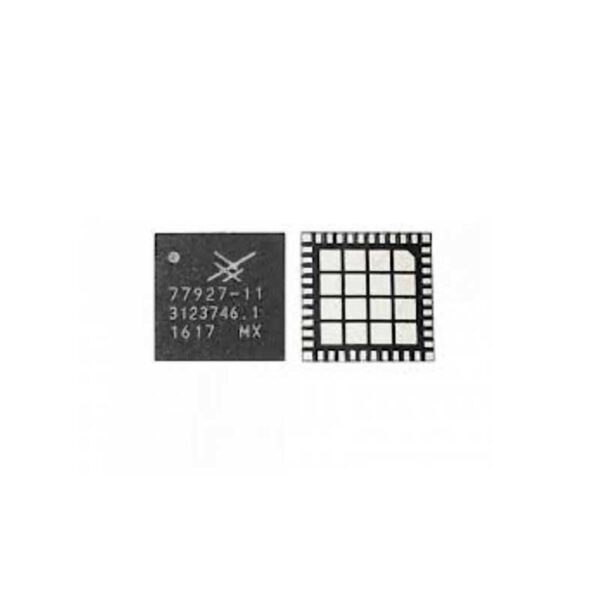
77928-11 Mobile Phone IC
Unparalleled Performance and Efficiency
The 77928-11 Mobile Phone IC is designed to deliver exceptional efficiency and performance for modern mobile devices. Built with advanced technology, it ensures seamless operation and smarter energy utilization while meeting the industry’s highest standards. 77928-11 Mobile Phone IC
Optimized for Modern Mobile Applications
Whether you’re developing cutting-edge smartphones or looking for a dependable component for your devices, the 77928-11 IC stands out. It supports high-speed processing and ensures consistent performance even under demanding conditions. Perfect for both flagship and mid-tier mobile devices. 77928-11 Mobile Phone IC
Durable and Industry-Standard Design
Crafted with precision, the 77928-11 Mobile Phone IC is durable and reliable, meeting the strict requirements of electronic hardware. Its compact build makes it a versatile choice for modern device designs, ensuring compatibility across various platforms. 77928-11 Mobile Phone IC
The SKY77928-11, part of the SkyLiTE™ family by Skyworks Solutions, is a highly sophisticated Tx-Rx Front-End Module (FEM). In the world of mobile repair and smartphone engineering, this IC is the “traffic controller” for cellular signals, managing how your phone talks to cell towers across 2G, 3G, and 4G LTE networks. 77928-11 Mobile Phone IC
Below is the detailed technical specification and analysis of the 77928-11 IC. 77928-11 Mobile Phone IC
Technical Specifications Table
| Parameter | Specification Details |
| Manufacturer | Skyworks Solutions, Inc. |
| IC Type | Transmit-Receive (Tx-Rx) Front-End Module (FEM) |
| Supported Generations | 2G (GSM/EDGE), 3G (TD-SCDMA), 4G (TDD-LTE) |
| Frequency Bands | Quad-Band GSM (850/900/1800/1900), LTE Band 39 |
| TRx Switch Ports | 16 Linear Ports (High isolation/Low loss) |
| Antenna Support | Dual Antenna (Supports Downlink Carrier Aggregation) |
| Control Interface | MIPI® RFFE (Radio Frequency Front End) |
| Technology | GaAs HBT (Gallium Arsenide Heterojunction Bipolar Transistor) |
| Operating Voltage | 2.5 V to 5.0 V (Compatible with APT/Buck DC-DC) |
| Package Type | 44-pad MCM (Multi-Chip Module) |
| Dimensions | 5.5 mm x 5.5 mm x 0.8 mm (Max) |
| Efficiency (PAE) | ~34% to 38% depending on the band |
Architecture and Internal Components
The 77928-11 is not a single transistor but a complex system-in-package. It integrates several critical RF (Radio Frequency) components into one tiny square:
1. Power Amplifier (PA) Blocks
The module contains two primary Power Amplifiers fabricated using Gallium Arsenide (GaAs).
-
Low-Band (LB) PA: Handles GSM850 and GSM900.
-
Mid-Band (MB) PA: Handles DCS1800, PCS1900, TD-SCDMA (Bands 34/39), and TDD-LTE Band 39.
2. Antenna Switch Matrix
With 16 TRx ports, this IC allows the phone to switch between different frequency bands and antennas instantly. This is vital for Carrier Aggregation (CA), where the phone combines multiple frequencies to provide faster 4G data speeds.
3. CMOS Controller
A built-in silicon CMOS die acts as the brain, providing precision biasing for the GaAs amplifiers and decoding the MIPI RFFE commands sent by the phone’s main CPU/Modem.
Key Features for Mobile Performance
-
Average Power Tracking (APT): The IC is optimized to work with the phone’s power management system to reduce battery consumption by adjusting the voltage based on the required signal strength.
-
WiFi Coexistence: It features a built-in “notch filter” to suppress noise, ensuring that cellular transmissions do not interfere with the phone’s WiFi or Bluetooth signals.
-
ESD Protection: Built-in antenna protection prevents static electricity (from the user’s hands or environment) from frying the sensitive internal circuits.
-
Internal Matching: All RF ports are internally matched to 50 Ω, which simplifies the motherboard design for manufacturers like Oppo, Vivo, and Xiaomi.
Troubleshooting and Repair Insights
In mobile service centers, the 77928-11 is frequently replaced to solve “Network Signal” issues. Because this IC sits between the transceiver and the antenna, its failure is catastrophic for connectivity.
Common Failure Symptoms:
-
No Service / No Network: The phone fails to register on any network even with a valid SIM card.
-
Weak Signal: The phone only shows 1 bar of signal or only works when standing very close to a cell tower.
-
No 4G/LTE: The phone works on 2G (calling) but data (LTE) fails to connect.
-
Signal Jumping: The network bars fluctuate wildly or the phone frequently displays “Emergency Calls Only.”
-
Overheating: The area near the CPU/RF section gets extremely hot during a phone call or while using mobile data.
Repairman’s Checklist:
-
Voltage Check: Check for VCC (around $3.4\text{V}$ to $4.2\text{V}$) on the capacitors surrounding the IC.
-
MIPI Bus: If the modem cannot communicate with the IC via the MIPI SCL/SDA lines, the network will remain “Searching.”
-
Short Circuit: Use a multimeter in “Diode Mode” to check for shorts on the VCC_PA line. If a short is found, the 77928-11 is often the culprit.
Market Compatibility
The 77928-11 is widely used in mid-range smartphones, particularly those powered by Qualcomm Snapdragon or MediaTek chipsets. It is a common component in:
-
Oppo: A5, A7, and F-series models. 77928-11 Mobile Phone IC
-
Vivo: V-series and Y-series models.77928-11 Mobile Phone IC
-
Xiaomi: Various Redmi Note models. 77928-11 Mobile Phone IC
Conclusion
The Skyworks 77928-11 is a masterpiece of RF engineering, condensing a full quad-band transmission system into a $5.5\text{ mm}$ footprint. Its ability to manage 16 different paths while maintaining high efficiency makes it essential for modern 4G connectivity. For technicians, identifying this IC correctly is the first step in solving complex network-related motherboard faults.77928-11 Mobile Phone IC
More products : https://gaffarmarketdelhi.com