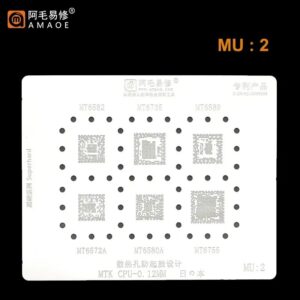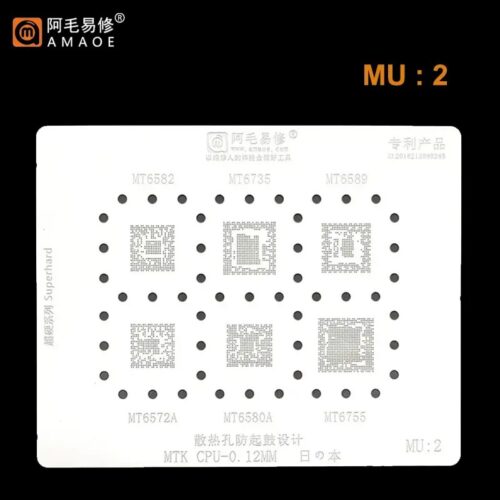
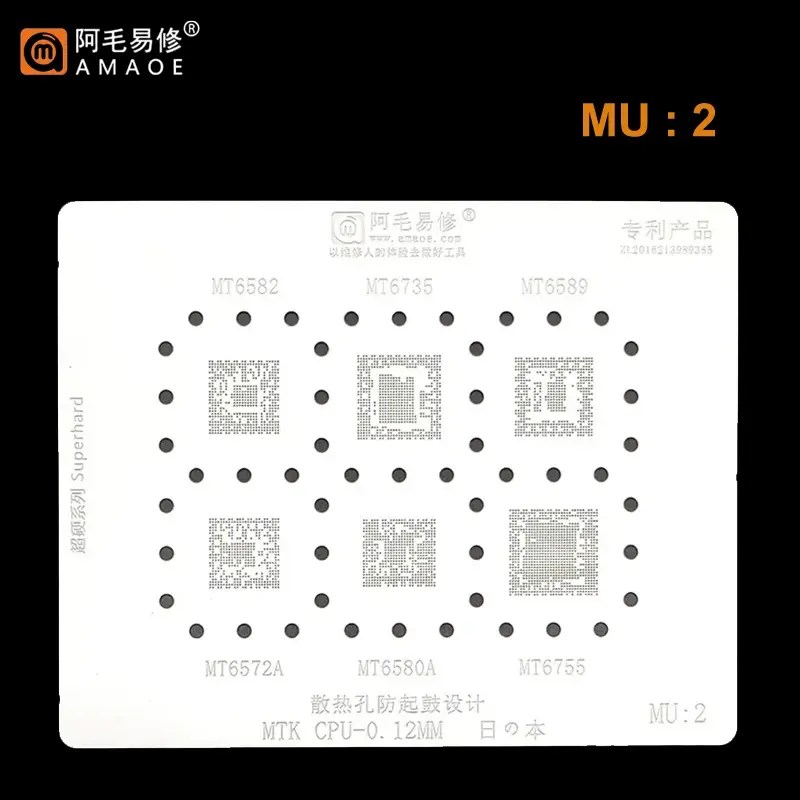
Amaoe MU2 BGA Reballing Stencil-Original
High-Quality Reballing Made Easy
The Amaoe MU2 BGA Reballing Stencil-Original is the perfect solution for achieving precise and accurate reballing results. Designed with premium-quality materials, this stencil offers durability and ensures optimal performance for both professionals and hobbyists. Amaoe MU2 BGA Reballing Stencil-Original
Compatible and Versatile
Engineered to cater to a wide range of soldering needs, the Amaoe MU2 is compatible with numerous BGA ICs, making it a versatile addition to your toolkit. Whether you’re repairing or customizing electronic components, this stencil simplifies complex tasks. Amaoe MU2 BGA Reballing Stencil-Original
Durable and Easy to Use
Built to last, the Amaoe MU2 BGA Reballing Stencil is resistant to wear and tear, providing consistent results over time. Its user-friendly design ensures a seamless application process, saving you both time and effort. Amaoe MU2 BGA Reballing Stencil-Original
The Amaoe MU2 BGA Reballing Stencil is a cornerstone tool for professional micro-soldering technicians, specifically those specializing in Android device repairs. Amaoe has built a reputation for high-precision stencils that mitigate the common “warping” issues found in cheaper alternatives. Amaoe MU2 BGA Reballing Stencil-Original
The MU2 is a “Universal” series stencil, though “universal” in this context refers to a specific set of high-demand MTK (MediaTek) and Qualcomm ICs rather than a generic grid. Amaoe MU2 BGA Reballing Stencil-Original
Key Technical Specifications
| Feature | Specification Details |
| Manufacturer | Amaoe (High-Precision Series) |
| Model Number | MU2 (MediaTek/Universal Series 2) |
| Material | Japanese Imported High-Quality Steel |
| Stencil Thickness | 0.12mm (Standard for precision BGA) |
| Hole Type | Square Holes with Rounded Corners (Anti-stuck) |
| Heat Resistance | High thermal stability; resists bulging/warping |
| Compatibility | MediaTek CPU, Power ICs, and EMMC/EMCP chips |
| Alignment | CNC Laser-cut precision for 1:1 pad matching |
In-Depth Component Support
The MU2 stencil is particularly valued because it covers a broad range of integrated circuits (ICs) found in mid-to-high-range smartphones (Xiaomi, Oppo, Vivo, etc.). Below is a breakdown of the specific chips typically supported on this plate: Amaoe MU2 BGA Reballing Stencil-Original
1. CPU & Processor Support
The stencil includes dedicated areas for popular MediaTek processors. These require extreme precision due to the high pin count and tight pitch.
-
MT6755V
-
MT6750V
-
MT6735V
-
MT6753V
2. Power Management (PMIC)
Power ICs are the most frequently replaced components after water damage or charging surges. The MU2 covers:
-
MT6353P / MT6351P
-
MT6328V / MT6350V
3. Memory & Storage (BGA Variations)
The MU2 is often used for “sandwich” reballing or memory swaps. It supports various BGA patterns including:
-
BGA 221
-
BGA 153
-
BGA 254 (Depending on the specific MU2 revision)
Design Excellence: Why Technicians Choose MU2
The “Original” Amaoe stencils utilize a proprietary manufacturing process that addresses three major pain points in BGA reballing:
1. The “Anti-Bulge” Design
Cheap stencils expand unevenly when hit with a heat gun (typically at $330°C$ to $350°C$). This causes the stencil to bow upward, allowing solder paste to bridge between pins. The MU2 uses a specific grade of Japanese steel that maintains flatness under localized heat. Amaoe MU2 BGA Reballing Stencil-Original
2. Square Holes with Rounded Corners
If a stencil hole is a sharp square, the solder ball often gets stuck inside the stencil when you try to lift it. Amaoe uses laser-cut square holes with microscopic internal chamfering and rounded corners. This ensures the solder balls stay on the chip pads, not in the stencil. Amaoe MU2 BGA Reballing Stencil-Original
3. Heat Dissipation Vents
If you look closely at an original MU2, you will notice small “non-functional” laser cuts or dimples in areas without chips. These act as expansion joints, allowing the metal to breathe without distorting the critical alignment areas. Amaoe MU2 BGA Reballing Stencil-Original
Best Practices for Using the MU2 Stencil
To maximize the lifespan of your Amaoe stencil and ensure a 100% success rate on the first “swing,” follow these professional guidelines:
-
Cleaning: Always clean the stencil with Mechanic 850 or 99% Isopropyl Alcohol (IPA) before use. Even a microscopic speck of old flux will cause a solder ball to stick.
-
Paste Consistency: Use a “dry” solder paste (183°C Lead-Saturated). If your paste is too oily, dab it on a lint-free cloth first to remove excess flux.
-
Thermal Management: Use a nozzle that covers the entire chip area. For the 0.12mm MU2, a temperature of $340°C$ with a low airflow (3 or 4 on most stations) is the “sweet spot” to prevent the stencil from dancing.
-
Pressure: Use curved tweezers to hold the stencil down at the edges of the IC, never in the center, to avoid creating a concave dip.
Summary of Advantages
-
Precision: $0.12mm$ thickness is the industry gold standard for balance between durability and ease of solder melting.
-
Efficiency: Multiple IC footprints on one plate reduce the need for a massive library of single-chip stencils.
-
Durability: Unlike “black” stencils that can flake, the MU2’s polished steel finish is rust-resistant and handles thousands of heat cycles.
Note: Beware of “A-grade” or “AAA” clones. Genuine Amaoe stencils feature the distinct etched logo and holographic packaging. The clones often use 0.1mm steel which warps instantly under heat. Amaoe MU2 BGA Reballing Stencil-Original
More Products : https://gaffarmarketdelhi.com