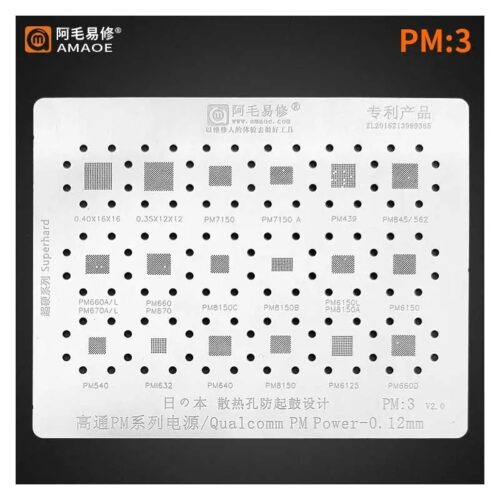
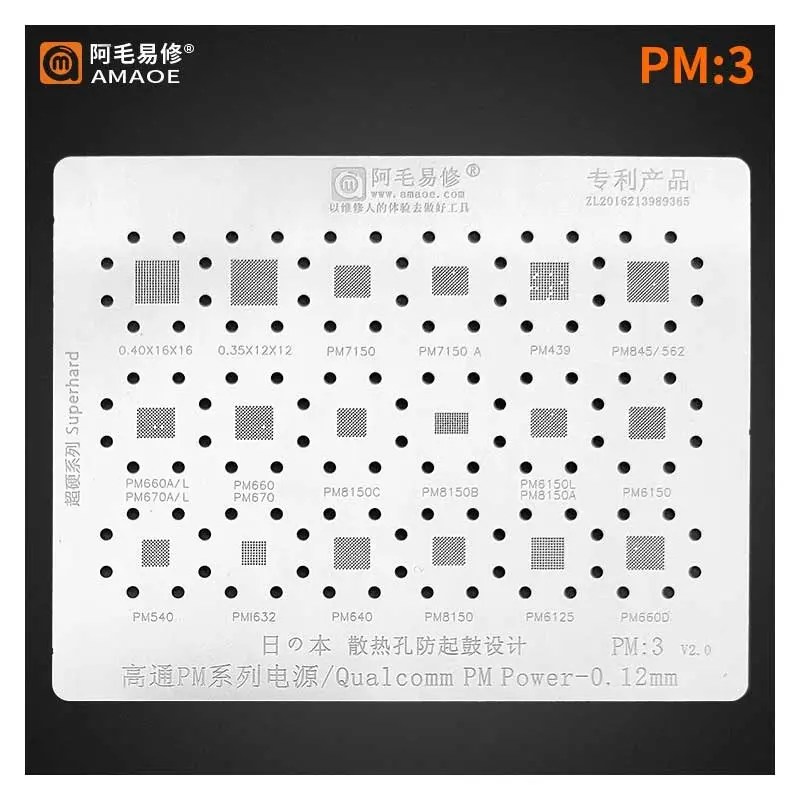
Amaoe PM3 BGA Reballing Stencil-Original
The Amaoe PM3 BGA Reballing Stencil-Original is the ultimate solution for professionals seeking precision and reliability in microelectronic repairs. Designed for high-performance, this original stencil ensures compatibility with various BGA chips and offers unmatched durability. Amaoe PM3 BGA Reballing Stencil-Original
Premium Design and Build
Crafted from high-grade materials, the Amaoe PM3 provides excellent resistance to deformation and heat. Its precisely aligned stencil apertures ensure smooth reballing processes, making it an essential tool for technicians working on chip-level repairs. Amaoe PM3 BGA Reballing Stencil-Original
Versatility for Multiple Applications
Whether you’re working on laptops, mobile phones, or advanced circuit boards, this stencil adapts seamlessly to your needs. It supports an extensive range of BGA configurations, enhancing productivity and accuracy in professional tasks. Amaoe PM3 BGA Reballing Stencil-Original
Why Choose the Amaoe PM3?
The original design offers guaranteed quality, backed by trusted performance. Its easy-to-use format saves time, while the robust construction ensures longevity, making it a reliable choice for technical experts and repair enthusiasts alike. Amaoe PM3 BGA Reballing Stencil-Original
The Amaoe PM3 BGA Reballing Stencil is a staple in the toolkit of professional micro-soldering technicians and smartphone repair experts. Specifically designed for power management integrated circuits (PMICs) and secondary logic chips, the PM3 is part of Amaoe’s renowned “Original” series, known for high-precision laser-cut apertures and thermal stability. Amaoe PM3 BGA Reballing Stencil-Original
Below is a comprehensive breakdown of the specifications, design features, and compatibility for this stencil. Amaoe PM3 BGA Reballing Stencil-Original
Technical Specifications: Amaoe PM3
| Feature | Specification Details |
| Model Name | Amaoe PM3 (Power Management Series 3) |
| Material | High-Grade Imported Japanese Steel |
| Manufacturing Process | High-Precision Laser Cutting |
| Thickness | 0.12mm (Standardized for uniform solder paste distribution) |
| Hole Type | Square holes with rounded corners (Anti-stuck design) |
| Heat Resistance | Up to 450°C – 500°C (Optimized for lead-free solder) |
| Compatibility | Universal PMIC, Audio ICs, and Charging ICs |
| Series | Middle-Layer/Component Level Repair |
| Alignment | Optical-grade transparency for manual alignment |
Key Design Characteristics
1. Square-Hole Technology
Unlike cheaper stencils that use circular drills, the Amaoe PM3 features square holes with rounded internal corners. This design is critical for two reasons:
-
Release: It prevents the solder paste from sticking to the stencil when you lift it.
-
Uniformity: It ensures that every BGA ball is the exact same volume, preventing shorts or “dry” joints during the reflow process. Amaoe PM3 BGA Reballing Stencil-Original
2. Thermal Expansion Control
One of the biggest headaches in reballing is “stencil bulging.” When heat is applied, metal expands. The PM3 uses a specific grade of stainless steel that has a low coefficient of thermal expansion. This means the stencil stays flat against the chip even when hit with $350^\circ C$ of air from a quick-heat rework station. Amaoe PM3 BGA Reballing Stencil-Original
3. Precision Thickness ($0.12mm$)
The thickness of a stencil determines the height of the resulting solder ball. At $0.12mm$, the PM3 strikes a balance between providing enough structural integrity to resist warping and ensuring the solder balls are high enough to bridge the gap between the IC and the PCB without being so large that they bridge together.
Chipset Compatibility Matrix
The PM3 is specifically curated to cover a wide range of chips found in modern Android and iOS devices. While “PM” stands for Power Management, this stencil is a “multi-purpose” layout.
| IC Category | Common Models Supported |
| Power Management (PMIC) | PM8916, PM8994, PMI8994, PM8909 |
| Audio Codecs | WCD9335, WCD9330, WCD9326 |
| Charging ICs | SMB1350, SMB1357, SMB1360 |
| Secondary Logic | Various 0.35mm to 0.5mm pitch controllers |
Usage Best Practices for Amaoe PM3
To get the most out of an original Amaoe stencil, the following workflow is recommended by master technicians:
-
Preparation: Clean the IC thoroughly using a soldering iron and wick until the pads are flat. Use isopropyl alcohol (99%) to ensure no flux residue remains.
-
Solder Paste Selection: Use a high-quality “Medium Temperature” ($183^\circ C$) or “Low Temperature” ($138^\circ C$) solder paste. Ensure the paste is slightly dry; if it is too runny, it will seep under the stencil and cause bridges.
-
The “Scrape”: Place the IC under the PM3, align the dots, and apply the paste in a single, firm swipe using a flat scraper.
-
Heat Application: Hold the stencil down with tweezers. Set your hot air station to approximately $300^\circ C$ to $330^\circ C$ with low airflow. Move the nozzle in circles to distribute heat evenly.
-
Cooling: Allow the stencil to cool for 5–10 seconds before lifting. This ensures the solder has solidified and won’t “smear.”
Why “Original” Matters
There are many “A-level” or “AAA” clones of Amaoe stencils on the market. However, the Original Amaoe PM3 is distinguished by its etched logo and the specific “burr-free” finish on the underside. A clone often has microscopic jagged edges inside the holes, which catch the solder balls and ruin the reballing attempt as you lift the plate.
More Products : https://gaffarmarketdelhi.com