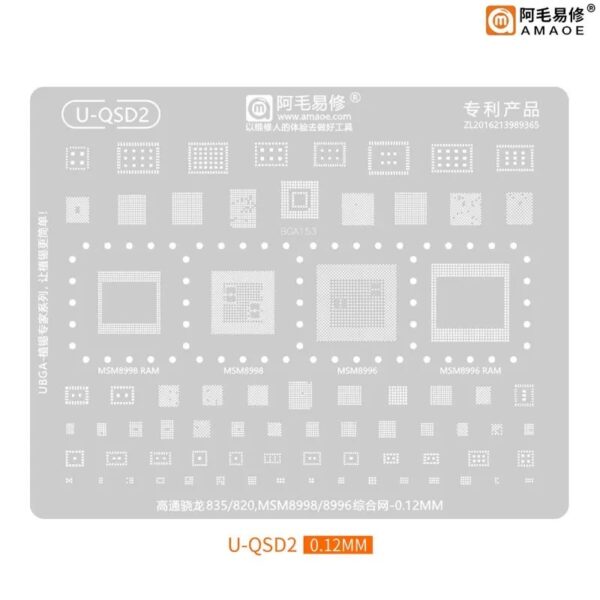
Amaoe U-QSD2 Stencil-Original
Unparalleled Accuracy for Your Projects
The Amaoe U-QSD2 Stencil-Original sets the standard for precision and reliability. Designed to meet the needs of professionals and hobbyists alike, this stencil ensures seamless application for crafting, repairs, and detailed designs. Built from high-quality materials, it delivers exceptional durability and lasting results. Amaoe U-QSD2 Stencil-Original
User-Friendly Design for Maximum Efficiency
Craft with confidence using the Amaoe U-QSD2 Stencil’s intuitive layout. Its ergonomic design simplifies intricate tasks, making it perfect for delicate soldering, micro-repair work, and detailed craftsmanship. Whether you’re handling a complex project or refining your skills, this stencil is tailored to assist you. Amaoe U-QSD2 Stencil-Original
Trusted Quality and Authenticity
Choose the Amaoe U-QSD2 Stencil for authenticity you can trust. This original stencil is a testament to professional-grade quality. Experience unmatched precision and enjoy peace of mind knowing you’re using a reliable, high-performing tool that meets the highest standards. Amaoe U-QSD2 Stencil-Original
The Amaoe U-QSD2 is a professional-grade BGA (Ball Grid Array) reballing stencil, specifically engineered for high-precision electronics repair. In the world of microsoldering, Amaoe is widely regarded as the industry standard due to its use of high-quality materials and “Square Hole” technology.
The U-QSD2 model is a specialized universal stencil designed primarily for high-end mobile processors and power management ICs, offering a balance between versatility and the rigid specs required for modern chipsets.
Technical Specifications: Amaoe U-QSD2
| Feature | Specification Details |
| Model Name | Amaoe U-QSD2 (Original Series) |
| Material | Japanese Imported High-Strength Stainless Steel |
| Hole Design | Precision Laser-Cut Square Holes (Anti-Bulge Design) |
| Thickness | $0.12\text{mm}$ (Standard Ultra-Thin) |
| Heat Resistance | High Thermal Stability (Resists warping up to $450\text{°C}$) |
| Edge Finish | Smooth, Bur-free Surface Treatment |
| Application | BGA Reballing for Qualcomm Snapdragon, RAM, and Power ICs |
| Compatibility | Universal patterns for various pitch sizes ($0.3\text{mm}$ to $0.5\text{mm}$) |
| Origin | Authentic Amaoe – Shenzhen, China |
Deep Dive: Why the U-QSD2 Stands Out
To understand why this specific stencil is a staple in repair labs, we need to look at the engineering choices that separate it from generic, cheaper alternatives.
1. The “Square Hole” Advantage
Most budget stencils use round holes. While easier to manufacture, round holes often lead to “solder bridging” or difficulty in releasing the chip once the solder paste has melted.
-
Release Mechanism: The square holes in the U-QSD2 have slightly tapered walls. This allows the solder balls to form perfectly and release from the stencil without sticking, which is the #1 cause of failed reballs.
-
Paste Consistency: Square corners hold the solder paste more securely during the initial “scraping” phase, ensuring each pad gets an identical volume of solder.
2. Material Science and Thermal Expansion
One of the most frustrating experiences in microsoldering is when a stencil “bows” or warps under heat. When the metal expands too quickly, it lifts off the chip, causing solder to run together underneath. Amaoe U-QSD2 Stencil-Original
-
Hardness: Amaoe uses a proprietary grade of stainless steel that maintains its flat profile even when hit with a $380\text{°C}$ air stream.
-
Elasticity: The U-QSD2 is flexible enough to be manipulated onto a chip but “snaps” back to its original flat state immediately.
3. Precision Laser Cutting
The holes in the U-QSD2 are not punched; they are laser-etched. This ensures that the walls of each aperture are smooth at a microscopic level. Rough walls in cheaper stencils act like “teeth” that grab the solder ball, leading to uneven ball heights across the chip. Amaoe U-QSD2 Stencil-Original
Practical Application Guide
The U-QSD2 is often used for “Universal” applications, meaning it isn’t limited to a single CPU. It is particularly effective for:
-
Android CPU Reballing: Excellent for Snapdragon 800-series chipsets where the pin density is extremely high.
-
DDR RAM Modules: Specifically LPDDR4 and LPDDR5 modules that require a $0.12\text{mm}$ thickness to ensure the balls aren’t too tall, which would interfere with the chip’s seating on the motherboard.
-
PMIC (Power Management): High-density power chips that often have a mix of ground pads and signal pads.
Maintenance Tips for Longevity
To ensure your U-QSD2 lasts for hundreds of reballs:
-
Cleaning: Use 99.9% Isopropyl Alcohol (IPA) and a soft-bristled brush. Never use a metal scraper to clean the holes, as this will burr the edges.
-
Storage: Keep the stencil in its original sleeve or a flat organizer. Even a slight “kink” in the $0.12\text{mm}$ steel can ruin its ability to sit flush.
-
Heat Management: While it is heat resistant, it’s best practice to pre-heat the chip and stencil gradually rather than blasting a cold stencil with maximum airflow.
Expert Note: If you find the solder balls are “popping” out during heating, ensure you are using a high-quality “No-Clean” solder paste with a $183\text{°C}$ melting point (Sn63/Pb37). The U-QSD2 is optimized for this specific paste consistency. Amaoe U-QSD2 Stencil-Original
Final Verdict
The Amaoe U-QSD2 is an investment in success rate. While you can find “Universal” stencils for a fraction of the price, the failure rate on high-density chips usually costs more in wasted time and damaged components than the cost of the original Amaoe tool. Its precision $0.12\text{mm}$ thickness is the “sweet spot” for modern mobile hardware repair. Amaoe U-QSD2 Stencil-Original

More Products : https://gaffarmarketdelhi.com
Follow us on https://www.instagram.com/gaffarmarketdelhi_official?igsh=MTM2cHM0Ynd4Z2tkNQ%3D%3D&utm_source=qr