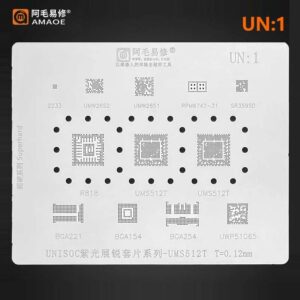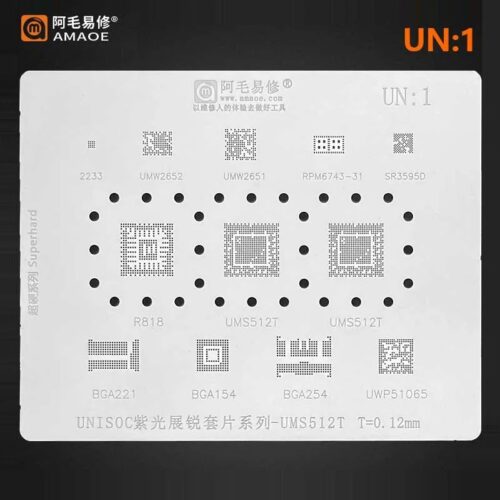
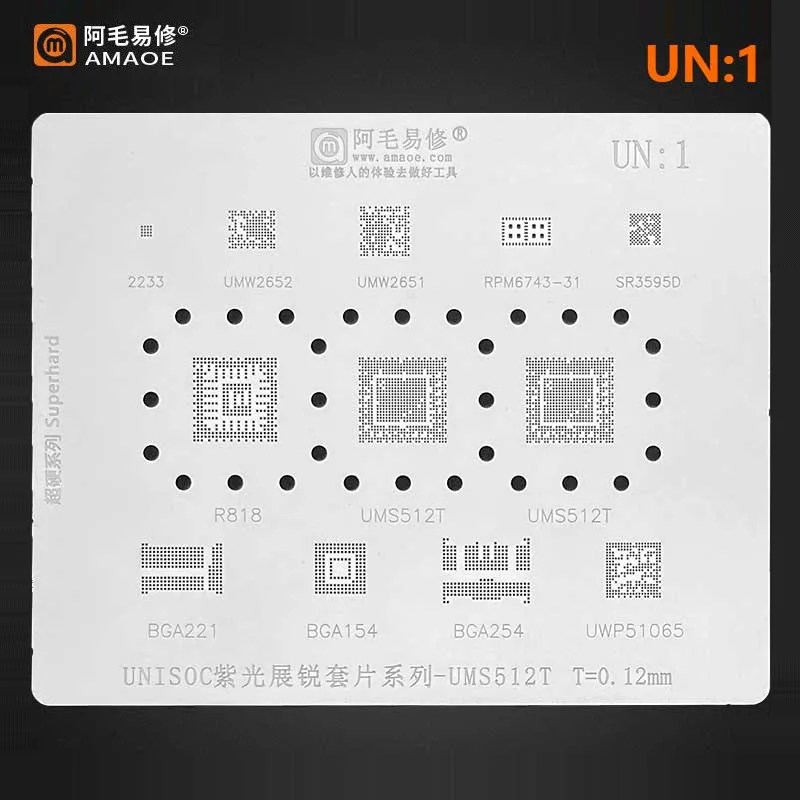
Amaoe UN1 BGA Reballing Stencil-Original
Elevate Your Reballing Precision
The Amaoe UN1 BGA Reballing Stencil-Original is your go-to solution for achieving unparalleled accuracy during BGA chip reballing. Designed for professionals and DIY enthusiasts alike, this tool ensures a seamless and efficient soldering process every time. Amaoe UN1 BGA Reballing Stencil-Original
Durable and Reliable Build
Crafted from high-quality materials, this stencil guarantees extended durability and consistent performance. Its precisely cut grid allows for easy alignment and minimal effort during assembly, making it perfect for detailed work on electronic components. Amaoe UN1 BGA Reballing Stencil-Original
Adaptable for Various Applications
Whether you’re repairing motherboards, mobile devices, or other intricate electronics, the Amaoe UN1 BGA Reballing Stencil fits various chip sizes and configurations with ease. Its universal design ensures compatibility, saving you time and enhancing productivity. Amaoe UN1 BGA Reballing Stencil-Original
The Amaoe UN1 BGA Reballing Stencil is a professional-grade precision tool specifically designed for the repair and maintenance of UNISOC (formerly Spreadtrum) chipsets. Known for its high-quality construction and “square hole” design, it is a staple in the toolkit of mobile motherboard repair technicians. Amaoe UN1 BGA Reballing Stencil-Original
Below are the comprehensive specifications and technical details for the Amaoe UN1 series. Amaoe UN1 BGA Reballing Stencil-Original
Technical Specifications Table
| Feature | Specification Details |
| Brand | Amaoe (Authentic/Original) |
| Model | UN1 (Unisoc Series 1) |
| Material | High-Grade Japanese Imported Stainless Steel |
| Stencil Thickness | 0.12mm (Ultra-thin for precise paste volume) |
| Aperture Type | Laser-cut Square Holes (Anti-stuck design) |
| Heat Resistance | High-temperature resistance (Prevents warping during reflow) |
| Compatibility | UNISOC / Spreadtrum CPUs and Power ICs |
| Support Chipsets | UMS512, UMS512T, UMW2651, UMW2652, SR3595D, etc. |
| Package Weight | Approximately 0.02kg |
| Dimensions | Standard BGA Repair Plate Size (Approx. 100mm x 80mm) |
Supported Chipset List
The UN1 stencil is a “comprehensive” plate, meaning it hosts multiple patterns for various components found in devices powered by Unisoc processors.
1. Central Processing Units (CPUs)
-
UMS512 / UMS512T: Commonly found in mid-range Android tablets and smartphones (e.g., Samsung Galaxy Tab A series).
-
UMS9230 / UMS9230H: High-performance Unisoc variants.
-
R818: Specialized SoC patterns.
2. Peripheral & Power ICs
-
UMW2651 / UMW2652: Wi-Fi and Bluetooth connectivity modules.
-
UWP51065 / UMP510G: Power Management ICs (PMICs).
-
RPM6743-31: Radio Frequency (RF) front-end modules.
-
SR3595D: Transceiver chips.
Key Features & Advantages
1. The “Square Hole” Innovation
Unlike cheaper stencils that use round holes, the Amaoe UN1 features CNC laser-cut square apertures. When solder paste is heated, it naturally forms a sphere. A square hole provides more space at the corners for the solder to release, significantly reducing the “stencil sticking” effect where the solder ball stays inside the hole when you lift the plate.
2. Precise 0.12mm Thickness
The thickness is mathematically calibrated to ensure that just enough solder paste is deposited.
-
Too thick: Causes solder bridging (short circuits).
-
Too thin: Results in “dry” joints (poor connectivity).
-
0.12mm: The industry standard for modern, densely packed mobile CPUs.
3. Thermal Stability
The Japanese steel used by Amaoe is designed to expand and contract uniformly. This prevents the “bulging” or “doming” effect that occurs when a stencil is heated directly with a hot air gun (350°C+).
Operational Best Practices
To get the most out of your original Amaoe UN1 stencil, follow these professional guidelines:
Preparation
-
Cleaning: Use 99% Isopropyl Alcohol (IPA) to clean the chip surface and the stencil. Any residue will cause uneven ball formation.
-
Alignment: Use a microscope to align the stencil holes with the BGA pads. The UN1 features etched markings to help center the chip.
Application
-
Solder Paste: Use high-quality 183°C (leaded) or 217°C (lead-free) solder paste. Ensure the paste is slightly dry; if it is too “liquidy,” it will bleed under the stencil and cause bridges.
-
Scraping: Apply the paste at a 45° angle using a clean spatula. One firm pass is usually better than multiple passes.
Reflow
-
Airflow: Set your hot air station to a low airflow (2-3 scale) to prevent the stencil from lifting or shifting.
-
Temperature: Hover at 300°C–330°C until the paste turns into shiny liquid balls.
Pro Tip: Always let the stencil cool for 5–10 seconds before lifting. This allows the solder balls to solidify and “grip” the chip pads, ensuring a 100% success rate on the first try.
More Products https://gaffarmarketdelhi.com
follow us on https://www.instagram.com/gaffarmarketdelhi_official?igsh=MTM2cHM0Ynd4Z2tkNQ%3D%3D&utm_source=qr