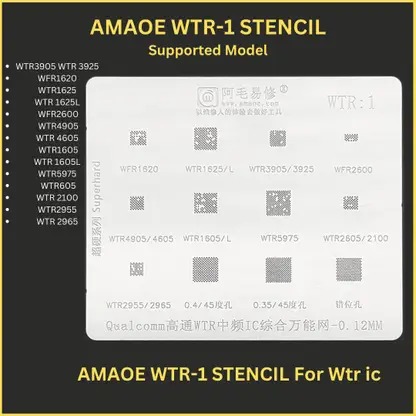
AMAOE WTR1 Stencil Original
Streamline Your Precision Work
The AMAOE WTR1 Stencil Original is specifically designed to bring accuracy and ease to your detailed projects. Whether you’re working on electronics, crafts, or other intricate tasks, this stencil offers the perfect blend of functionality and durability to meet your needs. AMAOE WTR1 Stencil Original
Durable and Long-Lasting
Built with high-quality materials, the AMAOE WTR1 Stencil ensures longevity, even with frequent use. It withstands wear and tear, making it a reliable tool for both professionals and hobbyists. Its robust design guarantees precise results every single time. AMAOE WTR1 Stencil Original
Versatility Meets Comfortable Use
From detailed soldering tasks to creative crafting, this stencil adapts to various applications with ease. Lightweight and easy to handle, it ensures a seamless workflow without causing strain. AMAOE WTR1 Stencil redefines convenience in precision-driven tasks. AMAOE WTR1 Stencil Original
Future-proof your projects with the AMAOE WTR1 Stencil—a tool you can rely on for unparalleled accuracy and steadiness. AMAOE WTR1 Stencil Original
The AMAOE WTR1 Stencil is a staple in the toolkit of any professional micro-soldering technician or mobile repair specialist. Known for high precision and heat resistance, this stencil is specifically designed for the reballing of WTR-series Radio Frequency (RF) ICs, which are critical components for signal processing in smartphones. AMAOE WTR1 Stencil Original
Below is a comprehensive breakdown of the specifications, material science, and application details for the Original AMAOE WTR1. AMAOE WTR1 Stencil Original
Technical Specifications: AMAOE WTR1 Stencil
| Feature | Specification Details |
| Brand | AMAOE (Original) |
| Model | WTR1 (RF IC Reballing Series) |
| Material | High-Grade Imported Japanese Steel |
| Thickness | 0.12mm (Standard High-Precision) |
| Hole Type | Square Holes with Rounded Corners (Anti-Stuck Design) |
| Heat Resistance | Up to 450°C (Anti-warping) |
| Supported ICs | WTR2965, WTR5975, WTR4905, WTR3925, WTR1605, etc. |
| Coating | Non-stick, Anti-oxidation finish |
| Application | BGA Reballing, Logic Board Repair, RF Signal Troubleshooting |
Deep Dive: Why the WTR1 Stencil Matters
1. Material Integrity
The “Original” AMAOE stencils are manufactured using premium steel that undergoes a specific tempering process. This ensures that when you apply high heat from a hot air station (typically between $320°C$ and $380°C$ for leaded or lead-free solder paste), the stencil maintains its structural flatness. Cheaper imitations often “bowl” or warp under heat, causing solder paste to bridge between pads.
2. Square Hole Technology
One of the distinct features of the WTR1 is the laser-cut square hole with chamfered edges.
-
Precision: Ensures the solder ball is perfectly centered on the IC pad.
-
Easy Release: The geometry prevents the solder paste from sticking to the walls of the stencil as you lift it away.
3. Comprehensive IC Support
The WTR1 is not a “one-chip” tool. It is a multi-cavity stencil that covers a wide array of Transceiver ICs found in iPhones, Samsungs, and various Android devices. These chips are notoriously sensitive; if the reballing isn’t perfect, the phone may suffer from “Searching…” or “No Service” issues.
Operational Guide: Best Practices
To get the most out of your AMAOE WTR1, follow these professional standards:
Preparation
-
Cleaning: Use 99% Isopropyl Alcohol (IPA) to ensure no old solder flux remains in the apertures.
-
Alignment: Use a microscope to ensure the IC pads are perfectly centered within the stencil holes.
The Reballing Process
-
Paste Application: Use a high-quality solder paste (e.g., $183°C$ Medium Temperature). Spread it evenly across the WTR1 apertures using a firm spatula.
-
Cleaning Excess: Wipe the surface of the stencil with a lint-free cloth so only the holes contain paste.
-
Heating: Apply heat evenly. Start with a lower airflow to prevent the stencil from vibrating or the paste from “skipping.“
-
Cooling: Allow the stencil to cool naturally for 5–10 seconds before attempting to pop the IC out.
Pro Tip: If the IC is stuck, do not force it. Apply a small drop of flux and a tiny bit of heat; the IC should slide out easily once the flux lubricates the spheres.
Maintenance and Longevity
The AMAOE WTR1 is built for hundreds of uses, but it is thin ($0.12mm$). To avoid damaging it:
-
Never use a metal scraper to clean the holes; use a soft-bristled brush.
-
Storage: Keep it in its original sleeve or a flat magnetic organizer to prevent accidental bending.
-
Residue: If flux burns onto the steel, soak it in a dedicated PCB ultrasonic cleaner for 2 minutes.
Summary of Benefits
-
Efficiency: Reduces the need for multiple reballing attempts.
-
Cost-Effective: A single WTR1 plate covers the most common RF chips in the market.
-
Reliability: Consistent solder ball height across the entire grid, which is vital for the flat-seating of RF chips.
More Products : https://gaffarmarketdelhi.com