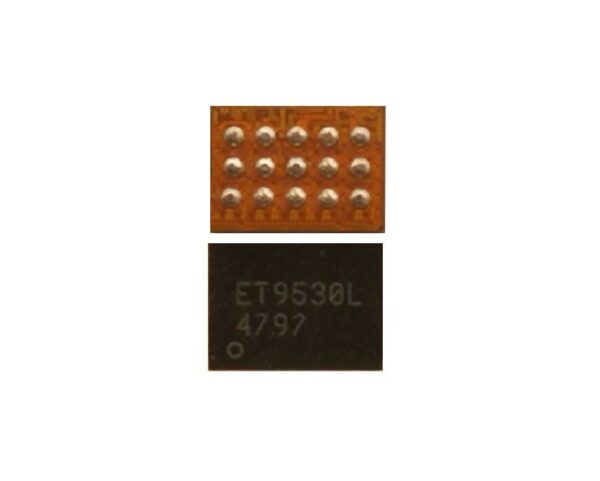
ET9530L Mobile Phone IC
Powerful and Efficient Design
The ET9530L Mobile Phone IC is engineered to boost your device performance with its advanced architecture and energy-efficient design. It enables seamless multitasking and improved functionality, setting a new standard for integrated circuit efficiency. ET9530L Mobile Phone IC
Reliable Performance for Modern Devices
Designed for next-generation mobile phones, the ET9530L IC ensures stable operation, even under heavy usage. Its cutting-edge technology supports high-speed processing and reduces power consumption, making it an ideal choice for your modern devices. ET9530L Mobile Phone IC
Quality That Matches Your Expectations
Built with precision and high-quality materials, the ET9530L Mobile Phone IC stands out as a trustworthy component for any mobile electronics project. It’s designed to deliver long-lasting performance and maintain the durability of your device. ET9530L Mobile Phone IC
The ET9530L is a specialized Integrated Circuit (IC) primarily utilized in the mobile telecommunications industry. Known predominantly as a Charging IC or Power Management IC (PMIC), it is a critical component for devices requiring precise voltage regulation and battery protection. ET9530L Mobile Phone IC
The ET9530L is most commonly found in Samsung’s mid-range “J” and “A” series (such as the Samsung J530F and J330), as well as some Xiaomi and Vivo models. Its primary role is to manage the flow of electricity from the USB port to the lithium-ion battery, ensuring the device charges safely and efficiently. ET9530L Mobile Phone IC
ET9530L Technical Specifications
Below is the detailed specification profile for the ET9530L IC. ET9530L Mobile Phone IC
1. General Characteristics
| Parameter | Specification |
| Model Name | ET9530L |
| Function | Charging Management / Power IC |
| Package Type | BGA (Ball Grid Array) |
| Pin Configuration | Typically 30-ball or 36-ball layout (varies by revision) |
| Material | Silicon-based semiconductor with high-grade molding |
| Operating Temperature | $0^{\circ}\text{C}$ to $100^{\circ}\text{C}$ |
| Storage Temperature | $-40^{\circ}\text{C}$ to $+125^{\circ}\text{C}$ |
2. Electrical Specifications
| Parameter | Value |
| Input Voltage (VBUS) | 4.5V to 6.5V (standard USB) |
| Over-Voltage Protection (OVP) | Typically triggers at >6.8V |
| Output Voltage (V_BAT) | Regulated 3.7V to 4.4V |
| Charging Current | Adjustable (Standard 500mA to 2A) |
| Efficiency | >90% during peak charging cycles |
| Low Power Mode | Supported for standby battery conservation |
Key Functions and Architecture
The ET9530L isn’t just a simple switch; it is a sophisticated regulator. Its architecture includes several sub-modules designed to protect the handset’s motherboard from electrical surges. ET9530L Mobile Phone IC
Core Functional Modules:
-
Over-Voltage Protection (OVP): If a faulty charger or a “dirty” power source provides a voltage spike, the ET9530L acts as a fuse, cutting off the circuit to prevent the CPU or EMMC from burning out.
-
Thermal Management: The IC monitors its own temperature. If the phone becomes too hot during fast charging, the ET9530L will “throttle” the current to lower the heat. ET9530L Mobile Phone IC
-
Battery Detection: It identifies the battery’s current state of charge (SoC) to decide whether to use Constant Current (CC) or Constant Voltage (CV) charging modes.
-
USB Interface Sensing: It detects whether the device is connected to a standard PC USB port or a high-speed Wall Adapter.
Device Compatibility List
The ET9530L is a “universal” part within certain manufacturer ecosystems. If you are a technician, you will find it in:
| Manufacturer | Primary Models |
| Samsung | Galaxy J5 (2017), J7 Pro (J730F), J3 Pro (J330), S7 Edge (G935F – regional variants) |
| Xiaomi | Certain Redmi 4/5 series variants |
| Oppo/Vivo | Various mid-range models utilizing ET-series power management |
Troubleshooting and Fault Symptoms
When an ET9530L IC fails, the mobile phone will typically exhibit specific behaviors. Because this IC sits between the charging port and the battery, it is often the first point of failure during a power surge.
Common Signs of a Faulty ET9530L:
-
Fake Charging: The phone shows the lightning bolt/charging icon, but the battery percentage does not increase or actually decreases.
-
No Power: The device won’t turn on even with a known-good battery, as the IC cannot pass power to the main PMIC.
-
Overheating: The area of the motherboard near the charging port or CPU becomes extremely hot immediately after plugging in a charger.
-
Slow Charging: The device takes 10+ hours to reach a full charge because the IC is stuck in a low-current state.
Repair and Installation Guidelines
Replacing the ET9530L requires professional-grade micro-soldering tools. Since it is a BGA (Ball Grid Array) chip, it cannot be soldered with a standard iron.
Note: This IC is moisture-sensitive. Ensure that replacement parts are kept in a dry environment and pre-heated if they have been exposed to humidity to prevent “popcorning” during the soldering process.
Required Tools:
-
Hot Air Rework Station (set to approx. $340^{\circ}\text{C}$ to $360^{\circ}\text{C}$)
-
High-quality BGA Flux (NC-559 or similar)
-
Solder Wick and Isopropyl Alcohol (for pad cleaning)
-
Microscope for alignment
Installation Step-by-Step:
-
Removal: Apply flux and heat the old IC evenly until it can be lifted without force.
-
Cleaning: Clear the old solder from the motherboard pads using a wick.
-
Reballing: If using a salvaged IC, ensure all solder balls are uniform. Most technicians prefer buying “New Original” chips that come pre-balled.
-
Alignment: Align the Pin 1 Marker (usually a small dot on the corner of the IC) with the indicator on the PCB.
-
Reflow: Heat until the IC “settles” into place via surface tension.
More Products : https://gaffarmarketdelhi.com