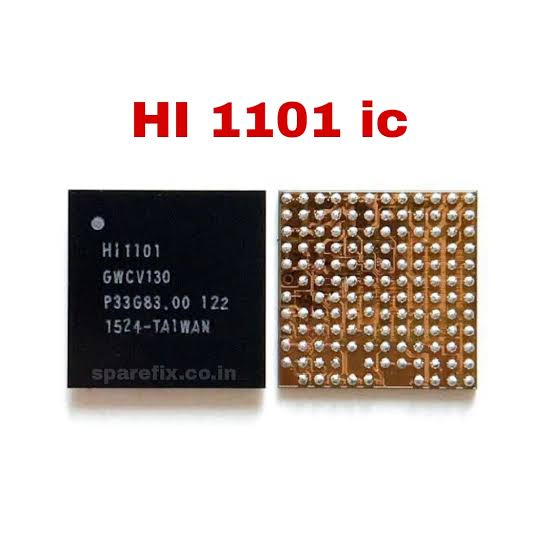
HI 1101 Mobile Phone IC
Enhanced Performance for Mobile Devices
The HI 1101 Mobile Phone IC is the perfect solution to elevate the performance of modern smartphones. Designed with precision, it ensures seamless functionality, maximizing efficiency across devices. HI 1101 Mobile Phone IC
Reliable and Durable Components
Built with high-quality materials, the HI 1101 IC is engineered for durability and reliability. Whether it’s powering advanced apps or managing complex tasks, this microchip guarantees consistent results every time. HI 1101 Mobile Phone IC
Compact Design with Powerful Integration
With its compact design, the HI 1101 Mobile Phone IC seamlessly integrates with various mobile architectures. Its innovative technology ensures smooth operation, making it a top choice for manufacturers aiming for excellence. HI 1101 Mobile Phone IC
The HI 1101 (often identified as the HiSilicon Hi1101) is a highly integrated connectivity chip developed by Huawei’s semiconductor division. It is primarily a “connectivity combo” chip, meaning it handles multiple wireless protocols—Wi-Fi, Bluetooth, and FM radio—all within a single silicon die. HI 1101 Mobile Phone IC
In the ecosystem of mobile hardware, this chip played a crucial role in providing high-speed data and stable connections for flagship and mid-range devices like the Huawei P8 and Mate series during their peak. HI 1101 Mobile Phone IC
Technical Overview: The Connectivity Hub
The HI 1101 was designed to minimize the physical footprint on the motherboard while maximizing power efficiency. By integrating various radios into one chip, manufacturers could save space for larger batteries or slimmer phone profiles. It typically works in tandem with a Kirin SoC (System on a Chip), which handles the heavy processing, while the HI 1101 manages the “invisible” wireless traffic. HI 1101 Mobile Phone IC
HI 1101 Detailed Specifications
| Feature | Specification Details |
| Manufacturer | HiSilicon (Huawei) |
| Model Name | Hi1101 |
| Type | Connectivity Combo IC (Integrated Circuit) |
| Wi-Fi Standards | 802.11 a/b/g/n (Dual-band support) |
| Wi-Fi Frequency | 2.4 GHz and 5.0 GHz |
| Bluetooth Version | Bluetooth 4.0 / 4.1 (Low Energy support) |
| FM Radio | Integrated FM Receiver/Transmitter |
| Process Node | 40nm / 28nm (Depending on revision) |
| Interface | SDIO 3.0 / UART / PCM |
| Package Type | WLCSP (Wafer Level Chip Scale Package) |
| MIMO Support | Single-stream (SISO) / Basic Diversity |
| Power Management | Integrated Low-Dropout (LDO) regulators |
Deep Dive: Component Capabilities
1. Dual-Band Wi-Fi
The HI 1101 supports both the crowded 2.4 GHz band and the clearer 5 GHz band. While it doesn’t support the modern Wi-Fi 6 standards (it belongs to the Wi-Fi 4 generation), it was revolutionary for its time by offering stable throughput for HD video streaming and low-latency gaming on mobile devices.
2. Bluetooth 4.0 Low Energy (BLE)
Bluetooth on the HI 1101 was optimized for the “Internet of Things” (IoT) dawn. The inclusion of BLE allowed smartphones to stay connected to wearables like the early Huawei Bands or smartwatches without draining the battery, as it significantly reduced the power consumption during idle or low-data transfer periods.
3. FM Radio Integration
Unlike many modern flagship chips that have abandoned terrestrial radio, the HI 1101 includes a dedicated FM core. This allows users to listen to local radio broadcasts without using any cellular data, provided a wired earphone is plugged in to act as an antenna.
Architecture and Physical Design
The chip utilizes a WLCSP (Wafer Level Chip Scale Package). This is a fancy way of saying the chip is roughly the size of a grain of sand’s footprint on the motherboard. This compact design is essential because modern smartphones are incredibly crowded internally.
-
RF Front-end: The chip includes sensitive low-noise amplifiers (LNAs) to pick up weak signals and power amplifiers (PAs) to transmit data back to the router or Bluetooth device.
-
Coexistence Mechanism: One of the biggest challenges for combo chips is “interference.” Since Wi-Fi and Bluetooth both operate on 2.4 GHz, the HI 1101 uses advanced scheduling logic to ensure that a Bluetooth mouse or headset doesn’t drop connection when you start a Wi-Fi download.
Common Use Cases & Repair
In the repair community, the HI 1101 is a common target for “reballing” or replacement if a device suddenly loses both Wi-Fi and Bluetooth functionality simultaneously. Because these features are housed on the same IC, a failure in the HI 1101 power rail usually knocks out all wireless connectivity (excluding cellular).
Summary of Performance
While the HI 1101 has been succeeded by newer chips like the Hi1102 and Hi1103 (which introduced 802.11ac and better MIMO), the 1101 remains a benchmark for the transition into high-efficiency, multi-protocol integration. It proved that HiSilicon could compete with industry giants like Broadcom and Qualcomm in the connectivity space.
More Products : https://gaffarmarketdelhi.com