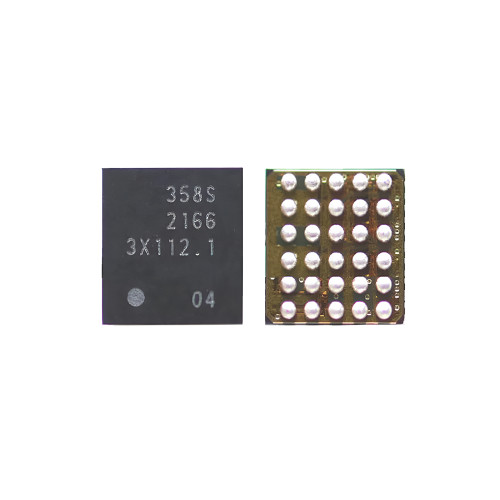
Mobile Phone IC For 358S-2166 Original
The 358S-2166 is a high-performance Charging and USB Interface Control Integrated Circuit (IC). It is primarily utilized in mid-range smartphones and tablets, particularly within the Xiaomi Redmi and Samsung Galaxy ecosystems.
As a dedicated charging controller, its primary role is to manage the power intake from the USB port, regulate the voltage for battery charging, and facilitate the “handshake” between the device and external chargers or data peripherals.
Technical Specifications: 358S-2166
| Feature | Specification Detail |
| Model Number | 358S-2166 / 358S 2166 |
| Component Category | Secondary PMIC / USB Charging Controller |
| Package Type | 30-Pin BGA (Ball Grid Array) |
| Pin Configuration | Double Row / High-Density Grid |
| Primary Function | USB Charging Control & USB Data Switching |
| Supported Protocols | Standard 5V Charging / BC 1.2 / USB OTG Support |
| Input Voltage ($V_{BUS}$) | 5.0V (Nominal) |
| Output Type | Regulated DC for Battery Charging and System Rails |
| Integrated Protections | Thermal Shutdown, Over-Voltage (OVP), Over-Current (OCP) |
| Compatible Devices | Redmi 3, Redmi 4A, Samsung Galaxy Tab T211, T331, T531 |
Core Functional Roles
The 358S-2166 acts as the intelligent manager for the device’s charging port. Its architecture is designed to protect the more sensitive components of the phone from power fluctuations.
1. Charging Management
The IC manages the Constant Current (CC) and Constant Voltage (CV) phases of the charging cycle. It monitors the battery’s state and adjusts the intake current to ensure the battery is charged safely and efficiently without overheating.
2. USB Interface Control
This chip is responsible for detecting the type of device connected to the USB port. Whether it is a standard wall charger, a PC data cable, or a USB-OTG accessory (like a flash drive), the 358S-2166 switches the internal signal paths to the appropriate logic blocks.
3. Power Path Protection
Because it is directly connected to the charging port, it serves as a sacrificial “gatekeeper.” If a user uses a faulty charger that sends a high-voltage spike, the 358S-2166 is designed to fail first, effectively disconnecting the power path before the high voltage can reach the Application Processor (CPU) or Main Power IC.
Common Symptoms of Failure
The 358S-2166 is a frequent point of repair due to its exposure to external electrical stressors.
-
No Charging Response: The device does not show a charging icon or draw current when plugged in, despite the charging port being physically intact.
-
“Fake” Charging: The phone shows the lightning bolt symbol, but the battery percentage stays the same or drops even while plugged in.
-
Total Dead Condition: A short circuit inside the 358S-2166 can pull the main system voltage rail to ground, preventing the device from turning on entirely.
-
USB Data Issues: The device charges but cannot be recognized by a computer for file transfers or software flashing.
Professional Repair & Installation Notes
Replacing the 358S-2166 is considered a Level 3 repair task requiring precision micro-soldering equipment.
-
Thermal Profile: Use a hot air station at $340°C – 355°C$ for removal. Because this is a 30-pin BGA, ensuring even heat distribution across the chip surface is critical to avoid “popcorning” the silicon.
-
Alignment: The chip features a Pin 1 marker (a small dot on one corner). Inverting the chip during installation can cause a permanent short on the battery line, potentially damaging the motherboard further.
-
Reflow Technique: Since the pads are densely packed, it is highly recommended to use a high-quality no-clean flux to prevent bridges between the 30 solder balls.