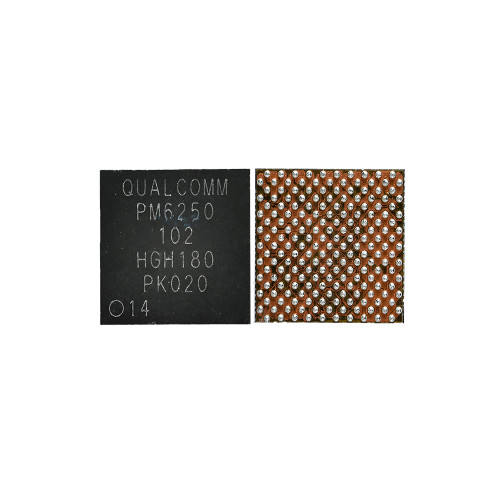
Mobile Phone IC For PM6250 Original
The PM6250 (specifically the PM6250-102) is a high-performance Power Management Integrated Circuit (PMIC) developed by Qualcomm. It is primarily utilized in mid-to-high-tier smartphones, particularly those built on the Qualcomm Snapdragon 675 and similar 600-series architectures.
This IC serves as a central hub for power distribution, managing tasks ranging from USB-C Power Delivery (PD) negotiation to fine-tuning the voltage supplied to the CPU and display panels.
Technical Specifications: PM6250 IC
| Feature | Specification Detail |
| Model Number | PM6250 (Variants: 102, 002) |
| Manufacturer | Qualcomm |
| Package Type | QFN-48 (Quad Flat No-lead) |
| Dimensions | $4\text{mm} \times 4\text{mm}$ (Typical) |
| Input Voltage ($V_{BUS}$) | $3.5\text{V} \text{ to } 21\text{V}$ (Supports USB PD 3.0) |
| Output Voltage Range | Configurable from $0.6\text{V} \text{ to } 3.3\text{V}$ |
| Max Charging Current | Up to $3.0\text{A}$ (Supports 30W Fast Charging) |
| Switching Frequency | Adjustable, typically ~1MHz |
| Efficiency | Up to 95% under optimal loads |
| Communication Interface | $I^{2}C$ / SPMI (System Power Management Interface) |
| Operating Temperature | $-40\degree\text{C} \text{ to } +125\degree\text{C}$ |
Supported Device Compatibility
The PM6250 is widely recognized in the repair industry for its presence in popular Samsung and Xiaomi models released between 2020 and 2022.
-
Samsung Galaxy: A52 (A525), A72 (A725).
-
Xiaomi/Redmi: Redmi Note 9, Redmi Note 9 Pro, Mi 10, Mi 10 Ultra, Redmi K30.
-
Other Platforms: Select Vivo and Oppo mid-range models using Qualcomm chipsets.
Core Functional Roles
The PM6250 is not just a simple regulator; it is an intelligent controller that manages the electrical “life” of the mobile device.
1. Power Supply and Distribution
The IC houses multiple Buck Converters and LDO (Low-Dropout) Regulators. Buck converters are used to efficiently step down the battery voltage for high-current components like the Application Processor (AP). LDOs provide “clean,” low-noise power to sensitive components such as the camera’s Image Signal Processor (ISP) and the audio subsystem.
2. Charging and Battery Management
One of the PM6250’s standout features is its compliance with USB Power Delivery 3.0. It communicates with the wall charger to negotiate the highest safe voltage and current, allowing for modern “Fast Charging” speeds (up to 30W in many Xiaomi configurations). It also monitors the battery’s Internal Resistance (IR) and temperature to prevent overheating.
3. Logic Power Sequencing
Modern CPUs require power to be delivered in a specific order (e.g., the I/O rail must often stabilize before the core voltage is applied). The PM6250 handles this Power-On Reset (POR) sequence, ensuring the processor boots correctly without internal logic errors.
Diagnostics and Repair Information
The PM6250 is a common failure point in devices that have suffered from electrical surges or water damage.
Common Symptoms of Failure
-
Dead Set: The phone does not respond to the power button and shows no current draw ($0.00\text{A}$) on a USB tester.
-
Stuck Boot: The device draws a small, frozen amount of current (e.g., $0.06\text{A}$ to $0.15\text{A}$), indicating a failure in the power-up sequence.
-
Charging Issues: The phone displays a charging icon but the percentage does not increase, or it fails to recognize the charger entirely.
-
Overheating: The area around the PMIC becomes excessively hot even when the phone is idle.
Professional Replacement Steps
Replacing the PM6250 requires advanced micro-soldering skills due to its QFN-48 footprint.
-
Preparation: Apply high-intensity heat insulation tape (Kapton tape) around the IC to protect adjacent components like the CPU or EMMC.
-
Removal: Use a hot air station set to approximately $330\degree\text{C}$ to $350\degree\text{C}$.
-
Cleaning: Clean the motherboard pads using a soldering wick and high-quality flux to ensure a flat surface for the new chip.
-
Alignment: Align the “Pin 1” dot on the IC with the marking on the PCB.
-
Soldering: Apply heat until the IC “settles” or “dances” into place via surface tension.