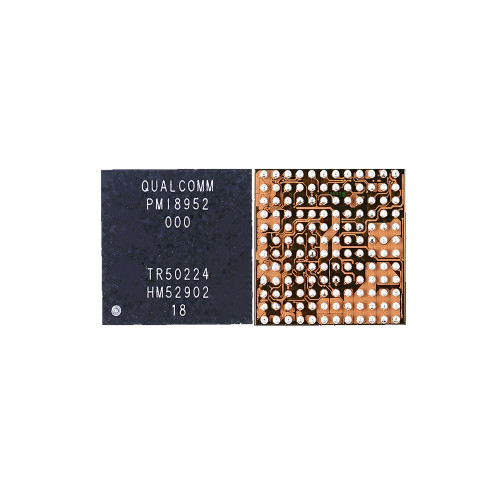
Mobile Phone IC For PMI8952 Original
The PMI8952 is a highly integrated Power Management Integrated Circuit (PMIC) designed by Qualcomm. It is part of the “Companion PMIC” series, typically paired with a primary PMIC (like the PM8952 or PM8953) to handle secondary power functions. In most mobile architectures, the PMI8952 focuses heavily on battery charging, display power, and flash/torch drivers.
It is most notably found in the Xiaomi Redmi Note 3, Redmi 3S, and various mid-range devices from Motorola and Samsung that utilize the Snapdragon 650/652 series chipsets.
Technical Specifications: PMI8952
| Feature | Specification Detail |
| Model Number | PMI8952 (Variants: 000, 001) |
| Manufacturer | Qualcomm Technologies, Inc. |
| Package Type | 144-pin Wafer Level Nanoscale Package (144 WLNSP) |
| Interface | SPMI (System Power Management Interface) / $I^{2}C$ |
| Charging Support | Fast Charge (Quick Charge 2.0/3.0 compatible) |
| Input Source | USB VBUS, Wireless Power (WiPower support) |
| Output Channels | 21 Total programmable output channels |
| CPU Core Current | Supports up to $6.0\text{A}$ (Peak) |
| Display Bias | Integrated +/- voltage rails for LCD/OLED bias |
| Backlight Driver | High-efficiency WLED (White LED) driver |
| Thermal Protection | Integrated shutdown threshold at $120\degree\text{C}$ |
| Operating Temp | $-30\degree\text{C} \text{ to } +125\degree\text{C}$ |
Core Functional Blocks
The PMI8952 is a “mixed-signal” device, meaning it handles both digital logic and high-power analog signals. Its architecture is divided into several key systems:
1. Battery & Charging Management
Unlike many primary PMICs, the PMI8952 often houses the main Switch-Mode Battery Charger (SMBC). It manages the transition between USB power ($V_{BUS}$) and battery power ($V_{BATT}$), ensuring the system remains stable during high-demand tasks while simultaneously charging the battery. It includes a built-in Fuel Gauge to accurately report battery percentages to the Android OS.
2. Display and Backlight Support
The IC is responsible for the “Display Bias.” For LCD screens, it generates the specific positive and negative voltages (typically $+5\text{V}$ and $-5\text{V}$) required to drive the liquid crystal panel. It also contains the WLED driver, which powers the high-voltage backlight string behind the screen.
3. Flash and Haptics
To save space on the motherboard, Qualcomm integrated the Camera Flash/Torch drivers into this chip. It can provide high-current bursts for the LED flash. Additionally, it contains a dedicated Haptics Driver (Vibrator driver) to control the device’s vibration motor.
Common Faults and Troubleshooting
The PMI8952 is frequently the culprit in “Half-Dead” or “No Display” scenarios.
1. Temperature Error
If a phone displays a “Battery Temperature Too Low” or “Too High” message even when cold, the thermal sensing circuit inside the PMI8952 (or its connected thermistor line) is often defective.
2. Charging Stuck at 0%
Since this IC manages the charging gate, a failure in the USB_IN or CHG_OUT pins will lead to a device that shows a charging icon but never increases its capacity.
3. Light and Graphics Issues
Because it controls the backlight (WLED) and display bias, a shorted capacitor on the PMI8952 output lines will cause a “Black Screen” where the phone is on (vibrates/rings) but nothing is visible.
Replacement & Reballing Notes
Replacing the PMI8952 is a precise task due to its 144-ball density.
-
Heat Management: Use a nozzle temperature of $340\degree\text{C} \text{ to } 350\degree\text{C}$ for removal.
-
Pin 1 Orientation: Always note the position of the small dot on the corner of the chip. Installing it backwards will immediately blow the main power rail ($V_{PH\_PWR}$).
-
Solder Type: For long-term reliability in mobile repairs, $183\degree\text{C}$ leaded solder paste is recommended for reballing to withstand thermal stress better than the original lead-free solder.