Mobile Phone IC For S515 Original
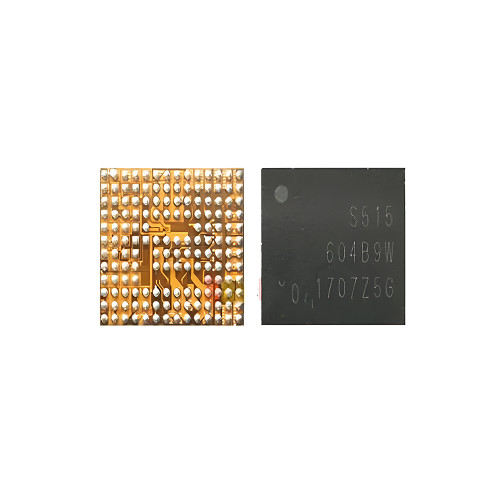
The S515 Power IC (part of the S2MPU06X series) is a specialized Power Management Integrated Circuit (PMIC) designed primarily for Samsung’s mid-range and legacy flagship devices. Often referred to in the repair industry as a “Small Power IC” or “Charging IC,” it plays a vital role in regulating the voltage for the USB-C/Micro-USB interface and managing the power distribution to the display and secondary logic rails.
Below are the technical specifications and functional details of the S515 IC.
Technical Specifications: S515 Power IC
| Feature | Specification Detail |
| Model Number | S515 (Full PN: S2MPU06X01 / S2MPU06) |
| Component Type | Secondary PMIC / Charging Controller |
| Package Type | BGA (Ball Grid Array) |
| Pin Count | High-density micro-BGA configuration |
| Primary Function | Voltage regulation, USB Interface, and Battery Charging |
| Input Voltage ($V_{IN}$) | $3.2\text{V} \text{ to } 4.8\text{V}$ (Nominal Battery Range) |
| Supported Protocols | Standard Charging, USB $2.0/3.0$ Logic |
| Operating Temp | $-30\degree\text{C} \text{ to } +105\degree\text{C}$ |
| Efficiency | > 92% (Buck Conversion) |
| Key Protections | Over-Voltage (OVP), Over-Current (OCP), Thermal Shutdown |
Supported Device List
The S515 is highly versatile and is a staple component in Samsung’s repair manuals for devices released between 2016 and 2019.
-
Galaxy S Series: S7 (G930F), S7 Edge (G935F/S).
-
Galaxy J Series: J5 (2017), J6 (J600), J7 (2016 – J710F), J7 Pro (J730F), J7 Neo.
-
Galaxy M & A Series: M10 (M105F), A2 Core (A260G).
Functional Overview
The S515 IC is often categorized as a “Small Power IC” because it does not manage the entire motherboard (like a primary PMIC) but instead focuses on a dedicated cluster of power-intensive tasks.
1. USB and Charging Management
The S515 is the first line of defense and management for current coming from the charging port. It handles the Switching Charger logic, converting the $5\text{V}$ USB input into a voltage suitable for the Lithium-Ion battery. If this IC fails, the phone will typically show a charging logo but fail to increase the battery percentage (Fake Charging).
2. Intermediate Rail Regulation
Inside the chip are multiple LDOs (Low-Dropout Regulators). These take the fluctuating battery voltage and turn it into “clean” power for:
-
The Haptic Motor: Driving the vibration feedback.
-
Audio Amplifiers: Providing the burst power needed for clear loudspeaker output.
-
The LCD/OLED Bias: Ensuring the display panel receives the exact voltage required to render colors accurately.
3. Safety and Logic Sensing
The IC includes a Fuel Gauge interface that communicates with the battery’s internal protection circuit. It monitors the “Battery ID” and “Battery Thermal” lines. If the S515 detects an incompatible battery or a temperature spike, it will cut off power to protect the CPU from permanent damage.
Diagnostic Signs of a Defective S515
Because the S515 is connected directly to the charging circuit, it is prone to damage from low-quality chargers or car adapters. Common symptoms include:
-
Short Circuit (VPH_PWR): The phone gets hot near the top of the motherboard immediately after the battery is connected.
-
USB Connectivity Issues: The phone charges but is not recognized by a computer for data transfer.
-
“Temperature Too High” Error: An erroneous warning prevents the phone from booting or charging, even if the device is cool to the touch.
-
No Power (Dead): If the S515 fails to produce the “Power Good” signal for the secondary rails, the main CPU will never initiate the boot sequence.
Repair & Installation Best Practices
The S515 is a sensitive BGA chip. Technicians must follow these parameters to ensure a successful “IC Swap”:
-
Thermal Profile: Using a professional rework station, the desoldering temperature should be kept between 340°C and 360°C. Excessive heat can delaminate the thin PCB of the Galaxy S7/J7 series.
-
Flux Selection: High-grade, non-conductive “no-clean” flux is essential. Since the balls under the S515 are extremely close together, cheap flux can cause microscopic solder bridges.
-
Ball Alignment: The “Pin 1” dot must face the correct orientation (usually towards the CPU or the top of the board, depending on the specific model). An inverted chip will cause an immediate motherboard short.
Tech Tip: If a Galaxy S7 Edge is “dead” and drawing exactly $0.02\text{A}$ to $0.05\text{A}$ on a DC power supply, the S515 is the primary suspect after the battery and charging port have been ruled out.