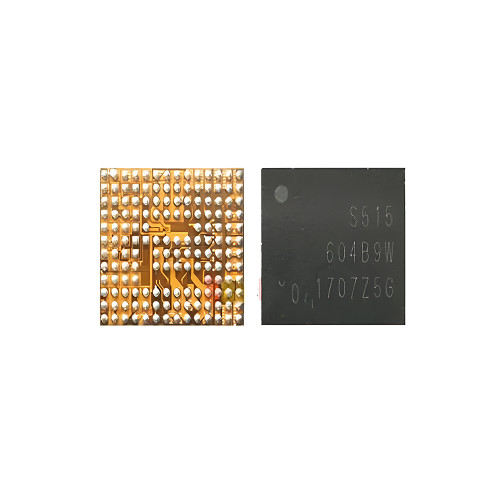
Mobile Phone IC For S5200 Original
The S5200 Power IC is a high-performance Power Management Integrated Circuit (PMIC) designed specifically for Samsung’s high-end smartphones, most notably the Galaxy S10 series (including the S10, S10+, and S10 5G).
Unlike legacy chips, the S5200 is a “Big Power IC,” meaning it acts as the primary power distributor for the device’s entire motherboard, managing complex tasks like CPU voltage scaling, high-speed wireless charging, and thermal protection for the Exynos or Snapdragon chipsets.
Original Technical Specifications: S5200
| Feature | Specification Detail |
| Model Number | S5200 (Main PMIC) |
| Device Compatibility | Samsung Galaxy S10, S10+, S10 5G (G973, G975, G977) |
| Manufacturer | Samsung (Proprietary Silicon) / Qualcomm Partnered |
| Pin Layout | BGA-196 (Ball Grid Array) |
| Input Voltage Range | $3.4\text{V} \text{ to } 4.5\text{V}$ (Operating) / Supports up to $21\text{V}$ for USB-PD |
| Voltage Regulation | ±1.5% Tolerance (High Precision) |
| PWM Switching Freq | ~2.0MHz (Optimized for low ripple noise) |
| Output Rails | 8+ Buck Converters / 20+ LDO Regulators |
| Thermal Protection | Automatic shutdown at $125\degree\text{C} – 150\degree\text{C}$ |
| Efficiency Rating | > 94% under typical smartphone load |
| Interface | SPMI (System Power Management Interface) / $I^{2}C$ |
Key Functional Roles
1. Advanced Power Distribution
The S5200 is responsible for converting the raw battery voltage into multiple specific “rails” required by the hardware. It features high-frequency Pulse Width Modulation (PWM) control, which reduces electrical noise. This is critical for the Galaxy S10’s performance, as it ensures the CPU/GPU can throttle speeds up and down without system crashes.
2. High-Speed Charging & Wireless Support
This IC handles the “negotiation” between the phone and the charger. It supports:
-
USB-PD 3.0: Allowing for 15W–25W wired fast charging.
-
Fast Wireless Charging 2.0: Managing the induction coils to prevent excess heat while pushing 12W–15W wirelessly.
-
Wireless PowerShare: Reversing the current to charge accessories like Galaxy Buds on the back of the phone.
3. Energy Conservation & Idle Modes
One of the S5200’s primary design goals is reducing “Idle Drain.” It can shut down almost all secondary power rails when the phone is in deep sleep, lowering the discharge rate to under $0.6\%$ per hour in ideal conditions.
Diagnostics: Identifying S5200 Failure
In the repair industry, the S5200 is a common replacement part for devices that have “died” suddenly. Because it is a BGA-196 chip, failure often occurs due to thermal stress or physical drops that crack the microscopic solder balls underneath.
Common Symptoms of Failure
-
Dead Device (No Power): The phone draws $0.00\text{A}$ or a very low, fluctuating current (e.g., $0.01\text{A} – 0.05\text{A}$) when connected to a DC power supply.
-
Overheating While Charging: The area near the CPU/Battery connector (specifically around component U2200) becomes hot to the touch.
-
Inaccurate Battery Reporting: The phone dies at 15% or 20% suddenly, or the percentage jumps erratically.
-
Fast Charging Disabled: The phone only “Slow Charges” (taking 5+ hours for a full cycle) regardless of the cable used.
Replacement Notes for Technicians
The S5200 requires a high level of soldering expertise. Unlike older DIP or SMD components, the BGA-196 layout means the solder balls are hidden beneath the chip.
-
Reflow Temperature: The chip should be removed at approximately 350°C with a “slow-ramp” heat profile to prevent warping the multi-layered motherboard.
-
Thermal Pad: The original S5200 design includes a central thermal pad or grounded ball cluster to dissipate heat into the PCB. When replacing, ensuring this connection is solid is vital to prevent the new chip from burning out.
-
Bootloop Prevention: Using a “Grade A” or Original IC is essential; third-party clones often have slightly different timing frequencies that can trigger “Kernel Panic” or bootloops in the Android OS.