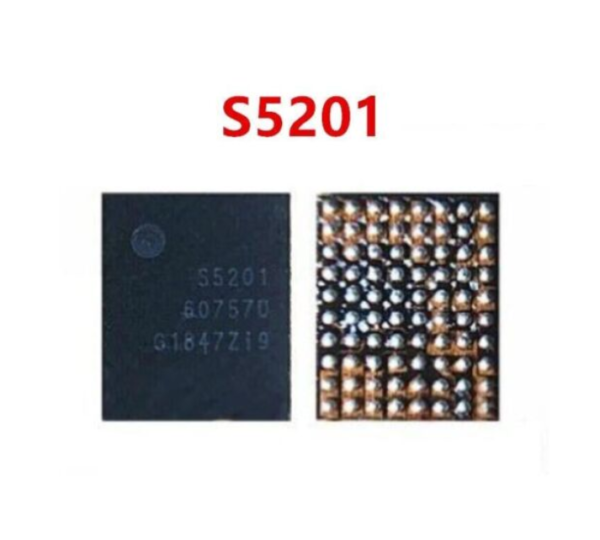
Mobile Phone IC For S5201 Original
The S5201 IC is a specialized auxiliary power management and audio codec component engineered primarily for the Samsung Galaxy S10 5G and related flagship variants. Within the intricate power architecture of these devices, the S5201 works in tandem with the primary PMIC (often the S5200) to manage specific high-fidelity audio functions and auxiliary power rails for the camera and sensor modules.
Below is the technical specification breakdown for the S5201 integrated circuit.
Technical Specifications: S5201 IC
| Feature | Specification Detail |
| Model Number | S5201 |
| Common Alias | S5201 Audio / Auxiliary Power IC |
| Primary Function | Audio Codec & Auxiliary Voltage Regulation |
| Package Type | 40-Pin BGA (Ball Grid Array) |
| Compatible Devices | Samsung Galaxy S10 5G (G977), S10 series, Note 10 |
| Input Voltage ($V_{IN}$) | $3.4\text{V} \text{ to } 4.5\text{V}$ (Nominal) |
| Audio Processing | High-Definition Sound Ringing & Signal Processing |
| Power Output Rails | LDOs for Camera VDD and Audio Amp Bias |
| Operating Temp | $-25\degree\text{C} \text{ to } +85\degree\text{C}$ |
| Efficiency | ~90% (Low-power standby optimization) |
| Material Composition | Silicon Die with Polished Finish |
Functional Role in Mobile Hardware
The S5201 is a multi-functional chip that bridges the gap between pure power delivery and high-end multimedia processing.
1. Audio and Sound Management
Unlike a standard power chip, the S5201 is often referred to as a “Sound Ringing Chip.” It is responsible for the digital-to-analog conversion (DAC) and amplification required for the device’s loudspeakers and headphone output. It ensures low-distortion audio playback even at high volume levels.
2. Auxiliary Power Logic
In high-end smartphones like the Galaxy S10 5G, the main PMIC cannot handle every single voltage rail without overheating. The S5201 acts as a “sub-PMIC,” taking the load for:
-
Camera Sensors: Providing stabilized $1.2\text{V}$ or $1.8\text{V}$ rails for the autofocus and image sensor logic.
-
Secondary Logic: Powering auxiliary sensors like the proximity and light sensors.
3. Power Distribution Efficiency
By isolating audio and auxiliary functions into the S5201, Samsung’s engineers reduced electrical noise on the main processor’s power lines. This “clean” power delivery is what allows the S10 series to maintain high performance during gaming or 4K video recording.
Common Symptoms of a Defective S5201
Because this IC manages both sound and specific power rails, its failure presents unique diagnostic challenges:
-
No Sound/Audio Distortions: The most common sign. If the loudspeakers, earpiece, and microphone all fail simultaneously, the S5201 audio codec is likely damaged.
-
Camera Failure: If the camera app crashes with a “Server Error” or “Camera Failed” message despite having a functional camera module, the S5201 may not be providing the necessary auxiliary power.
-
Partial Power Fail (Hang on Logo): If an auxiliary rail is shorted within the IC, the phone may start to boot but hang indefinitely because the “Power Good” signal for the sensors is never received.
-
Localized Heating: Technicians often find that the area near the audio circuitry becomes excessively hot to the touch during playback.
Repair & Installation Guide
The S5201 is a 40-pin BGA chip, making it a “medium difficulty” repair for micro-soldering professionals.
-
Preparation: Due to its proximity to the main CPU and RAM in some models, use thermal shielding (Kapton tape or silver foil) to prevent accidental desoldering of neighboring chips.
-
Heat Settings: Use a hot air station set to $340\degree\text{C} – 355\degree\text{C}$. The S5201 is relatively small and will “float” into place quickly once the solder reaches its liquidus state.
-
Ball Alignment: The chip features a precise $0.4\text{mm}$ or $0.5\text{mm}$ ball pitch. Proper cleaning of the motherboard pads with a soldering wick is mandatory before placing the new IC.