
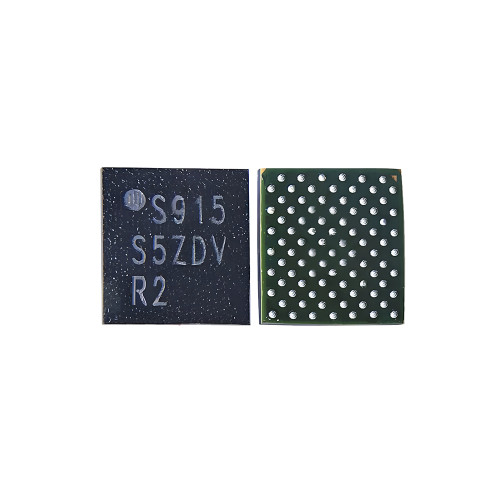
Mobile Phone IC For S915 Original
The S915 (often identified as the S2MPU03X01 or S2MPU03) is a critical Power Management Integrated Circuit (PMIC) manufactured by Samsung. It is primarily utilized in mid-to-high-end smartphones and tablets within the Samsung Galaxy ecosystem, specifically those from the 2017–2019 era, such as the Galaxy S8, Note 8, and A-series devices.
As a primary PMIC, the S915 acts as the “electrical heart” of the device, regulating the flow of power from the battery to sensitive components like the CPU, RAM, and display.
Technical Specifications: S915 Power IC
| Feature | Specification Detail |
| Model Number | S915 (Full PN: S2MPU03X01) |
| Manufacturer | Samsung (Proprietary Silicon) |
| Component Type | Main Power Management Integrated Circuit (PMIC) |
| Package Type | BGA (Ball Grid Array) |
| Pin Configuration | High-density 100+ Pin layout |
| Input Voltage Range | $3.4\text{V} \text{ to } 4.5\text{V}$ (Operating Battery Voltage) |
| Output Channels | 10+ Buck Converters / 25+ LDOs |
| Logic Interface | SPMI (System Power Management Interface) |
| Clock Frequency | $32.768\text{kHz}$ (Integrated Sleep Clock) |
| Thermal Protection | Integrated thermal sensor with auto-shutdown |
| Operating Temp | $-30\degree\text{C} \text{ to } +125\degree\text{C}$ |
Supported Device List
The S915 is a specialized chip found in several flagship and high-performance devices:
-
Galaxy S Series: S8 (G950F/U), S8 Plus (G955F/U).
-
Galaxy Note Series: Note 8 (N950F/U).
-
Galaxy A Series: A8 (2018), A8+ (2018), A7 (2017).
-
Galaxy Tab Series: Select Tab S3 and Tab S4 variants.
Core Functional Overview
The S915 is a highly integrated “Big Power” IC. Its original specification dictates a complex architecture designed to manage the entirety of the phone’s power-on sequence.
1. Buck Converters and LDOs
To maintain high efficiency, the S915 uses Buck Converters for high-current demands like the Application Processor (AP) core and GPU. It uses LDO (Low-Dropout) regulators for noise-sensitive components, such as the camera’s image signal processor and the audio DAC, ensuring “clean” power that doesn’t interfere with signal integrity.
2. Power-On Logic and Sequencing
When the power button is pressed, the S915 manages the Power-Up Sequence. It must wake up the processor’s I/O rails before the core rails to prevent “latch-up” conditions that could permanently fry the CPU. It also generates the RESET signal that tells the processor to start executing its boot code.
3. Real-Time Clock (RTC) and Sleep Management
The S915 houses the 32.768kHz crystal oscillator circuit. This maintains the device’s system time even when the phone is “off” and manages the transition into Deep Sleep modes, which is essential for preserving battery life when the screen is dark.
Diagnostics: Signs of a Defective S915
Because the S915 is the primary distributor of power, its failure usually results in a “dead” device.
-
No Power / No Boot: The device shows 0.00A on a USB ammeter or a very low, stuck current (e.g., $0.02\text{A}$ to $0.05\text{A}$) when the power button is pressed.
-
Short Circuit (VPH_PWR): If the S915 is internally shorted, the phone will get hot near the top of the motherboard as soon as the battery is connected.
-
Bootlooping: If the S915 fails to provide a stable “Power Good” signal to the CPU, the phone may restart indefinitely at the first logo.
-
Missing Specific Rails: For example, the phone turns on but has no sound or no camera function because a specific LDO output from the S915 has died.
Repair and Installation Notes
The S915 is a high-density BGA chip that requires professional-grade micro-soldering.
-
Shielding Nearby Components: The S915 is almost always located directly next to the CPU or NAND Flash. These chips are “underfilled” (glued) to the board. You must use thick Heat Shielding Tape to prevent the underfill on the CPU from expanding and “popping” the solder balls.
-
Heat Profile: Use a hot air station set to approximately $345\degree\text{C} – 355\degree\text{C}$.
-
Orientation: The “Pin 1” dot is critical. Aligning this improperly will cause a catastrophic short across the main battery line.