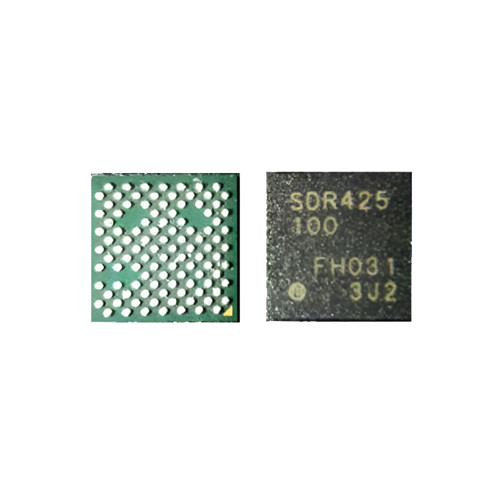
Mobile Phone IC For SDR425-001 Original
The SDR425-001 is a high-performance Radio Frequency (RF) Transceiver integrated circuit developed by Qualcomm. It serves as a secondary or companion transceiver in modern smartphone architectures, particularly those utilizing the Snapdragon 400 and 600 series chipsets.
While the primary transceiver handles the main 4G/5G data highways, the SDR425 is often tasked with managing secondary frequency bands, Carrier Aggregation (CA), and diversity reception to ensure a stable signal in challenging environments.
Technical Specifications: SDR425-001
| Feature | Specification Detail |
| Model Number | SDR425-001 |
| Manufacturer | Qualcomm Technologies, Inc. |
| Component Type | RF Transceiver (Intermediate Frequency) |
| Package Type | WLCSP (Wafer Level Chip Scale Package) |
| Process Node | 28nm / 14nm optimized lithography |
| Supported Networks | 2G, 3G, 4G LTE (Category 4/6/7) |
| MIMO Support | 2×2 MIMO (Multiple Input Multiple Output) |
| Interface | DigRF v4 / RFFE (Radio Frequency Front End) |
| Supply Voltage | $1.2\text{V} / 1.8\text{V}$ regulated inputs |
| Frequency Range | $700\text{MHz}$ to $2700\text{MHz}$ (Multi-band) |
| Operating Temp | $-30\degree\text{C} \text{ to } +85\degree\text{C}$ |
Supported Device List
The SDR425-001 is a common component in “global” versions of mid-range smartphones where multiple frequency bands are required for international roaming.
-
Xiaomi: Redmi Note 5, Redmi 6 Pro, Redmi S2/Y2.
-
Samsung: Galaxy J series (J4+, J6+), Select Galaxy A series (A10s).
-
Motorola: Moto G6 Play, Moto E5 series.
-
Vivo/Oppo: Various mid-range V and Y series models using Snapdragon 425/450.
Core Functional Overview
The SDR425-001 acts as the “translator” between the airwaves and the phone’s digital modem. Its original design focuses on three primary pillars:
1. Signal Transformation
The IC houses Low Noise Amplifiers (LNAs) and Mixers. When a radio signal hits the antenna, it is incredibly weak and noisy. The SDR425 amplifies this signal and “down-converts” it from a high frequency (like $2.1\text{GHz}$) to a baseband frequency that the processor can understand as digital data.
2. Diversity Reception
To prevent “dead zones” caused by holding the phone a certain way (the “death grip”), the SDR425 manages Diversity Antennas. It compares signals from two different antennas and intelligently combines them or picks the strongest one to ensure your call doesn’t drop.
3. Integrated Filtering
Traditional RF designs required many external filters (SAW filters). The SDR425 incorporates much of this filtering onto the silicon die itself, which reduces the overall footprint on the motherboard and allows for thinner phone designs.
Signs of a Defective SDR425-001
Because it is a radio chip, failures almost always manifest as communication errors.
-
“No Service” with IMEI: The most common symptom. If the phone shows it has an IMEI and Baseband version but stays on “Searching,” the SDR425 may be unable to lock onto a tower.
-
Weak Signal: The phone works near a cell tower but loses signal entirely when indoors or in rural areas.
-
Wi-Fi/LTE Interference: Since it manages the radio front end, a failing SDR425 can cause noise that interferes with the $2.4\text{GHz}$ Wi-Fi band, causing slow internet or Bluetooth drops.
-
Bootlooping: In rare cases, a short circuit inside the SDR425 can crash the SPMI bus, preventing the phone from booting past the logo.
Professional Repair Notes
The SDR425-001 is a WLCSP chip. It does not have traditional “leads” or large solder balls; instead, it has microscopic solder bumps on the bottom of the silicon.
-
Underfill Warning: Samsung and Xiaomi often use a hard black or transparent epoxy (underfill) to secure this chip. Attempting to lift the chip without properly softening and removing this glue will tear the delicate copper pads off the motherboard.
-
Heat Profile: Use a hot air station at $335\degree\text{C} – 350\degree\text{C}$. Because the chip is exceptionally light, use the lowest airflow setting to prevent it from shifting or “flying away” during the reflow process.
-
Replacement vs. Reballing: Due to the low cost of the SDR425-001, it is usually more efficient to replace it with a new “pre-balled” chip rather than attempting to reball a used one.