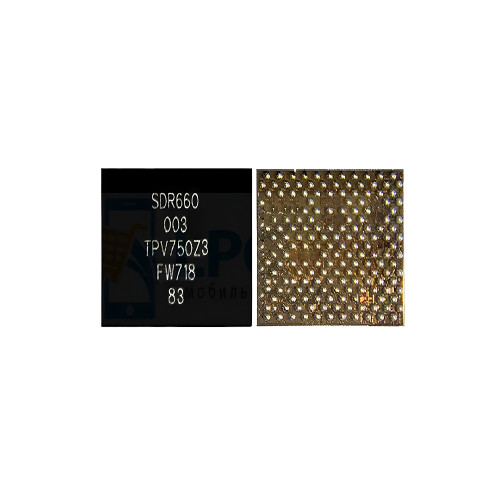
Mobile Phone IC For SDR660 Original
The SDR660 is a highly integrated Radio Frequency (RF) Transceiver chip developed by Qualcomm. It is a core component in the “RF Front-End” of mid-range and high-end smartphones, typically paired with the Snapdragon 660, 670, and 710 processor platforms.
As a transceiver, its primary job is to bridge the gap between the digital modem and the analog world of radio waves. It converts digital data into radio signals for transmission (uplink) and translates received radio waves back into digital data for the phone to process (downlink).
Technical Specifications: SDR660 RF Transceiver
| Feature | Specification Detail |
| Model Number | SDR660 |
| Manufacturer | Qualcomm Technologies, Inc. |
| Function | RF Transceiver (Intermediate Frequency) |
| Package Type | Wafer-Level Chip Scale Package (WLCSP) |
| Process Technology | 14nm FinFET |
| Supported Networks | 2G, 3G, 4G LTE (Cat 12/15) |
| Frequency Bands | Multi-band support (Low, Mid, and High Bands) |
| MIMO Support | 4×4 MIMO (Multiple Input Multiple Output) |
| Carrier Aggregation | Up to 3x Downlink / 2x Uplink |
| Interface | DigRF v4 / RFFE (Radio Frequency Front End) |
| Supply Voltage | $1.2\text{V} / 1.8\text{V}$ logic rails |
| Operating Temp | $-30\degree\text{C} \text{ to } +85\degree\text{C}$ |
Supported Device List
The SDR660 is a “workhorse” chip found in a vast number of devices released between 2017 and 2020.
-
Xiaomi: Redmi Note 7 Pro, Mi A2, Mi 8 Lite.
-
Samsung: Galaxy A9 (2018), Galaxy A60, Galaxy A70 (Select variants).
-
Oppo/Vivo: R11, R15, V11, V15 Pro.
-
Nokia: Nokia 7 Plus, Nokia 7.2.
Functional Overview
The SDR660 acts as the “translator” for the phone’s wireless communication. It handles several complex tasks simultaneously to ensure you have a stable signal.
1. Frequency Synthesis and Conversion
The chip contains sophisticated Voltage-Controlled Oscillators (VCOs) and Phase-Locked Loops (PLLs). These allow it to tune into specific carrier frequencies (e.g., 1800MHz or 2100MHz). It uses Zero-IF (ZIF) architecture, which simplifies the hardware design by eliminating the need for bulky intermediate filter components.
2. MIMO and Carrier Aggregation
To achieve “Gigabit LTE” speeds, the SDR660 utilizes Carrier Aggregation (CA). This allows the phone to download data across multiple frequency bands at once. The 4×4 MIMO capability means the chip can manage four distinct data streams simultaneously through the antenna array, significantly improving throughput in crowded areas.
3. Envelope Tracking Support
The SDR660 works with Envelope Tracking (ET) ICs to adjust the power supply of the Power Amplifier in real-time. This ensures that the transmitter only uses the exact amount of power needed for the signal’s “envelope,” which reduces heat and extends battery life significantly during long calls or data sessions.
Common Faults and Troubleshooting
Because the SDR660 is directly involved in the signal path, it is a common point of failure for network-related issues.
1. “No Service” or “Searching”
If the phone displays “No Service” but the IMEI and Baseband versions are still visible in the settings, the SDR660 is often the culprit. It may be unable to “lock” onto a frequency due to an internal PLL failure or a cracked solder joint under the chip.
2. Weak Wi-Fi/Bluetooth and LTE Conflict
In some architectures, the SDR660 handles coexistence logic. If the chip is failing, you might notice that using Wi-Fi causes the LTE signal to drop, or vice-versa, due to poor signal isolation.
3. High Battery Drain (Radio Standby)
A partially damaged SDR660 can cause “Radio Interface Layer” (RIL) errors in Android, preventing the phone from entering deep sleep. If “Cell Standby” is the top battery consumer in your settings, the transceiver might be leaking current.
Repair and Installation Notes
The SDR660 is a very small, fragile WLCSP (ball-less) style chip. It requires extreme precision during repair.
-
Underfill: Many manufacturers (like Xiaomi and Samsung) apply a hard epoxy “underfill” around this chip. Technicians must carefully scrape this away at $200\degree\text{C}$ before attempting to lift the IC at higher temperatures.
-
Heat Sensitivity: Because it is manufactured on a 14nm process, the internal transistors are sensitive to heat. It is recommended to use $330\degree\text{C} – 345\degree\text{C}$ with high-quality flux to minimize the time the chip spends under the nozzle.
-
Stencil: Use a dedicated 0.3mm or 0.35mm pitch stencil for reballing if you are reusing a pulled chip.