
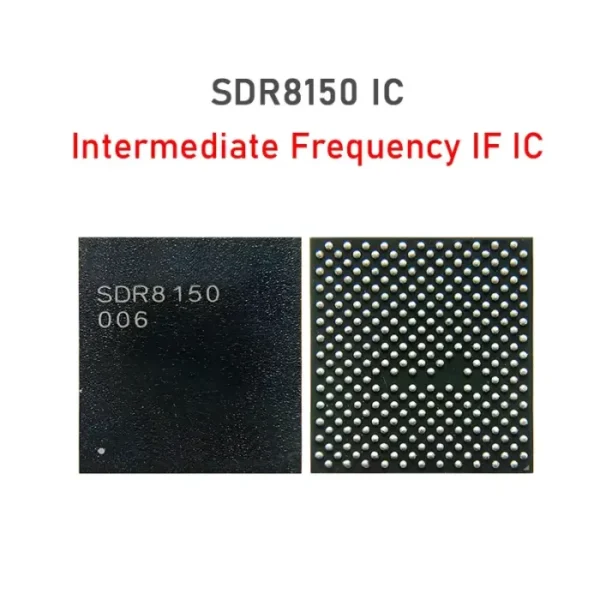
Mobile Phone IC For SDR8150 Original
The SDR8150 is a high-performance Radio Frequency (RF) Transceiver developed by Qualcomm. It is a cornerstone of the 5G era, specifically designed to work alongside the Snapdragon 855 and Snapdragon 865 platforms.
As a transceiver, its primary role is to convert digital signals from the modem into analog radio waves for transmission, and vice versa for receiving data. It is a “world-mode” chip, meaning it supports a massive array of global frequencies from legacy 2G to cutting-edge 5G Sub-6GHz.
Technical Specifications: SDR8150 RF Transceiver
| Feature | Specification Detail |
| Model Number | SDR8150 |
| Manufacturer | Qualcomm Technologies, Inc. |
| Function | 5G/4G/3G/2G RF Transceiver |
| Package Type | WLCSP (Wafer Level Chip Scale Package) |
| Technology Node | 14nm FinFET Process |
| Network Support | 5G NR (Sub-6), LTE Cat 24/22, HSPA+, GSM/EDGE |
| MIMO Support | Up to 4×4 MIMO on Downlink and Uplink |
| Carrier Aggregation | 7x Downlink / 3x Uplink (LTE) |
| Voltage Rails | $1.2\text{V}$, $1.8\text{V}$ (Digital/Analog Mixed) |
| Bandwidth Support | Up to $100\text{MHz}$ for 5G NR |
| Interface | DigRF v4 / RFFE v2.1 |
| Clock Frequency | $38.4\text{MHz}$ (Standard Crystal Reference) |
Supported Device List
The SDR8150 is typically found in flagship devices released between 2019 and 2021 that required early 5G capabilities.
-
Samsung: Galaxy S10 5G, Note 10+ 5G, S20 Series (Snapdragon variants).
-
Xiaomi: Mi 9 Pro 5G, Mi 10, Black Shark 3.
-
OnePlus: OnePlus 7 Pro 5G, OnePlus 8, 8 Pro.
-
Google: Pixel 4 XL, Pixel 5 (Secondary RF path).
Core Functional Architecture
The SDR8150 isn’t just a simple radio; it is a complex system-on-chip that manages the entire air interface of the phone.
1. 5G NR and LTE Coexistence
The SDR8150 is designed for Dual Connectivity (EN-DC). This allows the phone to stay connected to 4G LTE for signaling and 5G NR for high-speed data simultaneously. The chip manages the internal switching to ensure these two high-frequency signals do not interfere with one another.
2. Zero-IF (Intermediate Frequency) Technology
To save space in slim modern phones, the SDR8150 uses Zero-IF architecture. It converts radio signals directly to baseband frequencies without needing an intermediate step. This eliminates the need for bulky SAW filters, allowing for a much smaller motherboard footprint.
3. Advanced MIMO Management
With 4×4 MIMO, the SDR8150 can “talk” to four different antennas at once. This effectively quadruples the data highway, allowing for the gigabit speeds associated with 5G. It handles the phase shifting and signal combining required to make these four streams appear as one seamless data pipe to the user.
Common Signs of a Defective SDR8150
In the repair world, RF chips are often damaged by heat or physical drops. Because the SDR8150 is a BGA-style chip with many tiny connections, even a small crack can cause total network failure.
-
“No Service” with IMEI present: If your phone shows the IMEI and Baseband version in settings but cannot find a signal, the SDR8150 is likely failing to “tune” to the network.
-
Signal Dropping: The phone has a signal but drops calls or loses data connectivity as soon as it switches from 4G to 5G.
-
Extreme Battery Drain: A malfunctioning transceiver may “leak” current or force the CPU to stay awake while it constantly retries to hand off network signals.
-
No Wi-Fi/Bluetooth (Indirect): While the SDR8150 doesn’t handle Wi-Fi directly, it shares the RFFE (Radio Frequency Front End) bus. A short in the SDR8150 can “crash” the entire bus, causing other wireless chips to stop responding.
Professional Repair and Handling
The SDR8150 is a WLCSP chip, meaning it is essentially a piece of silicon with solder bumps on the bottom. It is extremely sensitive to thermal shock.
-
Underfill Removal: Most manufacturers apply “glue” (underfill) around the chip. This must be carefully picked away at 200°C using a fine needle before the chip can be desoldered.
-
Soldering Temperature: Use a high-quality hot air station at 335°C to 350°C. Because the chip is tiny, it can be easily “blown away” by high airflow; keep the air speed at a minimum.
-
Shielding: Always use heat-shielding tape on the CPU and NAND Flash nearby. The SDR8150 is often placed very close to the main processor to reduce signal latency.