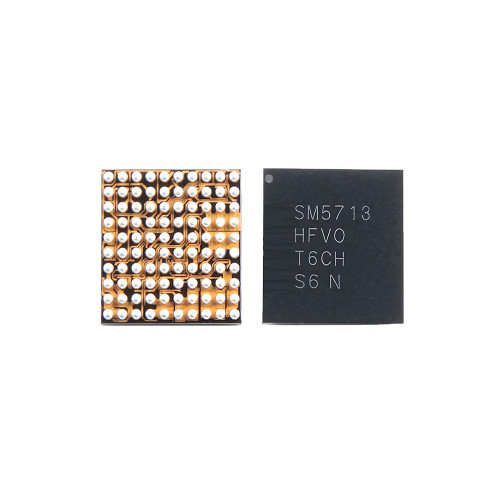
Mobile Phone IC For SM5713 ORIGINAL
The SM5713 (often identified as the S2MPU06) is a critical Power Management Integrated Circuit (PMIC) manufactured by Samsung. It is primarily categorized as a “Small Power IC” or “Charging IC” and is a cornerstone component in the power architecture of Samsung’s flagship and high-end mid-range devices from the 2019–2021 era.
Its primary role is managing the battery charging interface, regulating core voltages for the Application Processor (AP), and maintaining stability for high-speed communication interfaces like USB PHY and memory controllers.
Technical Specifications: SM5713 Power IC
| Feature | Specification Detail |
| Model Number | SM5713 (S2MPU06 Series) |
| Manufacturer | Samsung (Proprietary Silicon) |
| Component Type | Secondary PMIC / Battery Management System (BMS) |
| Package Type | 0.4mm pitch BGA (Ball Grid Array) |
| Input Voltage Range | $3.4\text{V} \text{ to } 4.5\text{V}$ (Operating Battery Range) |
| Voltage Channels | 6 Buck Converters / 2 LDO Regulators |
| Core Voltage Output | $0.8\text{V} \text{ to } 1.35\text{V}$ (CPU/GPU Core Support) |
| Communication Bus | $I^2C$ (Default Address: 0x6A) / SMBus |
| Quiescent Current | $\approx 18\mu\text{A}$ (Deep Sleep Mode) |
| Thermal Shutdown | $+135\degree\text{C}$ Threshold |
| Efficiency | $>95\%$ at peak duty cycles |
Core Functional Roles
The SM5713 is designed to offload specific power-intensive tasks from the main PMIC to reduce overall board heat and improve efficiency.
1. Dynamic Voltage Scaling (DVFS)
The SM5713 regulates essential rails like VDD_CORE and VDD_MIF. It handles dynamic scaling, meaning it adjusts the voltage in real-time based on the workload of the CPU and GPU. This is why a failing SM5713 often causes sudden reboots specifically during high-load activities like gaming or 4K video recording.
2. Advanced Charging Interface
It acts as the primary gatekeeper for the lithium-ion battery. The IC monitors cell voltage through high-precision ADC lines and communicates with the System on Chip (SoC) to negotiate charge states. It ensures that the transition between fast charging and trickle charging is seamless and safe.
3. High-Speed Circuit Support
The IC provides a stable power supply for the USB PHY and SRAM blocks. Because these components are highly sensitive to electrical noise (ripple), the SM5713 is engineered to maintain a ripple pattern of $\le \pm 12\text{mV}$, which is significantly more stable than standard generic regulators.
Supported Device Compatibility
The SM5713 is widely used across several series of Samsung smartphones:
-
Galaxy S Series: S10, S10+, S10e, S10 Lite.
-
Galaxy Note Series: Note 10, Note 10 Lite.
-
Galaxy A Series: A40, A50, A51, A60.
-
Galaxy M Series: M21, M30s.
Common Symptoms of a Defective SM5713
Technicians often target this IC when a phone displays “life” but fails to perform consistently.
-
Chronic Charging Issues: The device may not charge past a certain percentage (e.g., 15%) or may show a “phantom” low-battery warning despite having a full battery.
-
Unexpected Shutdowns: The phone turns off randomly when the battery is under load, often due to degraded internal voltage regulation circuits.
-
Temperature Spikes: Rapid overheating near the PMIC area on the motherboard during idle usage is a classic sign of internal leakage in the SM5713.
-
DC Power Supply Behavior: If the device draws more than $1\text{A}$ and then immediately shuts off, it usually indicates PMIC instability rather than a damaged coil or capacitor.
Professional Repair and Handling
The SM5713 is a high-precision component that requires careful micro-soldering.
-
Thermal Profile: Use a hot-air rework station with a target profile of $150\degree\text{C}$ preheat followed by a peak melt point of $245\degree\text{C}$ for no more than 10 seconds.
-
Pin Pitch: The balls are spaced at tiny $0.4\text{mm}$ intervals. Using too much flux or the wrong solder paste can easily cause bridges (shorts) between pins.
-
Ground Integrity: Ensure the ground plane is clean and free of corrosion. Moisture ingress often disrupts the feedback loops that control the PWM duty ratios inside the chip.