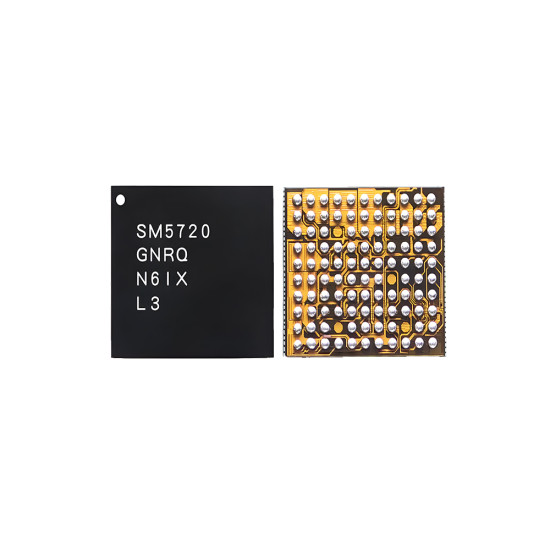
Mobile Phone IC For SM5720 Original
The SM5720 is a highly specialized Integrated Circuit (IC) developed primarily for the Samsung Galaxy ecosystem. It is technically classified as a Baseband Power Management IC (Baseband PMIC) or a “Small Power IC.”
While the main PMIC manages the primary system power, the SM5720 is dedicated to the Baseband/Modem section of the device, ensuring the network processor receives stable, regulated voltage to handle LTE/5G signals, voice calls, and data transmission.
Technical Specifications: SM5720 IC
| Feature | Specification Detail |
| Model Number | SM5720 / SM5720 Original |
| Component Type | Baseband Power Management IC (Baseband PMIC) |
| Primary Function | Power Supply for Network Modem/Signal Restoration |
| Package Type | WLCSP (Wafer Level Chip Scale Package) / BGA |
| Operating Voltage | Typically $1.2\text{V} / 1.8\text{V} / 2.8\text{V}$ output rails |
| Communication Interface | SPMI / $I^{2}C$ (Modem-to-PMIC Control) |
| Compatible Brands | Samsung Galaxy Series |
| Core Process | High-efficiency OEM-grade Silicon |
| Mounting Type | Surface Mount (BGA Soldering required) |
| Thermal Protection | Integrated Thermal Shutdown at high load |
Role in Mobile Device Architecture
The SM5720 is the “engine room” for the phone’s communication capabilities. Its roles include:
-
Modem Power Distribution: It provides specialized low-noise power rails to the baseband processor. This is critical because RF (Radio Frequency) components are sensitive to electrical noise, which can cause dropped calls or slow data speeds.
-
Signal Stabilization: By regulating the voltage reaching the network ICs, it ensures that the phone can “lock” onto a cell tower signal even in low-reception areas.
-
Heat Dissipation Management: Because network tasks (like 4G/5G data) are power-intensive, the SM5720 is designed with high thermal stability to prevent the modem section from overheating during long downloads.
Supported Device Compatibility
The SM5720 is a staple in Samsung’s flagship and mid-high range devices from the late 2010s.
-
Samsung Galaxy S8 / S8 Plus (G950, G955)
-
Samsung Galaxy Note 8 (N950)
-
Samsung Galaxy S7 / S7 Edge (G930, G935 – select variants)
-
Samsung Galaxy A-Series (Specific regional models)
Common Symptoms of a Defective SM5720
When this specific IC fails, the symptoms are almost always related to network connectivity or system power rather than software issues.
-
“No Service” or “Searching” Errors: If the phone displays an IMEI but refuses to find a signal, the SM5720 might be failing to power the modem.
-
Baseband Missing: In settings, the “Baseband Version” may show as “Unknown,” indicating the modem is not receiving power.
-
Dead Phone / No Boot: A short circuit inside the SM5720 can pull the main power line to ground, preventing the entire phone from turning on.
-
No Charging Solution: In some board designs, the SM5720 assists in the secondary charging path; a failure can lead to “Not Charging” or “Slow Charging” notifications.
Professional Repair & Handling Notes
The SM5720 is a BGA (Ball Grid Array) component, meaning it requires advanced micro-soldering tools to replace.
-
Diagnostic Tip: Confirm the fault is baseband-related by checking the voltage on the capacitors surrounding the SM5720. If these caps show a $0\Omega$ short to ground, the IC usually needs replacement.
-
Installation Temperature: A hot air rework station should be set between $330\degree\text{C}$ and $350\degree\text{C}$.
-
Shielding: Use high-intensity heat insulation tape (Kapton tape) to cover the rest of the motherboard. The SM5720 is often located near the main CPU; accidental heat overflow can cause the CPU’s underfill to expand and destroy the board.
-
PCB Preparation: Always use a high-quality flux and a copper solder wick to clean the pads before aligning the new SM5720 chip.