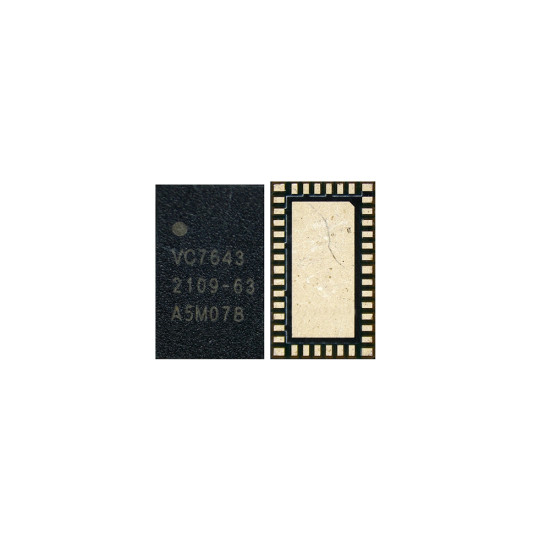
Mobile Phone IC For VC7643RF Original
The VC7643RF is a high-efficiency, multi-mode, multi-band Power Amplifier Module (PAM) designed by Vanchip. It is a critical component in the Radio Frequency (RF) front-end of mobile devices, specifically tailored for 4G LTE, 3G WCDMA, and 2G GSM/EDGE networks.
As a power amplifier, its primary job is to take the low-power RF signal from the transceiver (like the WTR or SDR series chips discussed previously) and boost it to a high power level so it can be transmitted through the antenna to a distant cell tower.
Technical Specifications: VC7643RF
| Feature | Specification Detail |
| Model Number | VC7643RF |
| Manufacturer | Vanchip (Beijing) Technologies |
| Component Type | Multi-Band Power Amplifier Module (PAM) |
| Package Type | LGA (Land Grid Array) |
| Dimensions | $4.0\text{mm} \times 6.8\text{mm} \times 0.9\text{mm}$ |
| Supported Modes | Quad-band GSM/GPRS/EDGE, WCDMA, LTE |
| Frequency Range | $698\text{MHz}$ to $2690\text{MHz}$ |
| Input Voltage ($V_{CC}$) | $3.0\text{V} \text{ to } 4.5\text{V}$ |
| Control Interface | MIPI RFFE (Radio Frequency Front End) v2.0 |
| Output Power (LTE) | $+28\text{dBm}$ (Typical) |
| Efficiency (PAE) | Up to 45% in High Power Mode |
| Operating Temp | $-30\degree\text{C} \text{ to } +85\degree\text{C}$ |
Functional Architecture
The VC7643RF is an “all-in-one” transmit module. It integrates several stages of amplification and switching into a single compact LGA package.
1. Multi-Band Power Amplification
The module contains separate amplification paths for Low Band (LB), Mid Band (MB), and High Band (HB). This allows a single chip to handle everything from the $700\text{MHz}$ LTE band used in rural areas to the $2.6\text{GHz}$ bands used for high-capacity urban data.
2. Integrated Antenna Switch
One of the key features of the VC7643RF is the integrated RF Switch. This internal matrix routes the amplified signal to the correct antenna port based on the frequency currently in use. This eliminates the need for an external antenna switch chip, saving space and reducing signal loss.
3. MIPI RFFE Control
The chip is controlled via the MIPI RFFE digital interface. This allows the phone’s modem to instantly adjust the gain, bias, and power mode of the amplifier in real-time. By dynamically adjusting these settings, the phone can save battery power when you are close to a cell tower and boost power only when you are in a weak signal area.
Common Faults and Troubleshooting
Because the VC7643RF handles high amounts of current and generates heat, it is often a “failure point” in devices with signal issues.
-
No Network / “Emergency Calls Only”: If the phone can see the network bars but cannot register or make a call, the transmitter (VC7643RF) may be blown. The phone can “hear” the tower, but the tower cannot “hear” the phone.
-
Rapid Battery Drain during Calls: If the IC is partially shorted, it will draw excessive current from the battery whenever the transmitter is active.
-
High Temperature near the Camera: In many layouts, the RF power amplifiers are placed near the top of the board. If this area becomes very hot specifically when using mobile data, the VC7643RF may be failing.
-
Instant Shutdown on Call: If the IC has a severe internal short, the sudden power draw when initiating a call can trigger the battery’s protection circuit, causing the phone to turn off instantly.
Repair and Installation Notes
The VC7643RF is an LGA package with a large central ground pad for heat dissipation.
-
Heat Dissipation: When soldering a new VC7643RF, the central ground pad must be perfectly bonded to the motherboard. If this connection is weak, the chip will overheat and burn out within seconds of making its first 4G data connection.
-
Solder Paste: Use a high-quality $183\degree\text{C}$ leaded solder paste for the repair. The lower melting point compared to factory lead-free solder prevents the motherboard from warping under the heat.
-
Reflow Temperature: Use a hot air station set to $340\degree\text{C} – 350\degree\text{C}$. Ensure the chip “toggles” or settles into place to confirm all pads have melted correctly.