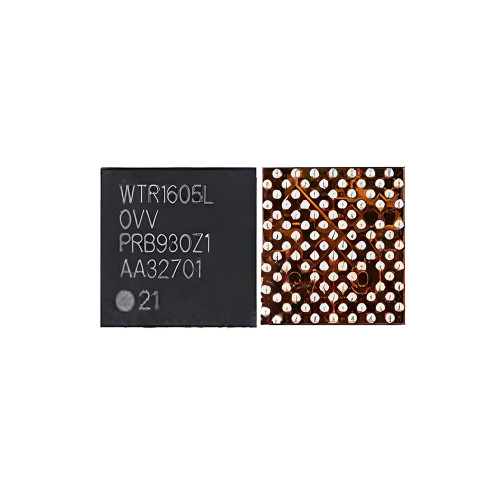
Mobile Phone IC For WTR1605L Original
The WTR1605L is a highly integrated Radio Frequency (RF) Transceiver chip developed by Qualcomm. It served as a landmark component in mobile technology, facilitating the transition to “world-mode” LTE connectivity in flagship devices like the iPhone 5s, Nexus 5, and Samsung Galaxy S4.
As a transceiver, its primary function is to act as the interface between the device’s antennas and the digital modem, translating analog radio waves into digital data and vice versa.
Technical Specifications: WTR1605L
| Feature | Specification Detail |
| Model Number | WTR1605L |
| Manufacturer | Qualcomm Technologies, Inc. |
| Component Type | RF Transceiver (Intermediate Frequency) |
| Package Type | WLCSP (Wafer Level Chip Scale Package) |
| Supported Networks | LTE (FDD/TDD), WCDMA, HSPA+, TD-SCDMA, GSM/EDGE |
| GPS Support | Integrated standalone GPS/GLONASS/BeiDou receiver |
| Process Node | 28nm LP (Low Power) CMOS |
| Interface | DigRF v4 / RFFE (Radio Frequency Front End) |
| Voltage Rails | 1.0V / 1.8V regulated inputs |
| MIMO Support | Diversity receive support for LTE |
| Operating Temp | -30°C to +85°C |
Core Functional Roles
The WTR1605L was designed to solve the “fragmentation” of global cellular bands. Before this chip, manufacturers often had to build multiple hardware versions of the same phone for different regions.
1. Multi-Band Frequency Synthesis
The IC contains highly flexible Voltage-Controlled Oscillators (VCOs). These allow the chip to tune into dozens of different LTE bands (from 700MHz up to 2.7GHz) using a single piece of silicon. It utilizes a Zero-IF (Intermediate Frequency) architecture, which eliminates the need for large, external SAW filters, drastically reducing the space needed on the motherboard.
2. Integrated Navigation (GNSS)
A unique feature of the WTR1605L is its integrated GPS engine. By housing the cellular radio and the satellite navigation receiver on the same die, Qualcomm reduced power consumption during location-tracking tasks, such as turn-by-turn navigation.
3. Power Efficiency
Built on a 28nm process, the WTR1605L was significantly more power-efficient than its predecessors. It supports Envelope Tracking, a technology that allows the RF power amplifiers to use only the exact amount of electricity needed for the current signal strength, preventing battery waste.
Common Faults and Diagnostics
In the repair industry, the WTR1605L is a common culprit for “No Service” issues in legacy flagship devices.
-
“Searching” or “No Service”: Even with a valid SIM card, the phone cannot find a network. If the IMEI is still present in settings, the WTR1605L is likely failing to “lock” onto a signal.
-
GPS Signal Failure: The phone can connect to LTE but cannot find a GPS lock, or the location accuracy is extremely poor.
-
Overheating near RF Section: A shorted WTR1605L will often cause the top area of the motherboard to become hot to the touch immediately upon attempting to place a call.
-
Baseband Error: On some devices (like the iPhone 5s), a failing WTR1605L can cause an “Error 1” or “Error 50” during an iTunes restore, as the software fails to communicate with the RF section.
Repair and Installation Notes
The WTR1605L is a WLCSP chip, meaning the solder balls are attached directly to the silicon die. It is exceptionally fragile.
-
Heat Profile: Use a professional hot air station set to 330°C – 345°C. Because the chip is very light, keep the airflow low to avoid “blowing” it into other components.
-
Underfill: Many manufacturers use a clear or black epoxy underfill. You must carefully scrape this away at 200°C before attempting to lift the chip, or you risk pulling the delicate copper pads off the motherboard.
-
Orientation: Always align the Pin 1 marker correctly. An inverted transceiver will cause an immediate short circuit on the 1.0V logic line.