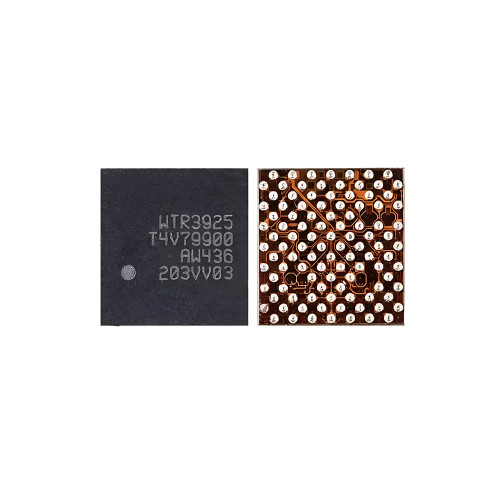
Mobile Phone IC For WTR3925 Original
Qualcomm. It is a cornerstone of the RF front-end for smartphones utilizing the Snapdragon 600 and 800 series platforms.
As a transceiver, its primary function is to act as a bridge between the digital modem and the device’s antennas. It converts digital data from the processor into analog radio waves for transmission (uplink) and translates incoming analog signals back into digital data (downlink).
Technical Specifications: WTR3925
| Feature | Specification Detail |
| Model Number | WTR3925 |
| Manufacturer | Qualcomm Technologies, Inc. |
| Component Type | RF Transceiver (Intermediate Frequency) |
| Package Type | WLCSP (Wafer Level Chip Scale Package) |
| Process Node | 28nm LP (Low Power) CMOS |
| Network Support | 2G, 3G, 4G LTE (Category 4/6/7/12) |
| MIMO Support | 2×2 and 4×4 MIMO |
| Carrier Aggregation | Supports up to 3x Downlink CA |
| Interface | DigRF v4 / RFFE (Radio Frequency Front End) |
| GPS Support | Integrated GNSS (GPS, GLONASS, BeiDou, Galileo) |
| Operating Temp | -30°C to +85°C |
Core Functional Overview
The WTR3925 was engineered to support the global expansion of LTE-Advanced networks. Its design focuses on three main pillars:
1. Advanced Carrier Aggregation (CA)
The WTR3925 is capable of Carrier Aggregation, allowing the device to “bond” multiple frequency bands together. This creates a wider data pipe, enabling much higher download speeds (up to 600 Mbps in Category 12 configurations) and improving network reliability in congested urban environments.
2. Universal Frequency Synthesis
This IC features a wide-band architecture that covers frequency ranges from 700 MHz to 3.8 GHz. This flexibility allows manufacturers to use the same chip in a “global” phone model that works across North America, Europe, and Asia, significantly reducing production costs.
3. Integrated Navigation (GNSS)
Unlike earlier generations that required a separate GPS chip, the WTR3925 integrates a full GNSS engine. By sharing the RF front-end, it reduces the overall power draw when using maps or location-based services, which is essential for preserving battery life.
Common Signs of a Defective WTR3925
Because it is the central hub for all wireless signals, a failure in the WTR3925 often results in a “dead” communication system.
-
“No Service” or “Searching”: If the device shows an IMEI and Baseband version in settings but refuses to find a signal, the WTR3925 may be failing to “tune” to the cell tower frequency.
-
Weak Signal Strength: The phone may work near a cell tower but lose signal entirely when indoors.
-
Radio Power Off: In Android testing menus (##4636##), if the “Mobile Radio Power” toggle is greyed out or switches back to “Off” automatically, the IC is likely faulty.
-
GPS Signal Loss: Since the GPS engine is integrated, a fault in this chip can lead to a complete inability to find a location lock.
Professional Repair & Installation Notes
The WTR3925 is a WLCSP chip with microscopic solder bumps directly on the silicon. It requires advanced micro-soldering skills.
-
Underfill Removal: Many brands (like Samsung and Xiaomi) use a hard underfill epoxy around this chip. You must carefully scrape this away at 200°C before attempting to lift the IC, or you will tear the copper pads off the motherboard.
-
Heat Management: Use a hot air station at 335°C to 350°C. Because the chip is extremely light, keep the airflow at the lowest setting to prevent it from “flying away” during the reflow process.
-
Orientation: Always align the Pin 1 marker (a small dot on the corner). Reversing the chip will cause an immediate short circuit on the regulated power lines.