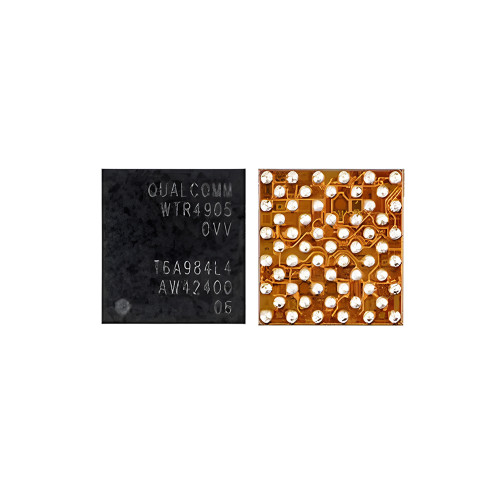
Mobile Phone IC For WTR4905 Original
The WTR4905 is a highly integrated intermediate frequency (IF) transceiver developed by Qualcomm. It is a critical component in the Radio Frequency (RF) front-end of mobile devices, typically paired with Snapdragon 400 and 600 series processors.
As a transceiver, its primary role is to act as the “translator” between the digital modem and the analog antennas. It converts digital data into radio waves for transmission (uplink) and translates received radio waves back into digital data for the phone to process (downlink).
Technical Specifications: WTR4905 IC
| Feature | Specification Detail |
| Model Number | WTR4905 |
| Manufacturer | Qualcomm Technologies, Inc. |
| Component Type | RF Transceiver / Intermediate Frequency IC |
| Package Type | WLCSP (Wafer Level Chip Scale Package) |
| Supported Networks | 2G, 3G, 4G LTE (Cat 4/6) |
| MIMO Support | 2×2 MIMO (Multiple Input Multiple Output) |
| Carrier Aggregation | Supports 2-carrier Downlink CA |
| Interface | DigRF v4 / RFFE (Radio Frequency Front End) |
| Supply Voltage | $1.0\text{V} / 1.8\text{V}$ (Logic and Analog rails) |
| GPS Support | Integrated GNSS (GPS, GLONASS, BeiDou) |
| Operating Temp | $-30\degree\text{C} \text{ to } +85\degree\text{C}$ |
Core Functional Roles
The WTR4905 is designed to provide high-performance connectivity while occupying minimal space on the motherboard.
1. Global LTE Connectivity
The WTR4905 was a pioneer in enabling global LTE roaming on mid-range devices. It supports a wide array of frequency bands ($700\text{MHz}$ to $2.7\text{GHz}$), allowing manufacturers to design a single motherboard for multiple international markets.
2. Integrated Satellite Navigation (GNSS)
Unlike older architectures that required a separate GPS chip, the WTR4905 integrates the GNSS receiver directly onto the silicon die. This reduces power consumption during location-tracking tasks and frees up valuable PCB real estate for larger batteries.
3. Zero-IF Architecture
The chip utilizes Zero-IF technology, which removes the need for bulky external Surface Acoustic Wave (SAW) filters. This direct-conversion method simplifies the RF path, reduces signal loss, and lowers the overall bill of materials (BOM) for device manufacturers.
Common Symptoms of a Defective WTR4905
Because the WTR4905 handles all incoming and outgoing wireless signals, its failure is usually catastrophic for the phone’s communication abilities.
-
“Searching” or “No Service”: If the phone displays the IMEI and Baseband version in settings but cannot find a signal, the WTR4905 is likely failing to tune to the correct frequency.
-
GPS/Location Failure: If the phone cannot find a GPS lock or shows you in the wrong location constantly, the integrated GNSS section of the chip may be damaged.
-
Radio Power Off: In engineering menus ($*\#*\#4636\#*\#*$), if the “Mobile Radio Power” toggle is greyed out or won’t stay “On,” the WTR4905 is likely not receiving power or has an internal short.
-
Rapid Battery Drain (Signal Related): If the chip is partially damaged, it may struggle to maintain a “lock” on the cell tower, causing the modem to work at maximum power and drain the battery in hours.
Repair and Installation Notes
The WTR4905 is a WLCSP chip, which is essentially a piece of silicon with microscopic solder bumps. It is extremely sensitive to physical stress and heat.
-
Underfill Removal: Many manufacturers (like Xiaomi and Samsung) apply a hard epoxy underfill around this chip. You must carefully scrape this away at $200\degree\text{C}$ before attempting to lift the IC, or you will pull the delicate pads off the motherboard.
-
Heat Settings: Use a professional hot air station set to $335\degree\text{C} – 350\degree\text{C}$. Because the chip is tiny and light, keep the airflow at the lowest possible setting to prevent it from “flying” off the board.
-
Alignment: Ensure the Pin 1 marker (a small dot on the corner) is perfectly aligned. Inverting this chip will cause a direct short on the $1.0\text{V}$ logic line, potentially killing the main CPU.