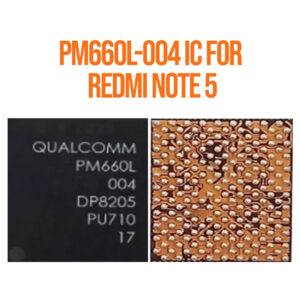
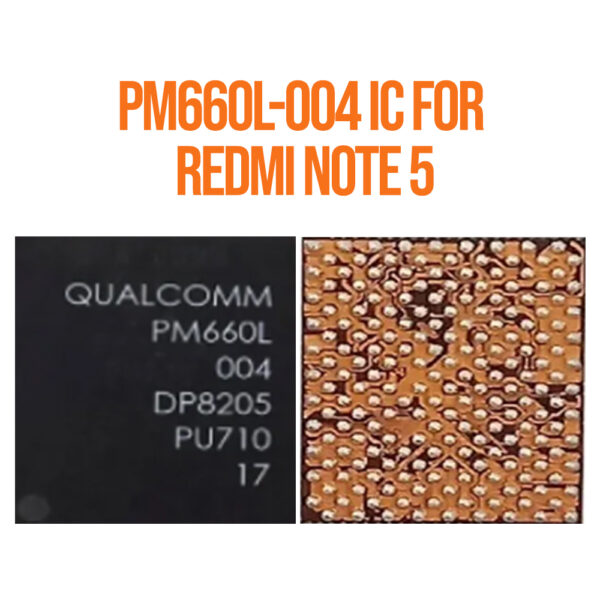
PM 660 L Mobile Phone IC
Upgrade Your Device Performance
The PM 660 L Mobile Phone IC is a cutting-edge integrated circuit designed to enhance the efficiency and performance of modern smartphones. From powering intricate communication functions to ensuring seamless energy management, this IC is the cornerstone of device reliability. PM 660 L Mobile Phone IC
Precision Engineered for Excellence
Developed with advanced technology, the PM 660 L offers optimized energy consumption and compatibility with a wide range of smartphone models. Its compact design ensures easy integration while delivering top-tier functionality without compromise. PM 660 L Mobile Phone IC
Why the PM 660 L Stands Out
Renowned for its durability and superior quality, the PM 660 L Mobile Phone IC ensures long-lasting performance and smooth operation. Whether you’re looking to repair or upgrade, this IC is the trustworthy solution for robust smartphone functionality. PM 660 L Mobile Phone IC
The PM660L is a highly versatile Power Management Integrated Circuit (PMIC) developed by Qualcomm. It is typically paired with the PM660 primary IC in mid-range and high-end smartphones (most notably those using the Snapdragon 660, 675, and 710 chipsets) to handle secondary power functions like display bias, haptics, and LED driving. PM 660 L Mobile Phone IC
While the primary PM660 handles core system voltages (CPU, GPU, RAM), the PM660L (the “L” often denoting secondary or specialized functions like Light/LCD) manages the peripheral power rails. PM 660 L Mobile Phone IC
Technical Specifications Table
The following table outlines the key technical parameters and operational characteristics of the PM660L IC.
| Feature | Specification |
| Manufacturer | Qualcomm |
| Common Part Numbers | PM660L-004-01, PM660L-001 |
| Package Type | BGA (Ball Grid Array) |
| Input Voltage Range | $3.7\text{V}$ to $4.4\text{V}$ (Nominal VBAT) |
| Number of LDOs | 12 to 15 (Model dependent) |
| Buck Converters | 3 to 5 High-efficiency Switchers |
| LED Driver Support | 6-channel current sink for WLED backlight |
| Max LED Output | Up to $30\text{mA}$ per row |
| Display Bias | Positive and Negative voltages for LCD/AMOLED |
| Communication Bus | SPMI (System Power Management Interface) |
| Charging Support | SMBus/I2C compatible for secondary charging logic |
| Thermal Protection | Internal shutdown at $150^\circ\text{C}$ |
| Operating Temp | $-40^\circ\text{C}$ to $+85^\circ\text{C}$ |
Core Functions & Role in Mobile Devices
The PM660L isn’t just a “backup” chip; it is essential for the visual and tactile interface of the phone. Its architecture is divided into several functional blocks:
1. Backlight & Display Power
This is the most critical role of the PM660L. It contains a high-voltage boost regulator capable of driving a string of up to 10 white LEDs (WLEDs) in series. For modern displays, it provides the $V_{SP}$ (Positive) and $V_{SN}$ (Negative) rails, typically $\pm 5\text{V}$ or $\pm 5.5\text{V}$, required to power the display panel logic. PM 660 L Mobile Phone IC
2. Secondary Buck/LDO Rails
While the main PMIC handles the heavy lifting for the processor, the PM660L provides “clean” power to sensitive components like:
-
Camera Modules: Low-noise LDOs for image sensor analog power.
-
Audio Codecs: Voltage rails for the speaker amplifier and headphone jack logic.
-
Haptics: Dedicated power for the vibration motor (ERM or LRA).
3. Power Sequencing
The IC communicates with the main Application Processor (AP) via the SPMI bus. It follows a strict “Boot Sequence.” If the PM660L fails to provide the “Power Good” signal or fails to initialize its rails, the phone will often get stuck in a “dead” state or “port detect” mode (9008 mode) because the CPU cannot complete its hardware check.
Comparison: PM660 vs. PM660L
In a typical Snapdragon 660 layout, these two ICs work in a Master-Slave relationship.
| Feature | PM660 (Primary) | PM660L (Secondary) |
| Primary Focus | Processor Core, Modem, RAM | Display, Flash LED, Haptics |
| Charging | Main Battery Charging Logic | Flash/Torch LED & Display Bias |
| Identification | Usually larger BGA footprint | Slightly smaller BGA footprint |
| Failure Symptom | No Power / No Port Detect | Backlight OK but no Graphics / No Flashlight |
Common Repair Symptoms
If you are a technician or hobbyist, a faulty PM660L usually manifests in the following ways:
-
No Backlight: The phone vibrates and receives calls, but the screen remains pitch black (often visible under a flashlight).
-
Graphic Glitches: Lines on the screen or “half-screen” display issues if one of the bias voltages is missing.
-
Short Circuit (Dead Phone): Since it is connected directly to the $V_{BAT}$ (Battery) or $V_{PH\_PWR}$ (Phone Power) rail, a short inside this IC will prevent the phone from turning on entirely.
-
Flashlight Failure: If the torch won’t turn on despite the camera working, the PM660L is the primary suspect.
Note: When replacing this IC, the suffix (e.g., -004) is vital. While a PM660L-004-01 is common in Xiaomi devices (Redmi Note 7), using a different variant might lead to compatibility issues with the firmware’s power mapping.
More Products : https://gaffarmarketdelhi.com