
PM 8150 Mobile Phone IC
High-Performance PM 8150 Mobile Phone IC
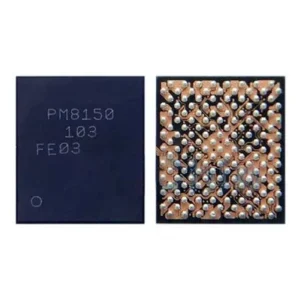
The PM 8150 Mobile Phone IC is a cutting-edge integrated circuit designed to elevate the performance of modern smartphones. Engineered for reliability and efficiency, this IC is the backbone for seamless power management in mobile devices, making it an essential component for superior performance. PM 8150 Mobile Phone IC
Exceptional Energy Efficiency
Designed to optimize power consumption, the PM 8150 ensures your devices run efficiently throughout the day. Whether you’re streaming, gaming, or multitasking, this IC supports consistent performance and reduced energy waste. It’s built to keep your device running cooler and longer. PM 8150 Mobile Phone IC
Compact and Versatile Design
The PM 8150 Mobile Phone IC combines advanced functionality with a compact design, ensuring it fits seamlessly into the latest smartphone architectures. Its versatility and compatibility make it suitable for a wide array of devices, ensuring scalability for next-generation technologies. PM 8150 Mobile Phone IC
The PM8150 is a high-performance Power Management Integrated Circuit (PMIC) developed by Qualcomm. It is a cornerstone of the Snapdragon 855 and 855+ ecosystems, serving as the primary energy distributor for flagship smartphones. PM 8150 Mobile Phone IC
Unlike entry-level chips, the PM8150 is designed for high-density power management, supporting multi-core CPUs, high-refresh-rate displays, and complex 5G modem requirements. PM 8150 Mobile Phone IC
1. PM8150 Core Specifications Table
| Feature Category | Technical Specification Detail |
| Model Number | PM8150 (Primary PMIC) |
| Manufacturer | Qualcomm Technologies, Inc. |
| Compatible Chipsets | Snapdragon 855 (SM8150), Snapdragon 855+ |
| Package Type | 161-pin Fan-Out Wafer-Level Pico-Scale Package (FOWPSP) |
| Package Dimensions | $4.49 \times 5.07 \times 0.55 \text{ mm}$ |
| Switching Regulators | 10 SMPS (2 HFS510 and 8 FTS510 Buck Converters) |
| LDO Regulators | 18 Independent Low-Dropout Linear Regulators |
| Communication Bus | SPMI (System Power Management Interface) |
| Clock Support | $38.4 \text{ MHz}$ Crystal Oscillator (XO) Controller |
| Safety Features | OTP (Over-Temp), OVP (Over-Voltage), OCP (Over-Current) |
| Input Voltage | $2.8\text{V}$ to $4.8\text{V}$ (Supports High-Voltage Li-ion) |
| Interface | 10 Configurable GPIOs (Digital/Analog pass-through) |
2. Deep Dive into PM8150 Architecture
Power Supply Rails (SMPS & LDOs)
The PM8150 features a massive array of voltage regulators to ensure every component receives precise power.
-
HF-SMPS & FT-SMPS: The 10 Switching Mode Power Supplies (SMPS) are responsible for high-current tasks. Specifically, the FTS (Fast Transient Switching) rails are dedicated to the CPU cores and GPU, which require rapid changes in current as you switch from an idle home screen to a heavy 3D game. PM 8150 Mobile Phone IC
-
LDO Regulators: The 18 LDOs provide “clean” (low noise) power to sensitive analog parts like the Bluetooth/Wi-Fi modules, audio DACs, and high-resolution camera sensors. Noise in these rails can lead to poor signal reception or grainy photos.
The Role of “Housekeeping”
Beyond just voltage, the PM8150 handles “housekeeping” tasks. It includes an On-chip ADC (Analog-to-Digital Converter) that constantly monitors battery health, internal chip temperature, and voltage levels. This data is fed back to the main processor via the SPMI bus, allowing the phone to display an accurate battery percentage and manage thermal throttling.
3. Variants and Compatibility
In the repair world, it is common to find different versions of the 8150 series. Understanding the difference is critical because they are not always interchangeable:
| Variant | Typical Role / Device |
| PM8150 | Primary Power Management (CPU/System) |
| PM8150B | Secondary PMIC (Often handles Charging/Battery logic) |
| PM8150L | Secondary PMIC (Auxiliary LDOs, Flash LED, Backlight) |
Compatible Devices:
This IC is found in legendary flagship models such as:
-
Samsung: Galaxy S10, S10+, Note 10 series (Snapdragon variants).
-
Xiaomi: Mi 9, Redmi K20 Pro.
-
OnePlus: 7, 7 Pro, 7T series.
-
Others: Google Pixel 4/4XL, Sony Xperia 1.
4. Common Troubleshooting & Repair Symptoms
If a PM8150 IC fails, the phone will typically exhibit one of the following “No-Power” symptoms:
-
Dead Boot (No Response): If the primary PM8150 fails, the phone will not vibrate or show any logo when the power button is pressed.
-
Short on VPH_PWR: This is the main power line generated by the PMIC. If a capacitor inside the IC shorts, the entire motherboard will draw high current from a DC Power Supply (usually $>1.0\text{A}$) immediately upon connection.
-
Boot Loop / Logo Hang: If the LDO rails for the RAM or CPU are unstable, the phone may start to boot but crash at the first sign of high power draw.
-
No Camera/Sound: If only specific LDOs (like L5 or L10) are damaged, the phone might turn on but fail to open the camera or play audio.
5. Professional Handling Note
Replacing the PM8150 requires expert BGA (Ball Grid Array) reballing skills. Since it is a FOWPSP package, it is extremely thin ($0.55\text{ mm}$). Excess heat from a rework station can easily warp the IC or cause internal shorts. Technicians usually recommend a pre-heating temperature of $150^\circ\text{C}$ and a final reflow at $330^\circ\text{C}$ to $350^\circ\text{C}$ depending on the flux used.
More Products : https://gaffarmarketdelhi.com