PM 8226 Mobile Phone IC
Reliable Power Management for Optimal Device Performance
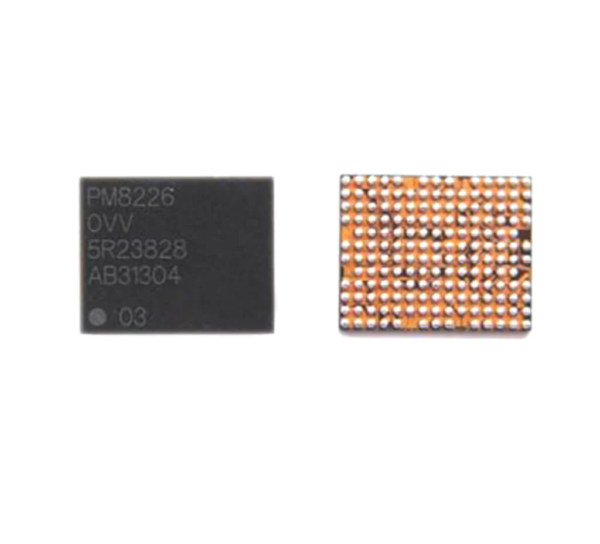
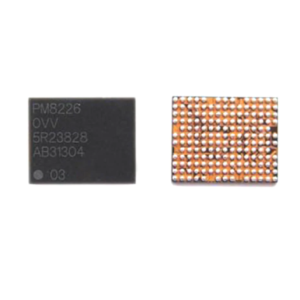
The PM 8226 Mobile Phone IC is a cutting-edge power management solution specifically designed to keep your mobile devices running smoothly and efficiently. Tailored for modern smartphones, this IC enhances energy distribution for seamless performance and extended battery life. PM 8226 Mobile Phone IC
Compact Design with Advanced Features
Engineered with precision, the PM 8226 features a compact design that integrates effortlessly into your device, ensuring powerful performance without compromising on space. Its advanced technology safeguards your device against overheating, overcharging, and other power-related issues. PM 8226 Mobile Phone IC
Perfect Solution for Modern Smartphones
Whether you’re building, repairing, or upgrading a mobile device, the PM 8226 Mobile Phone IC is the ideal choice for enhancing efficiency and reliability. Trust this innovative component to deliver consistent and dependable power management for your devices. PM 8226 Mobile Phone IC
The PM8226 is a classic and highly reliable Power Management Integrated Circuit (PMIC) designed by Qualcomm. It was a cornerstone of the mid-tier smartphone era, primarily powering devices with the Snapdragon 400 and 410 series processors. This IC acts as the primary energy regulator, ensuring that every component—from the high-speed CPU to the sensitive camera sensor—receives the exact voltage it needs to function without overheating. PM 8226 Mobile Phone IC
Below are the comprehensive specifications and technical details for the PM8226.
PM8226 Technical Specifications Table
| Feature Category | Technical Specification Detail |
| Manufacturer | Qualcomm Technologies, Inc. |
| Model Number | PM8226 (Primary PMIC) |
| Package Type | WLCSP-128 (Wafer Level Chip Scale Package) |
| Compatible Processors | Snapdragon 400 (MSM8226, MSM8926), Snapdragon 410 |
| Input Supply Voltage | $3.4\text{V}$ to $4.8\text{V}$ (Standard Lithium-Ion Battery) |
| Output Channels | 6 Buck Converters / 20+ LDO Regulators |
| Switching Frequency | $1.1\text{ MHz}$ to $2.2\text{ MHz}$ (High Efficiency) |
| Operating Temp Range | $-40^\circ\text{C}$ to $+125^\circ\text{C}$ |
| Communication Interface | SPMI (System Power Management Interface) |
| Safety Features | Over-Voltage (OVP), Over-Current (OCP), Thermal Shutdown |
| Charging Support | Basic Integrated Linear Charging Logic |
| Real-Time Clock (RTC) | Integrated 32.768 kHz oscillator support |
Core Functional Analysis
1. Power Distribution (Bucks vs. LDOs)
The PM8226 utilizes a hybrid architecture to manage power efficiently:
-
Buck Converters (S1-S6): These are used for “heavy-lifting.” For instance, S1 usually supplies the CPU core voltage. These converters are highly efficient (up to 90%+), meaning they produce very little heat while stepping down battery voltage to roughly $1.0\text{V}$.
-
LDO Regulators (L1-L20): These are “Low Drop-Out” regulators used for noise-sensitive parts. If you are using your phone’s camera or listening to high-quality audio, the PM8226 uses its LDOs to provide a “clean” signal that is free from the electrical noise generated by other parts of the board.
2. Battery & Charging Intelligence
Unlike modern phones that use a separate “SMB” charging IC, the PM8226 handles a significant portion of the charging logic for older architectures. It monitors the battery temperature through a NTC (Negative Temperature Coefficient) thermistor. If the battery gets too hot during charging, the PM8226 will automatically reduce the incoming current to protect the battery from swelling or exploding.
3. System Health & Safety
The IC is equipped with OTP (One-Time Programmable) memory that stores the boot-up sequence. When you press the power button, the PM8226 wakes up in a specific order:
-
VREG_S3 (usually the first rail to fire up).
-
VREG_L5 (powering the internal clocks).
-
VREG_S1/S2 (bringing the CPU to life).
If any of these rails are shorted to ground, the IC will perform a “Hard Reset” to prevent permanent motherboard damage.
Common Signs of PM8226 Failure
In mobile repairing, the PM8226 is often replaced when a phone shows the following symptoms:
-
The “Dead Boot” Issue: The phone does not turn on, and when connected to a DC Power Supply, it shows a constant current consumption of $20\text{–}50\text{ mA}$ without booting. PM 8226 Mobile Phone IC
-
Charging Errors: The phone shows a “Battery Temp Too High” or “Charging Paused” message even when the phone is cold. PM 8226 Mobile Phone IC
-
No Network/Wi-Fi: Since the PM8226 provides the auxiliary power to the RF (Radio Frequency) chips, a partial failure can cause the phone to lose signal. PM 8226 Mobile Phone IC
Technician’s Tip for Replacement
When reballing or replacing a PM8226, it is crucial to use a stencil with 0.4mm pitch. Because this is a BGA (Ball Grid Array) chip, even a tiny amount of excess heat can bridge the balls underneath, causing a short circuit that could kill the CPU. It is highly recommended to use a high-quality leaded solder paste ($183^\circ\text{C}$ melting point) for the most reliable connection. PM 8226 Mobile Phone IC
More Products https://gaffarmarketdelhi.com