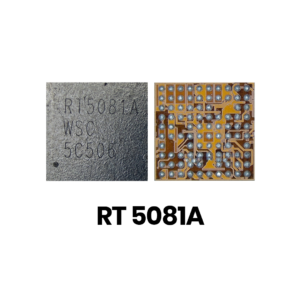
RT 5081 A Mobile Phone IC
Advanced Performance for Modern Mobile Devices
The RT 5081 A Mobile Phone IC is engineered to support the latest smartphone technologies, providing seamless functionality and enhanced performance. This advanced integrated circuit ensures optimal efficiency for various mobile features, delivering a superior user experience. RT 5081 A Mobile Phone IC
Reliable and Durable Hardware
Built for longevity, the RT 5081 A boasts robust construction that supports extended device lifespans. Whether it’s powering your apps, managing resources, or improving device stability, this IC is designed to meet your phone’s everyday demands without compromise. RT 5081 A Mobile Phone IC
Innovative and Easy Integration
Streamline your device upgrade with the RT 5081 A Mobile Phone IC. Its compact design ensures easy compatibility and integration across a wide range of smartphone models. Experience innovation in its simplest yet most effective form with this essential hardware component. RT 5081 A Mobile Phone IC
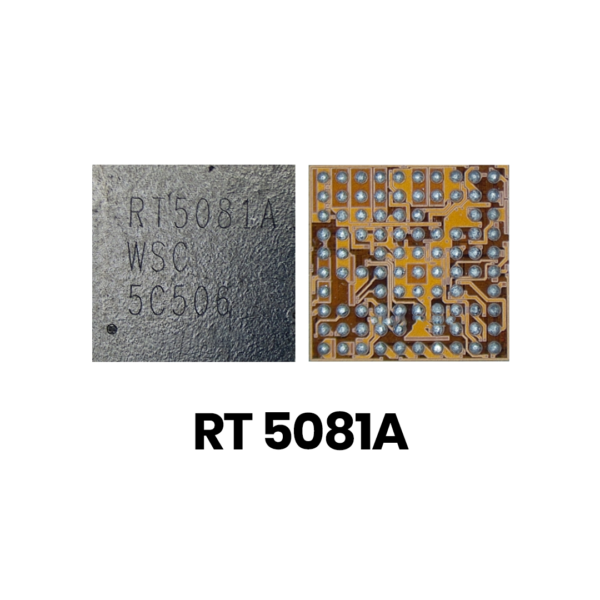
The RT5081A (often associated with its base model RT5081) is a highly integrated Sub-PMIC (Power Management Integrated Circuit) manufactured by Richtek Technology. It is designed specifically for modern smartphones and portable devices, acting as a multifaceted “hub” for power distribution, battery management, and peripheral driving. RT 5081 A Mobile Phone IC
In mobile repair circles, it is frequently found in devices from Xiaomi, Oppo, and Vivo, often functioning as a Charging IC or Backlight Driver. RT 5081 A Mobile Phone IC
Technical Specifications Table
| Feature | Detailed Specification |
| Manufacturer | Richtek Technology |
| IC Category | Highly-Integrated Sub-PMIC / Battery Charger |
| Input Voltage Range | $4V$ to $14V$ |
| Max Charge Current | Up to $3.25A$ (via Switching Charger) |
| Direct Charge Support | Low VIN High Current (LVHI) up to $5A$ |
| Communication Interface | $I^2C$ (Programmable settings and interrupts) |
| Battery Chemistry | Single-cell Li-Ion / Li-Polymer |
| Charging Stages | TC (Trickle), Pre-charge, Fast-charge, and CV (Constant Voltage) |
| USB Support | USB Type-C & Power Delivery (PD) Controller |
| WLED Driver | 4 channels, up to 8 series WLEDs ($29V$ max output) |
| Display Bias Rail | Dual Positive ($+4V$ to $+6V$) and Negative ($-4V$ to $-6V$) |
| RGB LED Driver | 3-channel sink current (up to $24mA$ per channel) |
| LDO Regulator | 1 channel ($1.6V$ to $4.0V$, $400mA$ capacity) |
| Package Type | WL-CSP-93B (Wafer Level Chip Scale Package) |
| Dimensions | $4.22mm \times 4.32mm$ |
Detailed Functional Breakdown
1. Battery Charging & Management
The RT5081A utilizes a synchronous PWM controller for high-efficiency charging.
-
AICR (Average Input Current Regulation): Prevents the input source (like a weak wall adapter) from crashing by limiting current from $100mA$ to $3.25A$.
-
High Accuracy: It maintains $\pm0.5\%$ voltage accuracy, crucial for the longevity of Lithium-based batteries.
-
Ship Mode: It includes a BATFET control that allows the device to enter a “Ship Mode,” reducing battery leakage to near zero during long-term storage.
2. Display and Backlight Solutions
One of the reasons this IC is so common is its ability to handle multiple display-related tasks simultaneously:
-
Backlight: It can drive up to 32 LEDs (4 strings of 8). It uses an exponential or linear mapping for brightness, which provides smooth dimming transitions.
-
LCD Bias: It provides the $+V$ and $-V$ rails required for TFT-LCD source drivers. This eliminates the need for an external “Display Power IC” in many mid-range designs.
3. Flash and Torch LED Drivers
The IC integrates two high-side current sources for camera flashes.
-
Strobe Mode: Can deliver up to $2.5A$ (combined) for short bursts during photo capture.
-
Torch Mode: Lower current levels (up to $400mA$) for video recording or flashlight use.
4. USB Type-C & Power Delivery
The RT5081A acts as the gatekeeper for the USB port. It handles Attach/Detach detection, orientation (plugging the cable in either way), and negotiates power profiles via the PD protocol. This allows the phone to request higher voltages (like $9V$ or $12V$) from compatible chargers.
Hardware Protections
To ensure the safety of the mobile device, the RT5081A includes a suite of hardware-level safeguards:
-
OVP (Over-Voltage Protection): Shuts down the charging path if the input voltage exceeds safe limits.
-
OTP (Over-Temperature Protection): Monitors the silicon temperature and reduces current or shuts down to prevent thermal runaway.
-
JEITA Compliance: It monitors battery temperature via an external thermistor ($NTC$) and adjusts charging current/voltage to prevent charging when the battery is too cold or too hot.
-
SCP (Short-Circuit Protection): Protects the LDO and display bias rails from grounding faults.
Application in Repair
In the mobile repair industry, the RT5081A is often diagnosed when a phone:
-
Fails to charge or shows “Fake Charging” (lightning bolt appears but percentage doesn’t rise).
-
Has a “No Backlight” issue where the screen is dark but an image is visible under a strong light.
-
Is stuck in a “Boot Loop” due to a failure in the $I^2C$ communication with the main CPU.
Note: Because this is a BGA (Ball Grid Array) package with 93 pins, replacement requires professional SMD rework stations and high-precision stencils for reballing.
More Products : https://gaffarmarketdelhi.com