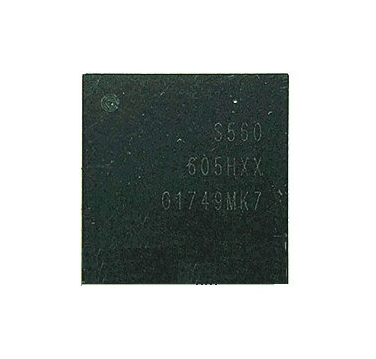
S 560 Mobile Phone IC
Reliable Performance
The S 560 Mobile Phone IC delivers consistent and efficient performance for your mobile device, ensuring seamless operations and superior functionality. Built with precision, it guarantees dependable operation even in demanding environments. S 560 Mobile Phone IC
Compact and Durable
Designed with a compact structure, the S 560 Mobile Phone IC is perfect for modern, slim devices. Its durable build enhances the longevity and reliability of your mobile device, offering you a cost-effective solution in the long run. S 560 Mobile Phone IC
Optimized for Modern Demands
This mobile phone IC is engineered to meet the needs of modern devices, offering optimized power management and improved energy efficiency. Upgrade your mobile device’s performance effortlessly with the S 560 IC. S 560 Mobile Phone IC
The S560 IC (Integrated Circuit) is a critical Power Management Integrated Circuit (PMIC) predominantly used in high-end mobile devices, most notably the Samsung Galaxy S9 and S9+ (G960F/G965F). S 560 Mobile Phone IC
While the term “S560” is sometimes confused with the 2012 Lenovo S560 smartphone, in the context of mobile hardware repair and component sourcing, it refers specifically to the Power Management Unit (PMU). This chip is responsible for regulating the complex electrical needs of a modern smartphone’s motherboard. S 560 Mobile Phone IC
Technical Specifications: S560 Power Management IC
The following table outlines the core specifications and functional characteristics of the S560 IC as used in mobile hardware environments. S 560 Mobile Phone IC
| Specification Feature | Details / Values |
| Component Name | S560 Power IC (PMIC) |
| Primary Compatibility | Samsung Galaxy S9 (G960), S9 Plus (G965) |
| Function | DC-DC Conversion, Voltage Regulation, Charging Management |
| Input Voltage Range | 3.4V – 4.5V (Standard Lithium-Ion Battery Range) |
| Number of Outputs | Typically 6+ (Regulated rails for CPU, GPU, Memory, etc.) |
| Package Type | BGA (Ball Grid Array) |
| Pin Configuration | High-density micro-BGA (approx. 40+ pins) |
| Material Composition | High-thermal-stability Silicon Semiconductor |
| Operating Temperature | -25°C to +85°C (Standard Mobile Grade) |
| Core Responsibilities | Boot sequence control, Thermal monitoring, Current limiting |
| Mounting Type | Surface Mount Technology (SMT) |
Core Functions and Importance
The S560 IC acts as the “heart” of the phone’s electrical system. Without a functioning S560, the device cannot distribute power from the battery to the various sub-systems.
1. Voltage Regulation and Distribution
Smartphones operate on multiple voltage levels. While the battery provides roughly 3.8V, the processor might require $1.1V$ for logic operations, while the display backlight might require significantly higher bursts. The S560 uses Buck-Boost converters to step voltage up or down with high efficiency.
2. Charging Management
The S560 monitors the intake of current from the USB-C port. It communicates with the charging logic to ensure the battery is charged safely, preventing overvoltage or overheating which could lead to lithium-ion instability.
3. Power Sequencing
When you press the power button, the S560 executes a “Power-On Sequence.” It wakes up the components in a specific order: first the clock crystal, then the CPU core, then the memory. If the S560 is faulty, the phone may enter a boot loop or stay completely “dead.“
Diagnostic Signs of a Faulty S560 IC
Technicians often target the S560 when a device exhibits the following symptoms:
-
No Power / Dead Phone: The device consumes 0mA or a very low, static current (e.g., 20mA) when connected to a DC power supply.
-
Overheating: The area around the PMU becomes excessively hot immediately after connecting a battery.
-
Short Circuits: A “full short” on the VCC_MAIN or VBATT line often leads back to a ceramic capacitor near the S560 or the IC itself.
-
Charging Issues: The phone detects a charger but the percentage never increases, or it shows a “temperature too low/high” error.
Installation and Repair Note
Replacing the S560 is a Level 3 hardware repair. Because it is a BGA chip, it requires a hot air rework station, high-quality flux, and precision reballing stencils. Due to its proximity to the main CPU (Exynos or Snapdragon), excessive heat during installation can lead to collateral damage to the processor or RAM.
More Products : https://gaffarmarketdelhi.com